

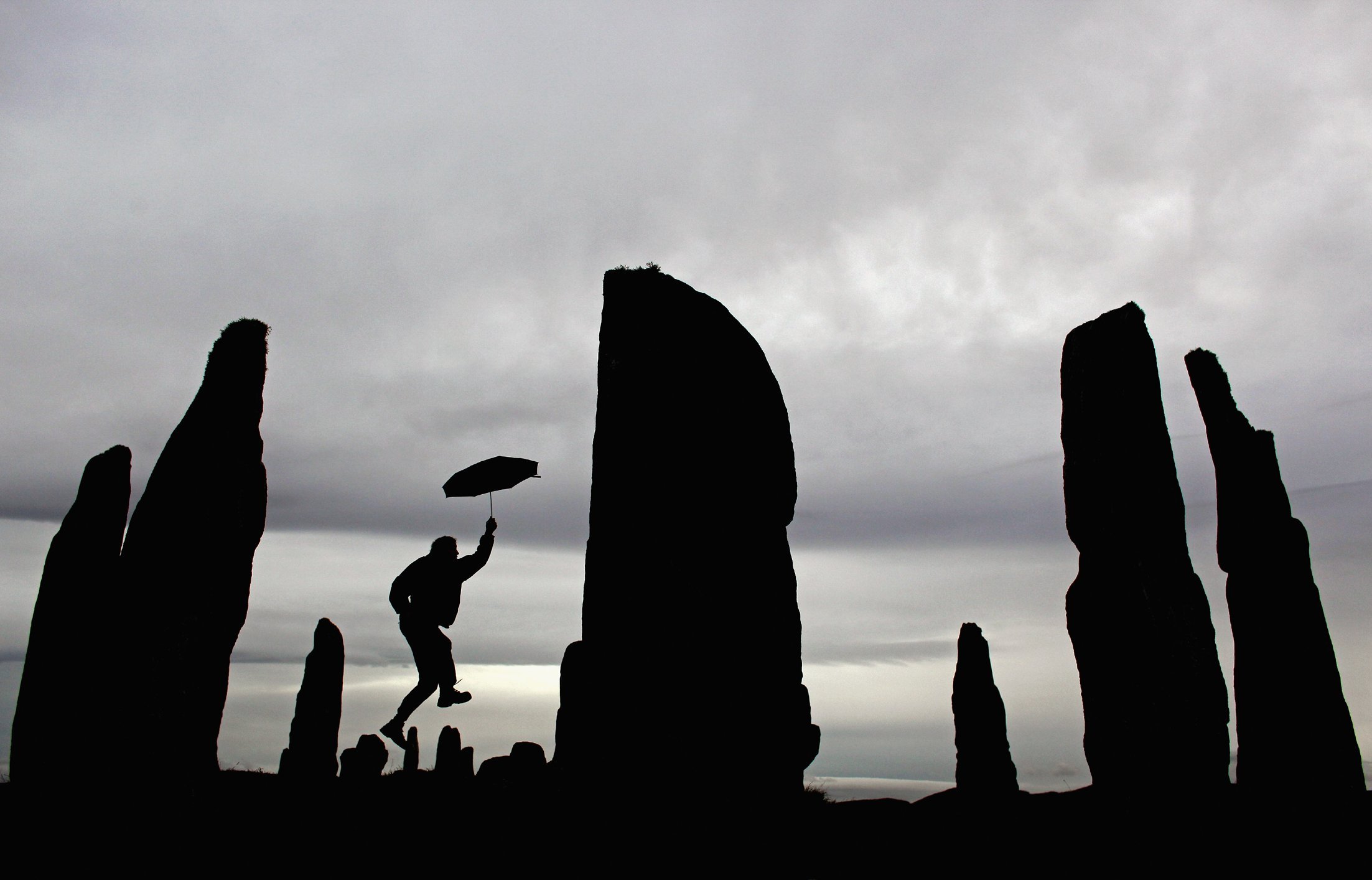
The rain was slanting sideways and so was I, lurching over in my waterproof parker. In fact, every tree and shrub on the island was similarly bent, wind-shorn and permanently bowed. The only things not crouched over, it seemed, were the enormous slabs of gneiss erupting from the ground in front of me.
Known in Gaelic as Clachan Chalanais, the Callanish stones are a 5000-year-old Neolithic monument, arranged in a cross-shaped pattern along a low ridge overlooking Loch Roag, near the village of Callanish on the Isle of Lewis. The central stone circle comprises 13 standing stones clustered around a 4.8m-tall monolith, at whose base lies a small chambered cairn, once used to house the dead.

Looking somewhat like a cemetery, these stones are rough, composed of Lewisian Gneiss — at least 3 billion years old. They are greyish, with occasional flesh-toned streaks, and the upper parts are encrusted with grey-green lichen. The lower parts of the stones are comparatively bare; the contrast dates from an excavation carried out in 1857, when the island’s owner dug out the surrounding peat.
Staring at this gradation, I thought of how immensely ancient these stones are, the long passage of time over which the soil has gradually gathered around them.
These stones are not isolated, but are instead the focal point in a broad ritual landscape spread across Lewis. Scattered throughout the surrounding peatlands are numerous associated stone circles, alignments, and settings — among them Callanish II, III, IV, and VIII — forming what archaeologists refer to as the "Callanish complex".
Public imagination tends to default to Stonehenge as the archetypal image of standing stones. I’ve marvelled at Stonehenge from a respectable distance — visitors are kept at a distance behind low barriers and roped pathways, after being funnelled through a gleaming visitor centre, replete with ticketing desks, shuttle buses, exhibitions, gift shops, and museum displays.
Yet across the United Kingdom there exists a dense network of stone circles and complexes that rarely receive the same attention Stonehenge does. There are thought to be around a 1000 stone circles across Britain and Ireland, an extraordinary concentration found almost nowhere else in Europe. Scotland in particular contains some of the most atmospheric and best-preserved examples.
Built during the late Neolithic and early Bronze Age from local stone, these circles were probably ceremonial and astronomical sites, aligned to the movements of the sun and moon.
Some of these circles have been remembered; others, forgotten. Some Neolithic sites exist in uneasy proximity to the modern world. In Aviemore, for example, an ancient stone circle has been practically engulfed by a housing estate. Dating to around 2200 BCE, the modest 12.8m circle once stood in open farmland and likely served as a focal point for ritual and communal life.
Today however, the circle is wedged awkwardly between grey pebble-dashed houses and neat cul-de-sacs with all the grandeur of a forgotten traffic island. Britain’s prehistoric past awkwardly shares space with conservatories and wheelie bins.
What is it that draws us to standing stones? What makes them so endlessly fascinating? I think part of their allure lies in the fact that they resist explanation.
So much can be imagined about them, so much written upon them. We know that prehistoric communities invested extraordinary effort in dragging, shaping, and erecting these monuments, but we don’t know their precise meanings.
These stones—even those left to moulder in housing estates— feel like a tangible connection to deep time: remnants of a pre-industrial, pre-Christian world in which communities shaped landscapes collectively and imbued them with ritual meaning.
Alexander Thom and Gerald Hawkins have proposed that Callanish functioned as a prehistoric lunar observatory. Thom and Hawkins hold that the stones align with the major lunar standstill, namely a dramatic event occurring every 18.6 years when the moon rises and sets at its most extreme points on the horizon. From the centre of the circle, the moon appears to skim low across the hills of Harris, like "a great god visiting the earth", to quote archaeologist Patrick Ashmore.
These astronomical theories however remain contested; critics have pointed out that over thousands of years, stones have shifted, weathered, and settled, making it difficult to distinguish intentional alignments from coincidence.
Excavations have also complicated the picture further, revealing pottery styles from across Scotland and beyond, suggesting that Callanish may have been not simply an observatory but a major ritual centre and meeting place where distant communities gathered, exchanged ideas, displayed status and exotic goods.
American poet Brendan Galvin imagined them not as architecture but as something closer to a petrified grove or crowd: "Tall and narrow, some look almost / reasonable, elders explaining / to a folk whose faces seem mis-hung / and woe-bedogged."
Unlike the carved certainty of churches and cathedrals, the Callanish stones offer no fixed message.
Instead, they stand silent and inscrutable against the Atlantic weather, inviting each visitor to project their own meaning on to them.
• Jean Balchin is an ODT columnist who has started a new life in Edinburgh.


