

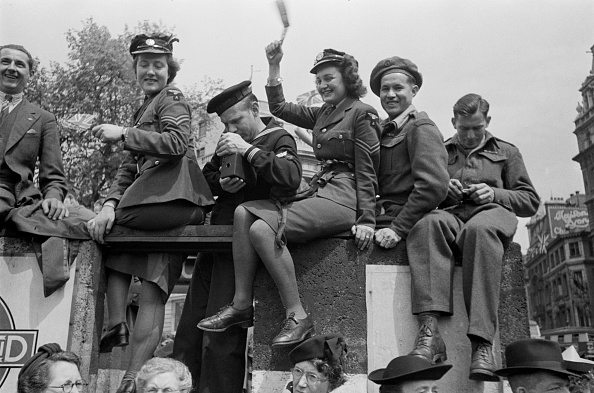
On the eve of the 80th anniversary of VE Day, Philip Temple looks back at childhoods on both sides of the conflict.
I ran into the back yard as the roaring grew louder and louder.
Bombers! They seemed to be just above the chimney tops of Castleford coal town and one flew right over us. ‘‘I saw the man at the back!’’ I shouted.
Grandad was not sure about that but, ‘‘I did, I did! ’E waved.’’
I was a 5-year-old jumping with excitement. ‘‘Where they going?’’ Grandad thought about it for a minute and said, ‘‘They’ve gone to bomb the Jerries. The army’s just invaded France.’’
‘‘Does that mean the war’s over?’ He smiled. ‘‘Nay lad but it won’t be long now.’’
It was D Day, June 6, 1944.
Four years later I got to know my stepfather, John. He did not want to talk about it at first but I knew he had been in the RAF and every small boy wanted to fly Spitfires. It was a bit disappointing when I found he had not been a fighter pilot, only a rear gunner, one of those at the back, in a Halifax bomber, which wasn’t a patch on the Lancaster either. But he had been shot down over a place called Mannheim on Christmas Eve 1944 and parachuted out and then was a prisoner of war. It took me years to get the full story out of him.
To exit the Halifax’s rear turret, he had to rotate it by hand until his back was facing out, then put on his parachute, then tumble backwards into space, at 15,000 feet with the plane on fire, his pilot trying to keep it stable while the crew escaped. He did not make it.
John had to count for at least 10 seconds after falling, to be sure of being clear of the burning bomber, before pulling the ripcord. He landed safely in a ploughed field, glad that he had managed to avoid a nearby pine plantation, but as he gathered in the parachute he heard shots being fired.
Local vigilantes were shooting at the Terrorflieger, terror flyers, as they parachuted down. A farmer ran towards John holding a pitchfork and he raised his hands but the farmer came on and pulled him into a ditch, hiding him from the shooters. When the firing was over, he handed John over to the local authorities and a lone corporal escorted him and other prisoners on a tram to holding barracks in Mannheim. The other passengers were not amused.
John spent the last five months of the war as a prisoner, shunted by train to a camp in Poland and then back to Germany. On one journey, a young guard asked if any of the prisoners could sing and when some put their hands up, he led them in a succession of Christmas carols. He had been a choirmaster before the war.
In 2016, my wife Diane and I travelled to Heidelberg to take part in the autumn festival of this companion Unesco City of Literature. It was one of the few German cities to avoid destruction by bombing, not by negligence but because the US High Command made an early decision to turn this historic hill town on the Neckar River into a pleasantly intact postwar base.
We visited the castle and walked the Philosophers Way, which was frequented less by university students than by youngsters in the latest craze of Pokemon. One afternoon, our host Marion took us to the home of artist Pieter Sohl in the forested hills above the city. It was an event to launch her biography of the artist and, from the garden decorated with his sculptures, there was a view over Heidelberg to the Upper Rhine plains and Mannheim where Pieter had been born.
I told Marion that I had published a novel about the suffering, and deaths, of a group of Berlin artists under the Nazis and bombing of World War 2. After the speeches, she said Pieter would like to talk about this and we sat beside a window looking on to the garden and exchanged histories.
During the war Pieter had lived with his grandparents on a farm near Mannheim. At age 11, six years older than me, he would go out daily in the vicious winter of 1944-45 to collect what firewood he could find in nearby plantations. One day he heard noises above him and saw a Terrorflieger hanging by his parachute from high branches.
Pieter was agile enough to climb up and help the Canadian airman down and take him home, where his grandparents fed him before handing him over to the authorities. I told him about my stepfather and wondered if he and the Canadian had journeyed together to the same camp for British and Commonwealth airmen.
We nodded and smiled and remembered them in our serendipitous encounter, looking out to those killing fields of 70 years before.

In May 1945 the war was over. They set a line of trestle tables in the lane between the rows of terrace houses in Lock Lane, Castleford, and there was a victory party for all the kids, and some of the grownups, too.
I had never eaten, or even seen, so many sweet puddings and jellies and I stuffed so much down so fast I was violently sick. ‘‘Serve you right, you greedy little bugger,’’ my grandad said.
A year later I was in London, after joining my mother, and she took me down to the Thames Embankment, close to Parliament, to see the big fireworks event marking the anniversary of VE Day. But I couldn’t see because of all the men and women in front of me and, when he saw my predicament, an American GI picked me up and perched me on his shoulders.
There had never been such a fireworks display. Everyone was laughing and smiling in the exhilaration of triumph and wonder. We had won and here was the glorious proof.
In the mid-1980s, I met Gunter Bennung near where I lived on Banks Peninsula. He travelled around schools, performing as Shiven the Clown, delighting kids up and down the South Island.
We were the same age and one winter we sat beside a roaring fire and talked about our families and our childhood. He was born in Potsdam just before the war and could not remember much about his father, who was soon involved in the fighting and had been killed in Yugoslavia during an RAF bombing raid.
The salient, distressing thing that Gunter knew about his father was that he had been in an officer in an SS regiment. Had he or had he not been involved in war criminal actions? Later I was to see a family album in which photos of his father had the insignia scratched from his uniform.
Not long before I was vomiting jelly at the Castleford street party, Gunter was with his mother, a nurse at a hospital on the island of Rugen, off Germany’s Baltic coast.
The Soviet army arrived and began to take over.
Gunter told me that his mother heard the words gulag and Siber in discussions about what to do with the staff. With the excuse of taking Gunter to the toilet, she escaped with him across country. When they reached the only bridge connecting the island to the town of Stralsund, it was on fire. Gunter remembered somehow getting across, balancing on single girders as his mother urged him on.
With the war coming to an end, tens of thousands of refugees headed west, away from the oncoming Soviet army. Gunter and his mother somehow made it on a train to Berlin and then on the S-Bahn towards their home in Potsdam.
Amid the surging crowds at Wannsee station, he panicked as he was carried away from his mother, but was able to find her later on the banks of the lake.
Reaching home was not the haven they expected. The house was taken over by Soviet troops, some of whom treated the bath as a lavatory.
They were relegated to the garage from which Gunter’s mother was treated as the household’s servant. More may have been expected of her. Gunter was not, at least, among the hordes of homeless children roaming the bombed-out streets of Berlin.
Gunter’s story and mine revealed that there are always two sides to the coin when nations go to war.
As a boy, I felt secure and proud that my country had won the war and that the other side, the Germans, were evil and deserved to be beaten. My stepfather and others of his generation were all heroes.
Gunter had only experienced terror and defeat, amid national humiliation and blame. It was an arduous journey towards the light with the burden of his father’s role. No wonder he became a clown to bring joy to children, and preached a philosophy of peace and love.
His story stirred the idea of my novel that would look at the lives of those ordinary Germans, on the other side of the coin, who had suffered during that horrific war.
It also led to my conviction that there should be no coins with sides based on demonisation of the other, creating only the damaging currencies of conflict that continue to savage our world.
• Philip Temple is a Dunedin author who has been publishing fiction and non-fiction for over 60 years.


