That’s why he proposed last September that the United States and Russia should extend their New Start nuclear arms control treaty for one more year, to gain more negotiating time for renewing it.

On the other hand, he is far more ignorant than Putin, which is why he didn’t even make an official reply to the Russian dictator’s proposal.
"If it expires, it expires," Trump told The New York Times last month. "We’ll just do a better one."
Well, it has just expired, and there’s no sign that the hyperactive US president is fast-tracking a replacement for what he sees as "Obama’s treaty".
Besides, you don’t win Nobel Peace Prizes by renegotiating old treaties.
It took years to negotiate the first Strategic Arms Limitation Treaty (Salt I), which was signed in 1969. It might never have happened if the two superpowers of the time, the United States and the Soviet Union, had not scared themselves half to death in the Cuban Missile Crisis.
They managed to sign Salt II in 1979, but neither side ratified it because the Soviet invasion of Afghanistan in 1980 led to a second peak in the Cold War.
Then the old Soviet Union collapsed and in 1991 the two countries signed the Strategic Arms Reduction Treaty (Start), which actually led to reductions in missiles and warheads for the first time.
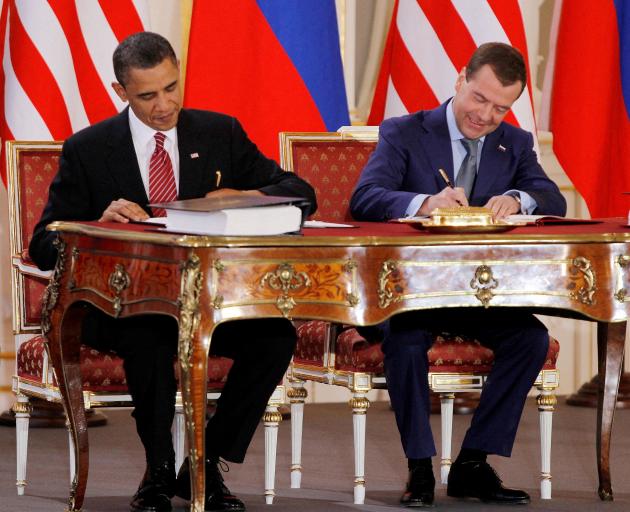
The last in a long series of arms reduction treaties was New Start in 2010, which reduced the permitted number of deployed nuclear warheads for each side to 1550, to be carried on no more than 800 delivery vehicles (missiles or bombers).
The treaties were a triumph for common sense and mutual respect, and they probably saved us from a nuclear war at least once in the past half-century. Without them, the two superpowers might still hold the insane 63,000-plus nuclear warheads that they had in the mid-1980s — enough for a nuclear winter 10 times over.
Instead, only about 11,000 nuclear weapons are held by the two together, even including those that are retired or held in stockpiles. About 1000 are spread out among more than half a dozen others: France, the United Kingdom, China, Israel, India, Pakistan and North Korea.
So, it seems stable enough for the moment — but it’s probably going to get worse, for two reasons.
One is that those treaty-backed limitations on the established nuclear powers really imposed an unspoken, understood limit on all the other nuclear-weapons countries too: they each weigh in at one-fifth to one-tenth of the number of warheads held by the top two. Now nobody has any limits.
If you know military thinking — if you just know human psychology — you will understand that this means arms races. You will also understand that arms races foster paranoia, because each side knows that its own motives are pure. Why are these evil people arming against us?
So how are we to get back to arms controls and regain the relative safety we have just lost? Not easily and perhaps not at all.
Negotiating arms control treaties is a long, tedious business that requires a firm grasp of huge amount of detail. This is not Trump’s forte — and he doesn’t even know why getting it done is so urgent.
In fact, he is entirely ignorant about the theory and practice of nuclear deterrence.
This became clear last August, when Trump took offence at something former Russian president Dmitry Medvedev said and declared that he had ordered two American nuclear submarines to "be positioned in the appropriate positions" in response to Medvedev’s "highly provocative" comments.
Nuclear deterrence is not taught in every primary school, but the man who is followed everywhere by the "football" that contains America’s nuclear launch codes should know a bit about it — like the fact that nuclear submarines that fire nuclear-armed ballistic missiles are always on station. That’s the only thing they do.
Their "appropriate positions" are huge tracts of deep ocean far from any shore where they go and remain submerged for several months. They are always within range of their targets, but never come closer than several thousand miles in order to minimise the risk of being detected.
They stay far away, awaiting the message that they hope never comes.
A minor detail, perhaps, but it tells us what Trump knows about nuclear weapons. Nothing. He doesn’t care about his ignorance either.
This is not a man who will put any effort into rebuilding a nuclear arms control agreement.
— Gwynne Dyer is an independent London journalist.