


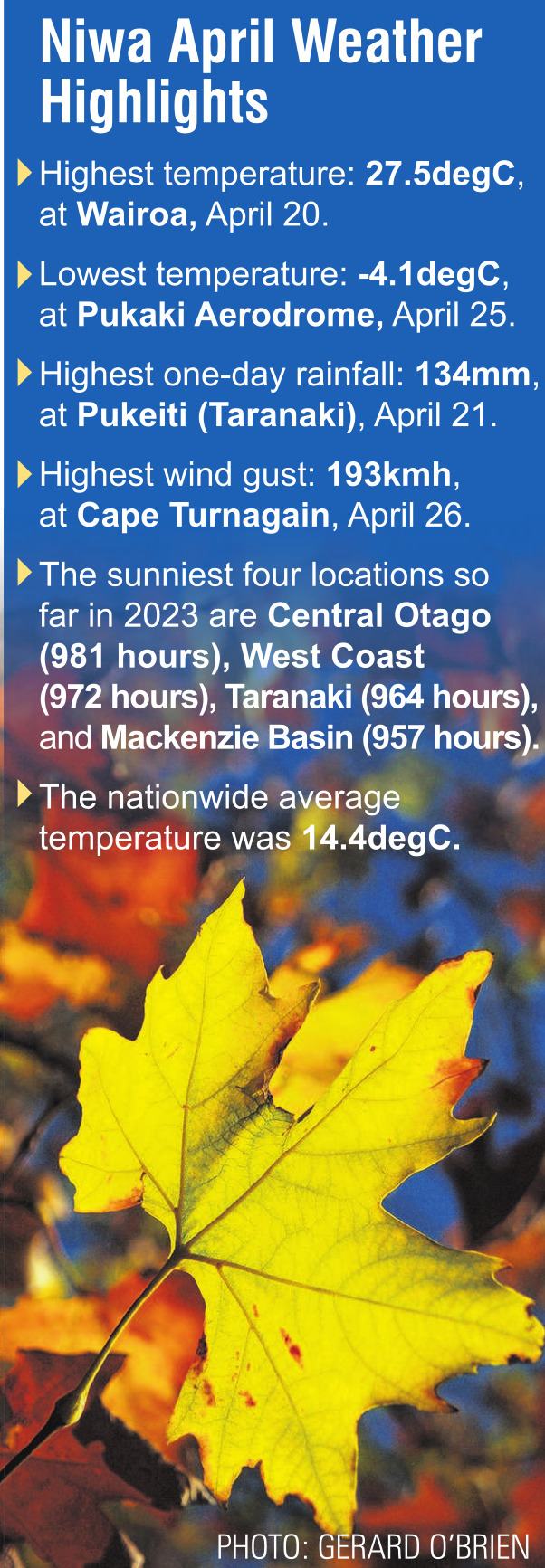
Niwa climate scientist Gregor Macara said temperatures were above average across most of the region, except for small areas of near average temperatures in parts of Central Otago.
Rainfall was below normal for Southland, coastal Otago and Canterbury, but above normal for Central Otago and parts of the West Coast.
Soil moisture levels were also below normal in coastal parts of North Otago and South Canterbury, but elsewhere, levels were generally near normal.
"April 2023 was a dry and warm month for many parts of New Zealand, with plenty of sunshine for the lower and western South Island.
"Mean sea level pressure (MSLP) was lower than normal over and northwest of the country, and higher than normal east and southeast of the country.
"This MSLP pattern resulted in more northeasterly winds than normal over New Zealand.
"The prevalence of elevated sea surface temperatures near New Zealand and more northeasterly winds than normal resulted in a warm month overall."
Oban (Stewart Island) recorded its highest mean air temperature for April with 12.6degC — the highest since 1975.
Tiwai Point recorded its second-highest (12.9degC) and Invercargill had its fourth-highest (12.5degC).
Mr Macara said Enso-neutral conditions persisted in April, but seas continued to warm across the equatorial Pacific, which was consistent with a developing El Nino weather phenomenon.
It was expected to arrive during winter.