
PHOTO
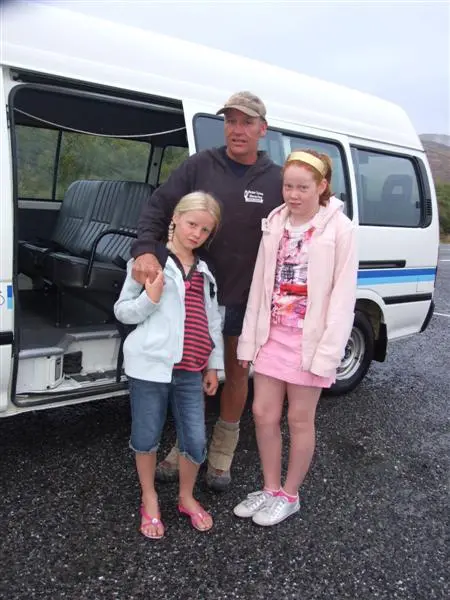
Tarras farmer faces $10,000pa bill to send his two daughters to local school
By the time Tarras farmer Bert Elstob's youngest daughter has finished primary school, he will have paid almost $40,000 just to get her there.
Because Mr Elstob, his partner Nicky Mead and their children Casey (11) and Brooke (8) live on a Lindis Pass station outside the Tarras School's existing bus route, they pay nearly $10,000 a year for a bus service provided free to neighbours just 10 minutes down the road.
The family shifted to Tarras last August and, with the support of Tarras School, asked the Ministry of Education to fund an extension of the bus route to accommodate Casey and Brooke.
Ministry of Education resourcing group manager John Clark said the Elstob-Mead case had been ‘‘thoroughly investigated'' and the request was denied because of ministry guidelines. ‘‘To ensure that policy is applied consistently, the ministry is unable to consider a side road extension for less than four people,'' Mr Clark said.
Another family with one school-aged child was due to shift near the Elstob-Mead property, so the two families had offered to cover a fourth child's costs if the Ministry would subsidise the other three. The answer was still no.
Last year, Ms Mead drove her daughters to and from Tarras School, a distance of 23km each way, a total of nearly 100km a day, but the trips impacted on farm work.
‘‘We couldn't get anything done,'' Mr Elstob said.
So the school, on the family's behalf, contacted bus provider Central Motorways this year to set up a private payment arrangement to extend the route.
At present, the family is charged $48 per day for that service - similar to the cost of driving the children themselves - and is eligible for the ministry's Conveyance Allowance to assist with travelling to meet the school bus.
Central Motorways manager Michael Harrison confirmed the company had offered a ‘‘private arrangement negotiated between the school and ourselves'' which was accepted by the school.
The $48 charge was ‘‘based on kilometres and wages''.
Tarras School board chairman Angus Chapman-Cohen had calculated the ‘‘astronomical'' annual school transport cost to the family at nearly $10,000, based on $240 a week for 40 weeks in the school year.
‘‘To put my youngest daughter through primary school, it's going to put me out $40,000,'' Mr Elstob said.
‘‘It would have been cheaper in the end for me to buy a bus.''
Mr Elstob felt there was a lack of leniency and flexibility in the system. Both he and the school had exhausted virtually every avenue.
‘‘We've just hit a brick wall everywhere we've gone with it,'' Mr Chapman-Cohen said.
The Elstob-Mead family's situation was not the first time the school had run into difficulties getting buses to pick up children in the Tarras area, where families lived on a ‘‘spiderweb, not a circle'' network of properties. The family of a new entrant to Tarras School, who lives on the Bendigo Loop Rd, would soon face costs of $750 a term for the bus service.
Central Motorways renewed its contract for the Tarras School bus run for a further six years in November 2008.
Mr Chapman-Cohen said when the school received notification of the upcoming school bus tender process in May-June 2008, the Elstob-Mead family did not live in Tarras so there was no need for the school to apply for the ministry's Direct Resourcing to operate its own bus.
After the family arrived in the area and it was later apparent the ministry funding did not cover Central Motorways extending the route, the school's inquiries into securing the bus contract themselves came too late.
‘‘We simply believe that we would have been able to make that amount of money [ministry funds] go a lot further than Central Motorways does. We're an isolated community.
That bus [if run by the school] could have been used as a community taxi, too.''
Mr Chapman-Cohen had written to Dunedin ministry representatives asking them to reconsider extending the bus route or renegotiating the contract, but was told it was a legal tender and there was no obligation for an extension under the current guidelines.
He also approached Central Motorways and asked it to consider relinquishing its renewed contract so the school could provide its own service, but was told that was ‘‘very unlikely''.
Mr Chapman-Cohen acknowledged Central Motorways needed to make a living and the onus was on the ministry to address the family's plight.
‘‘The new government are quite willing to charge families a truancy fine for not getting their kids to school, but they're not prepared to pay something towards getting their families there.''