
PHOTO
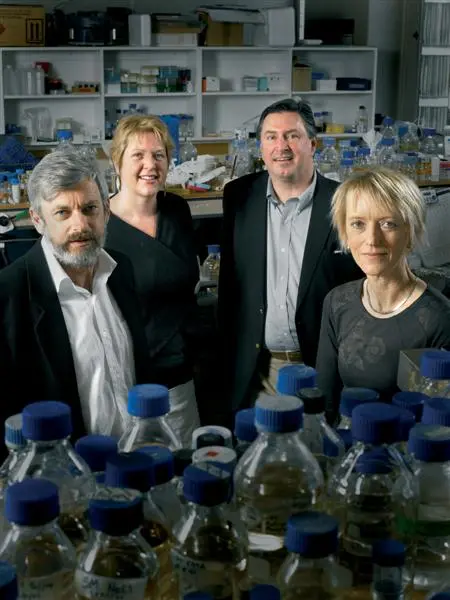
With evidence showing that about one third of all deaths worldwide are still caused by infectious diseases, scientists at the University of Otago are not taking this threat lying down.
As part of a new Health Research Council-funded programme, Human Pathogenic Viruses: Drug Targets and Therapeutic Potential, they are exploring the survival mechanisms, replication and invasive strategies of viruses.
Their aim is to understand the virus-host interaction and, using that information, first, to combat viruses or, second, to exploit them for beneficial purposes.
"In some larger viruses a lot of the genes are not simply about replicating or making other virus particles. They are about manipulating us,'' says Professor Andy Mercer, director of the University of Otago's Virus Research Unit.
"They have a core of genes which are the ‘housekeeping' genes - they do the replicating and expressing - and then they have 20 to 40 genes that they use to manipulate us, by suppressing our immune responses."
"Quite a few of those are clearly genes the virus has actually stolen from us. But it hasn't just taken them. It's taken them and adapted them so that they do exactly what the virus wants them to do ..."
The project is led by Mercer out of the University's Department of Microbiology and Immunology, but also incorporates Biochemistry.
"It's a three-year programme with a possible extension, has four lead researchers, 10 named investigators, three external collaborators, six research assistants and 21 current PhD and masters' students associated with it," he says.
"Each of the four projects within the programme shares the goal of developing new antivirals and other viral-derived therapeutics."
Leading the programme's charge on combating viruses are Professor Kurt Krause, a clinical specialist in infectious diseases whose scientific specialty is structural biology; and Dr Merilyn Hibma, a virologist working on the human papilloma virus (HPV), which has a direct causal link with cervical cancer.
Says Krause: "I'm very interested in how proteins work, because they are the machines that run the body. And I have a particular interest in the machines that are important in infectious diseases - sort of nano-machines if you will."
"These machines are essential so if you create a compound that will block their activity, then the organism can't replicate and the disease is cured or treated."
Krause, something of a biological locksmith, invokes the metaphor of a lock and key when explaining how his work relates to combating viruses such as HIV.
He holds up a picture of a complex three-dimensional protein molecule and explains: "What this is, in essence, is a picture of a lock that a locksmith can use to design a key. In each of these structures there is an active site which is usually a cavity on its surface, and this cavity has specific characteristics, charge and shape.
"So if you had a molecule that would fit into this cavity and be complementary in shape and charge and if it's very complementary it's a very tight fit, then that is potentially a good drug."
Hibma's work focuses on HPV regulation of cell-adhesion and how this contributes to immune system evasion. Understanding these mechanisms could offer opportunities to develop new anti-HPV therapeutic interventions to target pre-cancerous HPV-infected cells. It might also generate knowledge relevant in broader fields of cancer research.
"The HPV virus affects the antigen-presenting cells in the skin - the cells normally associated with producing an immune response - in such a way as to help it remain hidden in the host,'' says Hibma. "What we want to know is how the virus regulates the environment to do that?"
"It's not all bad news with viruses," says Mercer. "Two of our four projects have a major element of exploiting the knowledge we gain from viruses, or even using viruses themselves as tools."
This includes the work of the fourth lead researcher, Dr Sarah Young. She is investigating anti-cancer vaccines, based on harmless virus shells, called virus-like particles (VLP), as novel and effective vehicles to deliver immunising tumour proteins.
Mercer's own work - on the Orf virus and a set of genes that the virus has succeeded in stealing, such as a version of a human growth factor gene - also involves exploiting viruses for the treatment of other human diseases: can we take these viral proteins and use them to combat other diseases and pathologies?
Mercer cites a range of conditions and situations where there may be potential application of virus-derived therapeutics, including in healing wounds, arthritis, asthma, tumour growth and transplant rejection.
FUNDING
Health Research Council
Cancer Society of New Zealand