

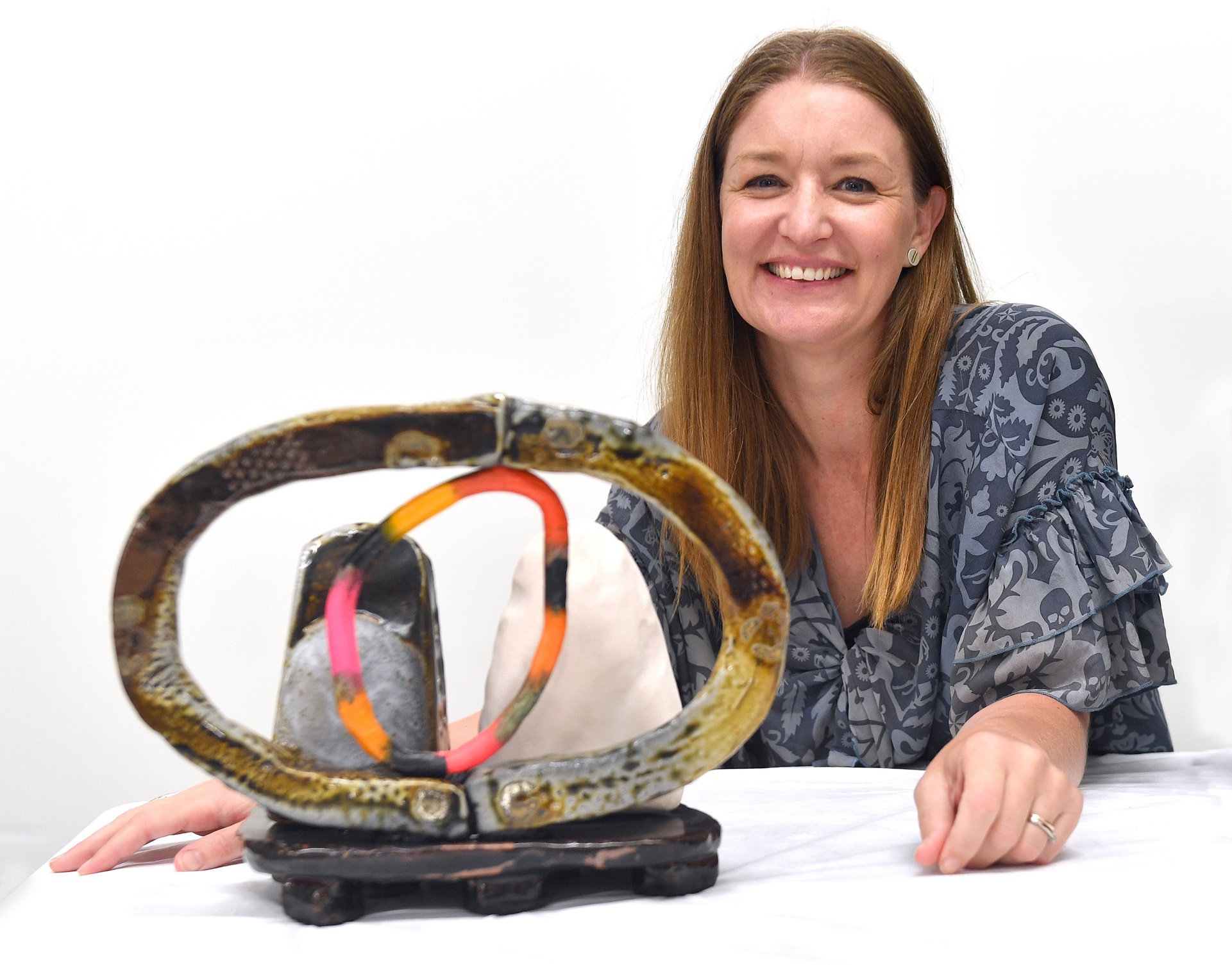
A "precarious" and totally non-functional teapot grabbed curator Lucy Hammonds’ attention many years ago.
By ceramicist Peter Hawkesby, the teapot reignited an interest Hammonds first had when seeing his work at art school but it was not until she was curating an exhibition for another organisation that she came across the teapot in the collection she was working with.
"It was sort of like a punk teapot. I felt like it was sort of intentionally anarchistic as an object and it was really intriguing to me because it kind of sat within this context of ceramicists who were interested in functional wares and then Peter’s work was speaking into that and also flying in the face of it, all at the same time."
So when she discovered the artist had moved from Auckland to Dunedin in 2020, where Hammonds is now curator at the Dunedin Public Art Gallery, she could not resist meeting him and visiting his studio.
"Peter, he is a really significant person within the recent history of studio ceramics in New Zealand. The reason for that, I suppose, is that he’s sort of a rule breaker."
He came into studio ceramics in Auckland when there was a boom in studio pottery — in particular, domestic ware — in the 1970s. While he joined the potters making a living from selling their works, he soon decided it was not going to sustain his interest and moved to Waiheke Island.
"He very much sort of turned away from the rules of how something should be made, how something should be fired, how something should be put together, and where there was a sort of wave of practitioners moving in one direction, he moved in an entirely different one."
It is something he has done consistently over his career, doing things his own way, including moving to Japan in the 1980s and running a cafe for two decades in Auckland before returning to fulltime ceramics-making in 2015.

"I thought it was a really great opportunity to sort of claim him as one of our own and bring a spotlight on to what he was working on and how he was processing in his practice the change of moving from Tamaki Makaurau."
The aim is to show artists at different stages in their careers and remind audiences that contemporary art is not just the product of emerging artists.
"Artists have long and sustained careers and have interesting things happening throughout those lives and that the gallery can provide a platform for whatever interesting thing might be happening for them."
During the past few years she has been talking with Hawkesby and following the progress of his work.
"It seemed to me that this was a really lovely opportunity to celebrate what he’s achieved over that period of time and also to introduce him to our audiences, particularly to our local audiences so that they can get an understanding of who he is and what’s so significant about his practice. So it’s quite an exciting exhibition."
It is not a survey of his career but more a focused look at his recent work in Dunedin which has gone in two directions — a series of new works, "heart basket", and an ongoing series of "re-jigged" works.
"It’s a very interesting exhibition to me, to observe the way it’s sort of coming together and how those two things intersect."
The "rejigged" works are created from a set of lose parts or objects that Hawkesby’s made over time and sort of accumulated "literally as a pile of bits and pieces" that are reconfigured in sculptural form.
"So within them they’ve got all these moments of shape and of technique and process and idea that belong to different moments in time that can be brought together into new form, but as a way of thinking about the passage of time and thinking about forms and ideas and interests and how they kind of come together and move apart and come together again across time."
"What needs to be new and what can be old. I see them as having these little moments of bridging because there are certain forms you can see across different works, there’s certain glazes you can see."
Equally, though, she says they are works that break rules and come together in ways that should not work.
"They’re very sort of satisfying and interesting sculpturally, and you can kind of see these little moments of dialogue across his archive where this clay might have been the favoured clay, or this glaze was really working very well, and you kind of see it repeat over time, and certain forms repeating over time."
Whereas Hawkesby described the basket works as landscapes which was a bit of a "revelation" for Hammonds. They reflect Hawkesby’s journey as he settled in to his new home and the environment he saw every day, looking over the city and harbour and as he walked between his home and studio.
"I think across the works there’s this real sense of kind of like a rhythm, or a meditative kind of process of working through those daily experiences, those sort of repeated motifs, so you can kind of see in the way the works are constructed, and the way the surfaces are sort of articulated, this sort of sense of a journeying landscape, and of a horizon line referred to in different ways, and repeated colours, and textures, and moments of lightness."
The basket works also reflect his discovery that in Dunedin it was more difficult to locate workable clays directly from the land than it was in Auckland. So on a trip to Waiheke he brought back clay where it was worked into the loose elements of the baskets.
"They physical material of the landscape goes on these journeys with ceramicists, as they move around places where there’s clay they like and how its going to work within the things that they’re wanting to make."
They were also made during a time when Hawkesby suffered from a heart condition. When Hammonds talked to him he described the works as carrying a "sort of almost like a heartbeat, or a rhythm of their making," in the way that they have repeated action imprinted on them.
Hand-built ceramics carry a strong sense of the maker’s body in their physical construction, in this case in the fingerprints that pinch the seams or the construction of the handle, she says.
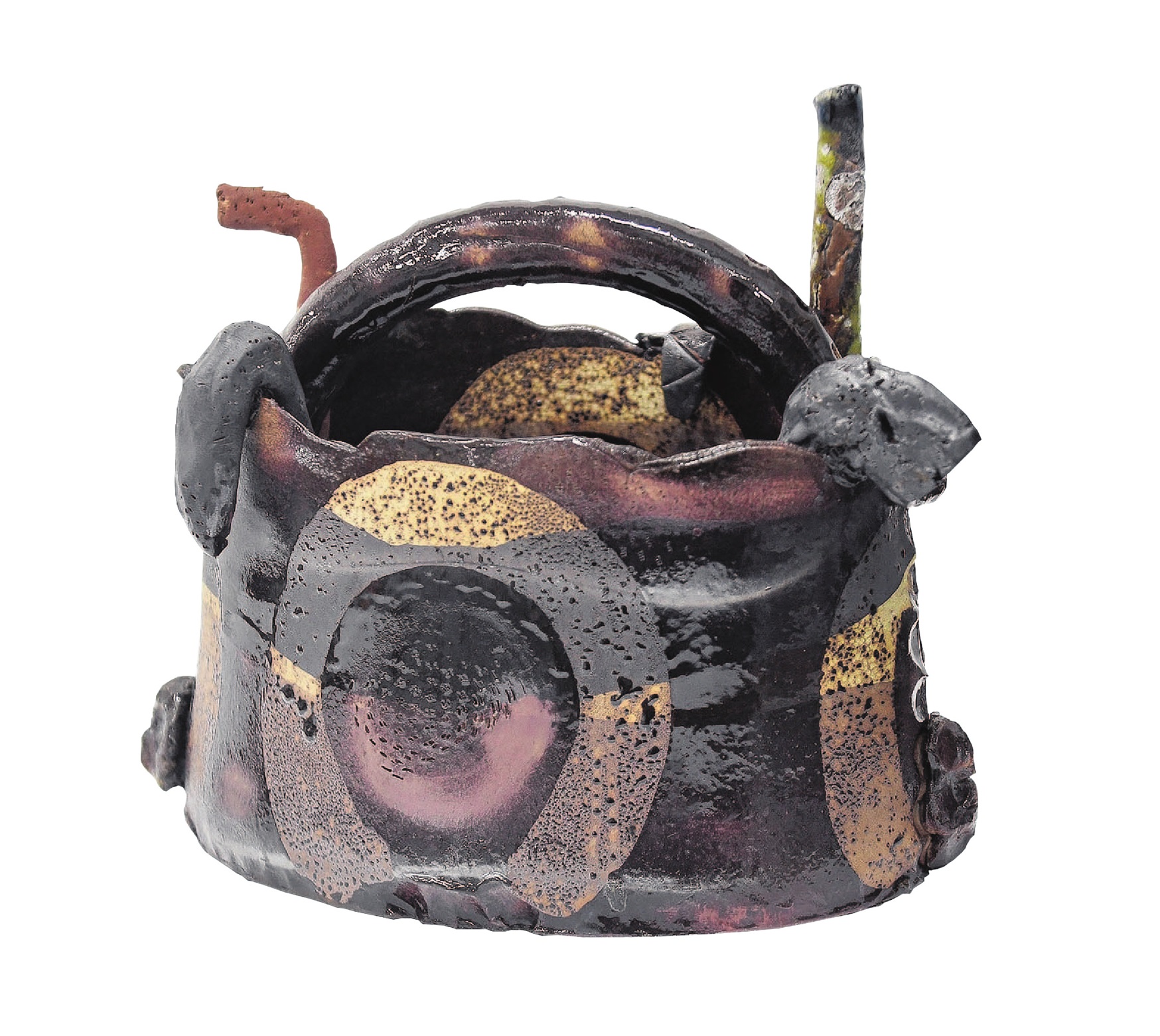
The nine baskets are all similar in the way they are constructed and glazed but each has a significant variation.
"They very much to me feel like works that accumulate knowledge and experience across the body of work, whereas the rejigged works I think have a different sort of tone, they come together in different ways, and there is a different time scale to them, because these basket works are all kind of born of one moment, whereas the other works, the rejigged works, come together and reform, and reform, and reform until they settle."
Hammonds believes in many ways the way Hawkesby is working is quite aligned with the way many of today’s contemporary sculptors are working.
"I’m very interested in moments where there’s a precedent for a contemporary interest. Sometimes the contemporary moment doesn’t realise that the precedent is there, and so exhibitions like this are a really good way of bringing into the spotlight that sense of an artist whose work is in conversation with subsequent generations, and Peter’s very much is."
While many in Dunedin’s ceramics world know Hawkesby now lives in Dunedin, much of the wider community does not.
"This was a really lovely opportunity to celebrate what he’s achieved over that period of time and also to introduce him to our audiences, particularly to our local audiences so that they can get an understanding of who he is and what’s so significant about his practice."
TO SEE
Peter Hawkesby: Heart Basket & Other Work
February 21-May 24. Dunedin Public Art Gallery


