

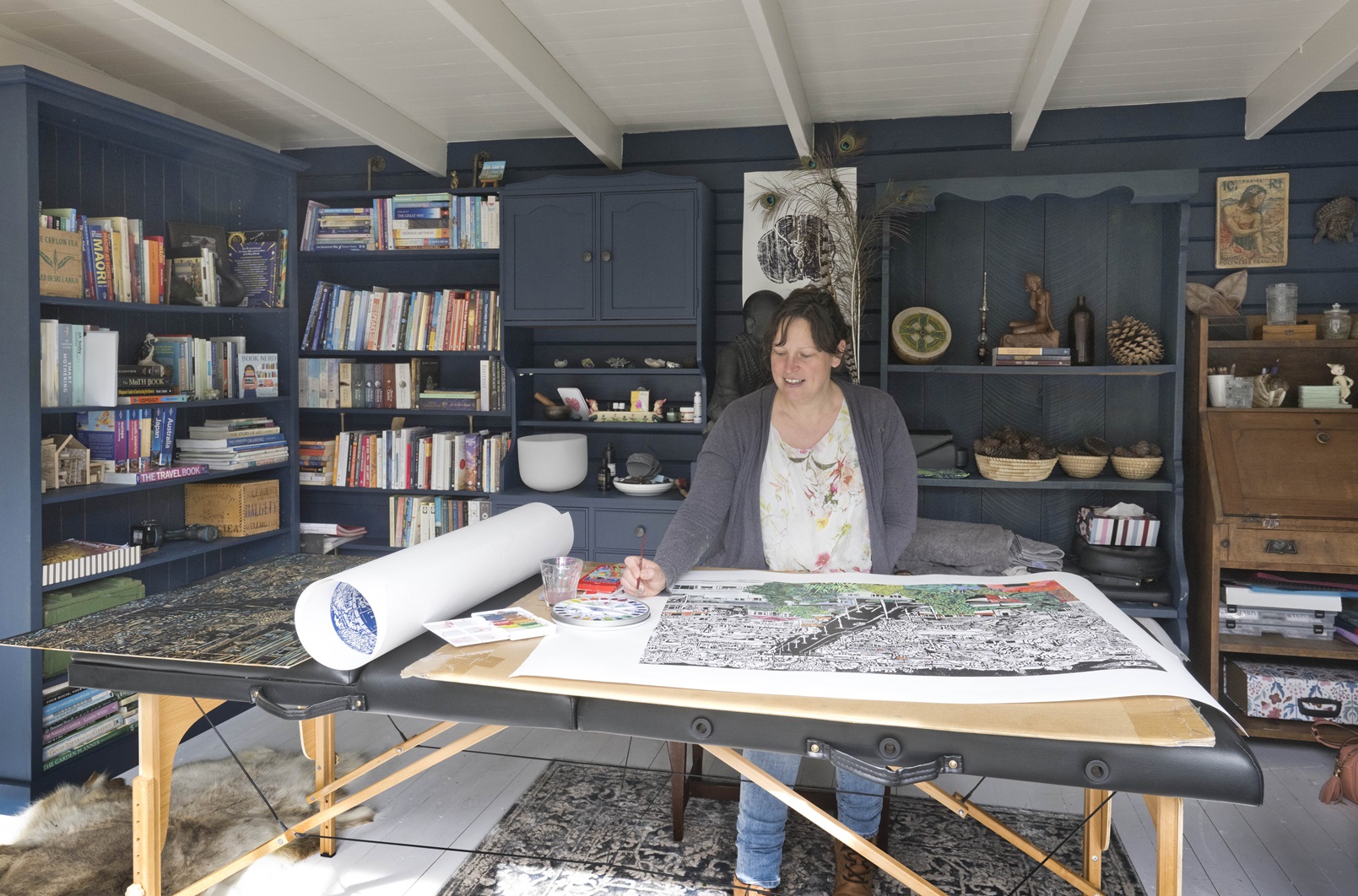
IN a little blue hut at the front of the garden, Disa Walker painstakingly paints the details of her woodblock print of Green Island.
A board has been put across her therapy table to give her a stable surface and as a mum of three children she takes advantage of the quiet time to put the finishing watercolour touches on the print.
While she looks out the French doors of the hut on to the front lawn where her children’s guinea pigs happily keep the lawn mown, it is the view up her street that captured her imagination.
"I’ve always loved hill suburbs, like how they look, how they sit, and there’s some beautiful work that quite a few Wellington artists do of those sorts of scenes, but they’re all paintings, and I was like, there’s no reason why I couldn’t do a print of that."
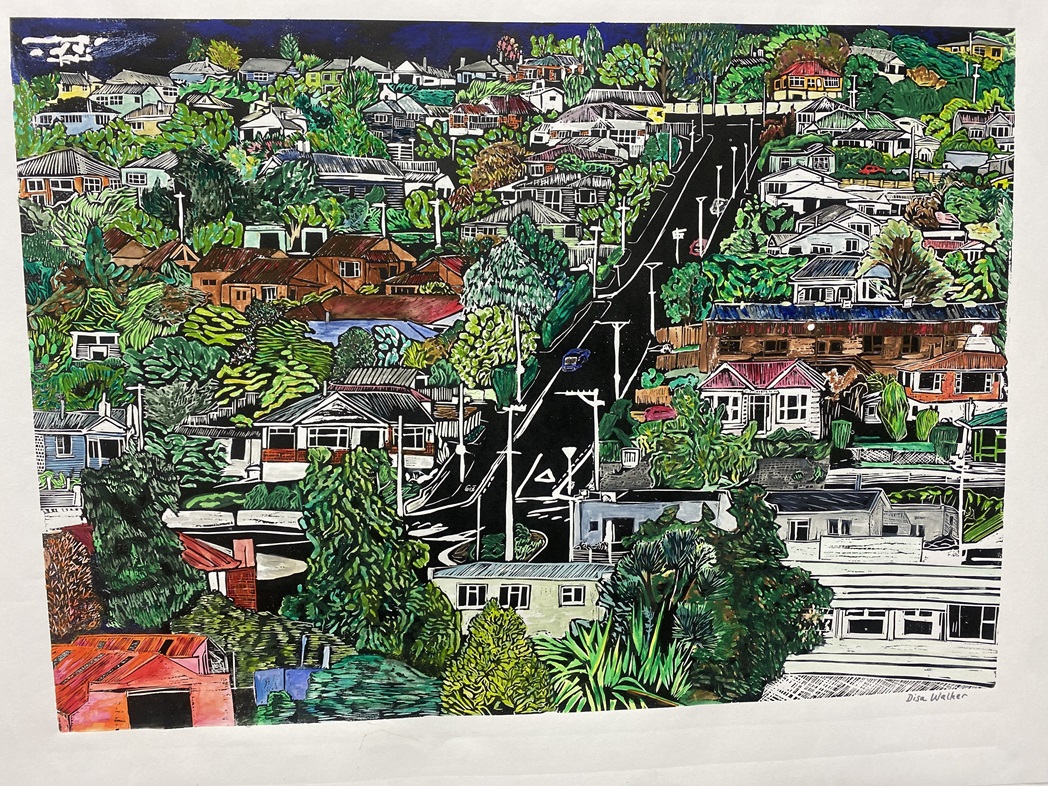
She admits Green Island is not a suburb that immediately comes to mind when you talk scenic Dunedin hill suburbs, but to Walker its range of architecture — from state houses to post-war and arts and craft homes and 1980s flats — has it all.
"I was like, actually, it’s really quite beautiful."
To get a wider look at the view, she headed across to Abbotsford and looked back across to Green Island, taking photographs to prompt her memory.
She then "Frankensteined them all together", changing the composition a little bit to adjust for scale and remove the trees in the foreground — it turned out to be the most frustrating part of the process.
"So there was a lot of trial and error. There’d be parts that weren’t very interesting, like maybe a big chunk of bushes that was just too much, so I’d take a house from somewhere else and pop it in, so it’s not exactly how it is, but most people can recognise the area and they’re like, oh, my house is there, so that’s been quite fun to do."
The project has been a long time in the making. Walker used to be a primary school teacher, a career she chose because it allowed her to do all the things she enjoyed, including art.
She enjoyed teaching, studying for her Masters in Education following her interest in holistic methods, how and why they work and when they do not. That led to roles in educational research and teaching teachers how to integrate technology into classrooms.
But after her second child was born in 2017 — which was a difficult birth — and other things happening in her family’s lives, she decided to stop teaching.
"I thought I’m going to have to simplify everything. It was a lot to give up ... but I just knew that I couldn’t keep doing it."
Walker decided the only way forward was to look at what she had missed out on by putting so much into her career and start over in a different way.
She loved gardening, so did a certificate in horticulture and an organic primary production course free through Open Polytechnic which fitted in well with raising three children. Walker also trained in holistic healing and studied landscape design but discovered the attention to detail and mathematics required in landscaping were not quite her thing.
"I’m more expressionist, like I do a lot of free movement. I was sort of thinking, I don’t know if any of these will lead to a job, but I just wanted to do them, and I figured as long as I was doing things, eventually I’ll figure out what to do.
Not keen to go back to painting, as she had done three years of assessed art at school, creating huge portfolios, she decided to take the option she had not back then: printmaking.
But given it had been so long since she had attempted any art, she did not want to make a big investment in equipment for something she might not enjoy long-term, so she decided to try Dunedin School of Art’s night classes.
"I really was craving the environment, actually. I wanted to be with other artists."
So she started doing daytime printmaking classes and later started a Thursday night ceramics class. She enjoys spending time with her fellow students, who are often — like her — caring for others or studying, taking a career break or professionals tapping into the art process to look at their work in new ways.
"So it’s been a really productive time, and in the meantime I have also been bringing my kids up, so it gave me something extra, I think, because eight years is a long time to not be thinking about new things and what makes you happy, and it’s been nice for my kids to see that I’m doing other things too. I’ve dragged them along to a lot of stuff, which I think is good for them."
As well as working in holistic healing, the printmaking has stuck. She started off with a few smaller things as she "got back on the horse" before deciding she had a big wall space in her lounge that she wanted to fill. Buying a piece that size would be expensive, so she thought she would give creating a piece for it a go herself — hence the hill suburb idea.
She found an appropriately sized piece of MDF and with her design sorted, then flipped, she used carbon paper to trace the design on to the board. Then using cutting tools of different sizes and shapes carved the design into the wood, hoping she did not take too much out.
"You have to work out how to do the marks to give the texture of things. The carving was very relaxing."
Given its size she decided to only work on this part of the process at art school, which took the better part of a year, alongside learning different ways to make prints and going on field trips to visit artists or see things around town.
"I was like, I’m not in a hurry, and that was the nice thing about the classes, like you’re not being assessed. If something doesn’t work, it doesn’t really matter, you’re just making it for you. Because there’s lots of other interesting people sitting around a table, and we’re all carving together, and like the people there in the class are just such high quality, amazing humans, so that’s a pretty nice place to go for a couple of hours a week."
With the design board finished, Walker has printed off a few different versions of her Green Island neighbourhood — a black one she is colouring in and a blue one. The prints were displayed as part of DSA’s night class exhibition last year.
"It actually changes how they look really. It’s almost like quite a different style. They call it in printmaking a graphic surprise, because every print is a bit different, and sometimes the really cool effects weren’t planned, they just sort of happen."
Walker has really enjoyed the process of discovery she has had in recent years and knows it is a privilege to have been able to do so.
"Some people don’t have that choice, but I’m lucky enough to have fallen into a space where I still have to look after the children, so it’s maybe a lot of flexibility in my time, rather than a lot of time, but it’s definitely been better than lots of other things. I’m not scrolling on my phone; there’s something good about using your hands."
Admittedly, she could have made it faster and used technology to assist her, but she likes the human touch doing it by hand brings to an art piece.
"Because people are quite spellbound by it, they just sit and look at all the little marks, because it is amazing when you think it’s just the choice of whether you take the wood out or not, what ends up making the picture. It’s cool."


