
PHOTO
Brassicas have always had a bit of an image problem. Brussels sprouts were certainly not sexy when I was growing up and eating cabbage soup was something usually associated with stories of abject poverty or mealtime for prisoners. The reality these days is far more exciting.
Brassicas are members of the mustard family and are hugely significant for the simple reason that this family contains more important horticultural and agricultural crops than any other genus.
Almost every part of the species has been developed for food use: the roots (swede and turnips), the stems (kohlrabi), the leaves (cabbages, kale, cavolo nero and Brussels sprouts), the flowers (cauliflower, broccoli and cima de rapa), and the seeds (mustard seeds and oil-seed rape).
There are more than 30 species and hybrids grown, mainly for food production but there are also several varieties grown solely for their ornamental value.
For us, in the South, brassicas are especially important, as unlike most other food crops, these crops love the cold - so much so that the taste of some varieties, such as cavolo nero, actually improves after a good frost. Better still, many can produce throughout the year, providing a continuous supply of vegetables.
Brassicas have always been highly regarded for their nutritional value, a great source of vitamin C, soluble fibre and multiple nutrients, with anticancer, antiviral and antibacterial properties. The humble broccoli has even been touted as a superfood!
The best thing is that there are a lot more appetising and exciting varieties available these days and gone is that lone, limp head in the bottom of your fridge.
Farmers' markets are starting to supply the likes of kale and, if you are lucky, cavolo nero, but the real selection on offer is to be found down at your local garden centre. Peppery cima de rapa is one of my favourites, a sprouting broccoli with real flavour and crunch.
Russian kale is extremely hardy and delicious and can easily be stir-fried in a hot pan almost as fast as spinach. Another personal favourite of mine is romanesco broccoli. Its amazing lime-green florets, twisting upwards like exquisite coral, make eating it almost a crime.
If you can't find the seeds you're looking for at your garden centre, just ask nicely for a quick look at their catalogue. You'll also see what the plants look like and you may well come across a few varieties you did not even know existed. A little effort now and you will be reaping the rewards for months to come.
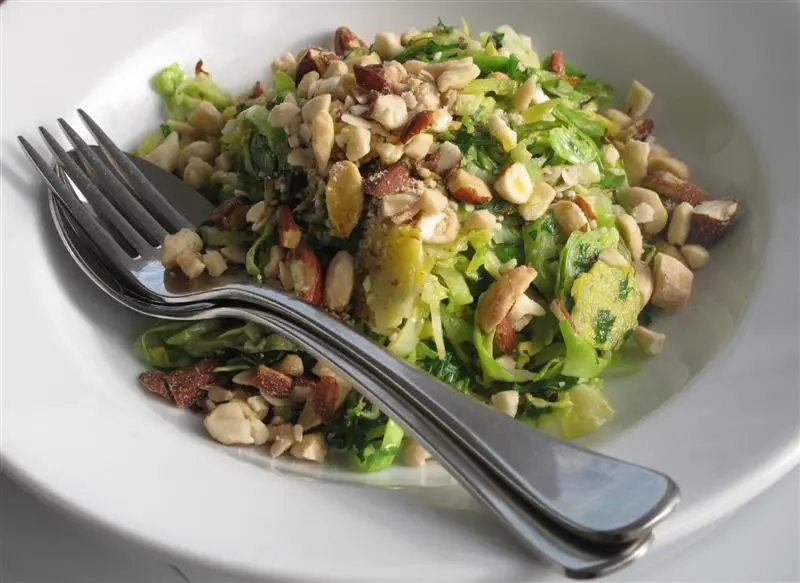
The following recipes give a quick snapshot of just how versatile these remarkable vegetables are. Brussels sprouts with roast almonds will make you look twice at this Southern gem - an amazingly tasty side dish or a healthy meal on its own.
A simple salad of Chinese cabbage, chicken, honey and sesame is fresh and light and quick to prepare. Cima de rapa with garlic, chilli and lemon is perfect, either on its own or with grilled meat or fish.
Confit duck with red cabbage, crisp bacon and roasted hazelnuts is a classic winter match that will satisfy on many levels. With so much selection and flavour on offer, you may never think of Brussels sprouts the same way again. Viva brassica!!
Brussels sprouts with roast almonds
Serves 2 as a side dish
10-12 medium-sized Brussels sprouts
30ml extra virgin olive oil
20g unsalted butter
1 Tbsp flat-leaf parsley, chopped
100g whole natural almonds, roasted and lightly crushed in a mortar and pestle
sea salt and pepper to taste
Slice Brussels sprouts as finely as possible, discarding the stems and the worst of the core.
Heat olive oil in a heavy-based saucepan over a medium to high heat then add the Brussels sprouts and stir-fry for about 30 seconds before adding butter.
Continue to cook for another minute before removing from heat. Add chopped parsley and season to taste. Top with crushed almonds and serve immediately.
Salad of Chinese cabbage, chicken, honey and sesame
Serves four
1 size 12 free-range or organic chicken
1tsp Chinese five-spice powder
50ml canola oil
1x 3cm piece fresh ginger, peeled and finely sliced then cut into very fine strips
1 Chinese cabbage, finely sliced
half a bunch of spring onions, finely sliced, Asian-style
2 Tbsp sesame seeds, toasted
4 Tbsp liquid honey
salt and pepper to taste
Bone and joint chicken into four pieces, then season with salt, pepper and five-spice powder.
Heat oil in an ovenproof heavy-based saucepan and briefly colour both sides of the chicken before placing in an 180degC oven to roast for 5 to 7 minutes or until just cooked.
Remove from oven and allow to rest. When rested, slice chicken thinly and toss in a large bowl with cabbage, ginger, spring onions and honey.
Check and adjust seasoning if needed and divide between four bowls. Drizzle with any resting juices left in the pan and top with sesame seeds.
Cima de rapa with garlic, chilli and lemon
Serves 2 as a side dish
300g or one large bunch cima de rapa
60ml extra virgin olive oil
1 clove garlic, crushed
1 fresh long red chilli or two pinches chilli flakes
quarter of a lemon, pips removed
In a medium-sized heavy based pot, heat two-thirds of the olive oil over a moderate to high heat. Roughly chop the bunch of greens once or twice and add to the hot oil.
Stir for 30 seconds on a high heat before placing a lid on the pot and reducing the temperature to medium (the lid will help to steam the cima de rapa).
After 30 to 40 seconds, remove the lid and add the remaining oil. Add garlic and chilli and stir for 15 seconds before finishing with a generous squeeze of lemon. Serve immediately.
Confit duck with red cabbage, crisp bacon and roasted hazelnuts
Serves two
2 prepared confit duck legs (cooked and stored in duck fat)
6-8 rashes of belly bacon, finely sliced and cooked until crisp
70g hazelnuts, roasted with skins removed
half a small red cabbage, thinly sliced
50g unsalted butter
50ml canola oil
1 red onion
1 clove garlic, crushed
2 bay leaves
400ml red wine
50ml red wine vinegar (we use Forum Cabernet Sauvignon vinegar)
1-2 Tbsp brown sugar (optional)
2 Tbsp flat-leaf parsley, chopped
salt and pepper to taste
100ml jus
Place butter and canola oil into a large heavy-based sauce pan over a gentle-to-moderate heat and slowly sweat the onion for five minutes until it has almost become translucent.
Add garlic, bay leaves and one third of the cabbage and continue to sweat down for another five minutes before adding another third of the cabbage. Continue to sweat as before and then add the remaining cabbage.
When the cabbage has cooked to about half its original volume, add the red wine and continue to cook until the liquid has reduced to almost nothing.
Add vinegar and adjust the seasoning to taste. Finish with a little brown sugar if desired and chopped parsley. Keep warm until ready to serve.
Meanwhile, in a small ovenproof frying pan, place the two duck legs, skin side down, on a piece of baking paper. This will prevent the duck skin sticking to the pan.
Place the pan with the duck into a 200degC-210degC oven for five to six minutes and remove once the skin has browned nicely.
Divide the cabbage between two plates and place a piece of duck on top. Scatter with hazelnuts and finish with the crisp bacon on top and a drizzle of jus. Enjoy!
- Bevan and Monique Smith own the award-winning restaurant and cafe Riverstone Kitchen on SH1 in North Otago, just south of the Waitaki Bridge. www.riverstonekitchen.co.nz