
After Christmas, Easter is our favourite food holiday - a lovely opportunity to bring together the people you care about and cook a special meal.
For us in New Zealand, Easter also falls at a beautiful, autumnal time of year, when we’re ready to cosy up indoors and spend some quality time in the kitchen, intoxicated by the delicious aroma of an Easter feast.

Many of us can thank Yotam Ottolenghi for introducing us to the joys and delights of Middle Eastern ingredients, and helping us realise that salads can be satisfying and beautiful and exciting! With this in mind, we have two gorgeous recipes infused with Middle Eastern flavours for your Easter table, starting with a bountiful Levantine cauliflower salad.
Inspired by two of our favourite Middle Eastern salads - fattoush and tabbouleh, we are certain this will become a new favourite for all! Scattered with gorgeous pomegranate, crunchy cucumber, fresh tomatoes, aromatic herbs, toasted nuts, sumac-pickled onions and finished with a tangy garlic-and-pomegranate dressing, this salad tastes as good as it looks.
We eat with our eyes, which means taking a little time to plate up your food and consider the garnishes is so important. It doesn’t have to be tricked up and complicated - sometimes a dish might just need a scatter of herbs or a gentle toss. This sentiment also rings true for our second recipe - Slow-braised lamb with lentils and frizzled onions.
A slow-cooked shoulder of lamb is one of our favourite things to cook and eat, especially for Easter. It’s also incredibly easy. You get that melt-in-your-mouth, fall-off-the-bone texture that we all know and love. The shoulder is a satisfyingly easy cut to cook; the oven does all the work and leaves you with the perfect flavour and fork-tender texture.
We’re taking the humble shoulder to new heights by pairing it with creamy Greek yoghurt, toothsome Puy lentils and sweet frizzled onions (our current obsession). These also bulk out the dish and help to make this divine lamb go even further.
Again, as you’re plating up, think about how you can make something look beautiful and appetising - often this is when layering comes into play: tucking the lentils under the lamb so they soak up all the delicious juices and putting the prettiest things on top so you see them first. It’s a balance between making something eat well and look good.
Wishing you all a very happy Easter!
With love, Annabel & Rose xxx
• Annabel and Rose Langbein’s weekly newsletter is ‘‘What to Cook Tonight’’: sign up at https://langbeinnewsletter.substack.com/
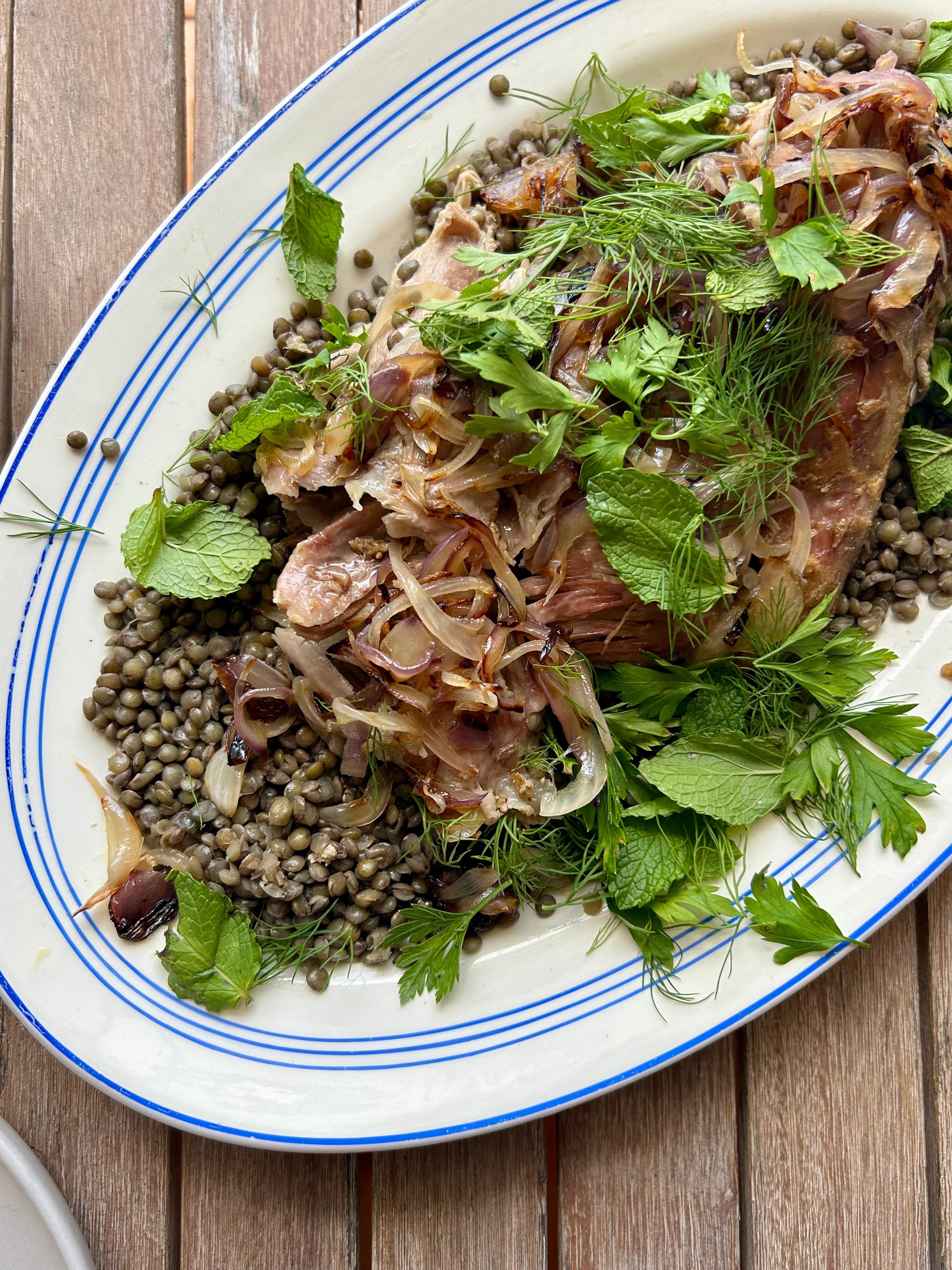
Slow-braised lamb with lentils & frizzled onions
Serves 4
Ready in 3½ hours plus marinating
Suitable for DF, GF, RSF
We like using an oyster shoulder (which has the blade without the ribs). You can ask the butcher to bone one
out for you if you don’t see it in the meat cabinet. A full shoulder also works a-OK, but it tends to have more fat, so you will need to skim off the fat before serving (or drop in some ice cubes so that the fat can adhere to these before removing).
Ingredients
1 bone-in oyster shoulder of lamb (1.1-1.3kg)
Spiced maple marinade
2 Tbsp extra-virgin olive oil
2 Tbsp lemon juice
1 Tbsp maple syrup or runny honey
1 Tbsp Dijon mustard
2 tsp ground cumin
2 tsp ground coriander
1 tsp salt
freshly ground black pepper
Frizzled Onions
3 Tbsp extra-virgin olive oil
2 onions, thinly sliced lengthways
Lentils
1 cup Puy lentils
1 bay leaf
To serve
1 cup Greek yoghurt (optional)
a handful of picked soft herbs (parsley, dill, mint)
lemon cheeks
Method
To prepare the marinade, combine all ingredients in a bowl or clean plastic bag. Add lamb and mix to coat evenly. Chill for at least 4 hours or overnight.
When ready to cook, preheat your oven to 150ºC fanbake.
Place 1½ cups of water in a Dutch oven or deep roasting dish. Place the lamb on top and slather with any surplus marinade, rubbing it over the top and sides.
Cover with a lid if you’re using a Dutch oven, and with baking paper and foil if you’re using a roasting dish. You want to ensure the dish is completely sealed.
Place in the oven to bake for 3½ hours. Check after 3 hours to ensure that the water hasn’t fully evaporated and the top of the meat is just starting to brown. If it looks good, re-cover, and pop it back in for the remaining 30 minutes.
If it isn’t browning, remove the lid, add a little more water if needed, and increase the temperature to 200ºC and cook until the skin is brown and crispy. You always want there to be a little liquid in the base of the dish at all times, as this is what steams the lamb and keeps the meat moist.
While the lamb is cooking, prepare the lentils and the onions. For the lentils, place the lentils in a pot with water to cover generously. Add a big pinch of salt and the bay leaf. Cover and bring to a gentle boil, then reduce to the lowest heat and simmer until just tender (20 minutes). Strain and set aside.
For the onions, heat oil in a pan over medium-high heat and cook onions, stirring frequently until very golden and starting to become crispy (8–10 minutes). Transfer to a plate lined with paper towels (to soak up any excess oil) and set aside.
To serve, spoon a bed of lentils on to a serving platter, then carefully pull the bones out from the lamb (they should come away very easily) and place the lamb on top of the lentils, using a couple of forks to break it up a little.
Spoon over some roasting juices, then sprinkle with frizzled onions and herbs to garnish.
Accompany with a bowl of Greek yoghurt for people to help themselves, and some lemon cheeks for last-minute squeezing.
NOTE: You can make this a day or two ahead of time. Cook for 3 hours, then chill and when ready to serve, bake again at 180ºC with ½ cup of water until golden and crispy on top, about 20-25 minutes - the perfect twice-baked lamb shoulder!

Levantine cauliflower salad
Pomegranate molasses is one of those ubiquitous ingredients that, once you discover it, you will wonder how you lived without it - it has a lovely sweet-and-sour piquancy.
Serves 4
Ready in 40min
Suitable for DF, RSF
Ingredients
2 cups couscous
2 cups boiling water
½ Telegraph cucumber or 2 Lebanese cucumbers, diced
250g cherry tomatoes, chopped
Arils of ½ a pomegranate, or ½ a 100g packet
½ recipe sumac-pickled onions (see below)
¼ cup toasted pine nuts or roasted chopped almonds
½ cup chopped soft herbs such as mint, dill, parsley
Flaky sea salt and freshly ground black pepper
Sumac-Pickled Onions
1 red onion, halved lengthwise and thinly sliced lengthwise
2 Tbsp lemon juice
1½ tsp sumac
a pinch of flaky sea salt
Roasted Cauliflower
2 Tbsp extra virgin olive oil
Finely grated zest of 1 lemon (save half for the couscous)
2 tsp ground cumin
1 tsp salt
Freshly ground black pepper
1 large cauliflower, cut into small florets
Pomegranate Dressing
¼ cup extra-virgin olive oil
2 Tbsp lemon juice
1 Tbsp pomegranate molasses
1 fat clove of garlic, finely grated
1 tsp Dijon mustard
Flaky sea salt and freshly ground black pepper
Method
For the onions, combine all ingredients in a bowl and mix well to combine. Place in the fridge to gently pickle for at least 20 minutes and up to two days.
Preheat your oven to 200ºC fanbake and take out a large roasting tray.
Combine olive oil, half of the lemon zest, cumin, ½ tsp salt, and pepper in a large mixing bowl. Add in chopped cauliflower and toss to combine. Transfer to your roasting tray, spread out into a single layer, and roast until the cauliflower is tender and slightly caramelised (20-30 minutes). Set aside to cool.
While that is cooling, make your couscous. Place couscous in a pot or heatproof bowl with the remaining lemon zest and ½ tsp salt and cover with 2 cups of boiling water. Set aside to hydrate for 10 minutes. Then fluff up with a fork.
For the dressing, place all ingredients in a jar and shake to combine.
To prepare the salad, spoon your couscous on to a large serving platter. Top with roasted cauliflower. Sprinkle over diced cucumber, tomatoes and pomegranate. Sprinkle over sumac-pickled onions.
Pour over the dressing, and finish with toasted nuts and herbs. Give it a gentle mix (use two forks to lift it a couple of times) and serve.
NOTE: If making this ahead of time, don’t add the toasted nuts until ready to serve.


