

After investing four years and more than $11 million into historic "Earnscleugh castle", its owners are finally ready to open it to the public.
The painstaking restoration project by Ryan Sanders and Marco Creemers included nine months battling the Central Otago District Council over the exterior, 18 months completing earthquake strengthening, three years living apart and one point where they seriously considered walking away.
Now most of the work is finished, they say they are "ecstatic".
"The dream we had four years ago has come to fruition exactly how we envisaged, just slightly more fabulous."
Founder of the Haka Tourism Group, Mr Sanders first learned the abandoned mansion between Alexandra and Clyde was for sale when one of his staff flagged it as a possible site for luxury backpackers’ accommodation.
He had other ideas, sending the link to his husband with a note saying, "stuff that".
"We’ll live there."
The couple had been living in an Auckland apartment for 35 years and searching for a Central Otago home for eight.
Within days of seeing the listing, they were flying south for a viewing.
Vacant for seven years, the early 1920s property resembled a "really bad student flat" with rotting carpet, black mould and collapsed ceilings.
Buckets collected water from the leaking roof and greenery grew in the cracked swimming pool.
The only ground-floor toilet was beyond the back door and a total absence of insulation made it colder inside than outside.
However, Mr Creemers says they instantly fell in love with the category 1 heritage-listed landmark: "halfway down the drive, we both sort of looked at each other and said, ‘we’re going to buy this, aren’t we?"’.
Unable to find local accommodation, the pair made half the house habitable for their contractors. But the renovations got off to a rocky start.

"One said it was clean. The other was sick on the lawn and wouldn’t come past the back gate."
The Earnscleugh story is one of bold dreams and changing fortunes.
Otago magistrate Alfred Strode, who leased the sprawling sheep station in 1862, grew rich supplying the needs of goldminers.
But within just a few years, rabbits reportedly introduced for sport by his farm manager and partner, William Fraser, had begun to strip the hillsides of vegetation.
At first, Fraser protected the rabbits to the point of prosecuting poachers. By the time he and other farmers realised just how much trouble they had created for themselves, it was too late.
The next leaseholder walked off the property, reduced from wealthy to near-penniless after a harsh winter killed much of his flock and rabbits had grazed the hills bare.
Then came Stephen Spain, who was born in a tent on the banks of the Clutha River during the gold rush.
After working as a butcher and baker and getting into minor legal troubles (involving wandering pigs and unpaid newspaper subscriptions), he took on the 28,000ha run in 1902.
In his first five months on the property, Spain employed 32 workers, who trapped and poisoned 250,000 rabbits.
Initially, he cashed in on the skins but during World War 1, he opened a canning factory in Alexandra. At its peak, the plant employed 90 workers and could process 15,000 rabbits a day.
Spain secured a lucrative contract with the British War Office but the marketing behind his success was questionable: British troops believed they were eating chicken and cans destined for France were reportedly labelled "poulet".
Pouring the profits back into Earnscleugh, he stocked the property with almost 20,000 sheep and commissioned noted architect Edmund Anscombe — the man behind Otago Girls’ High School and several University of Otago buildings — to design a large house for himself, wife Marion and their seven children.
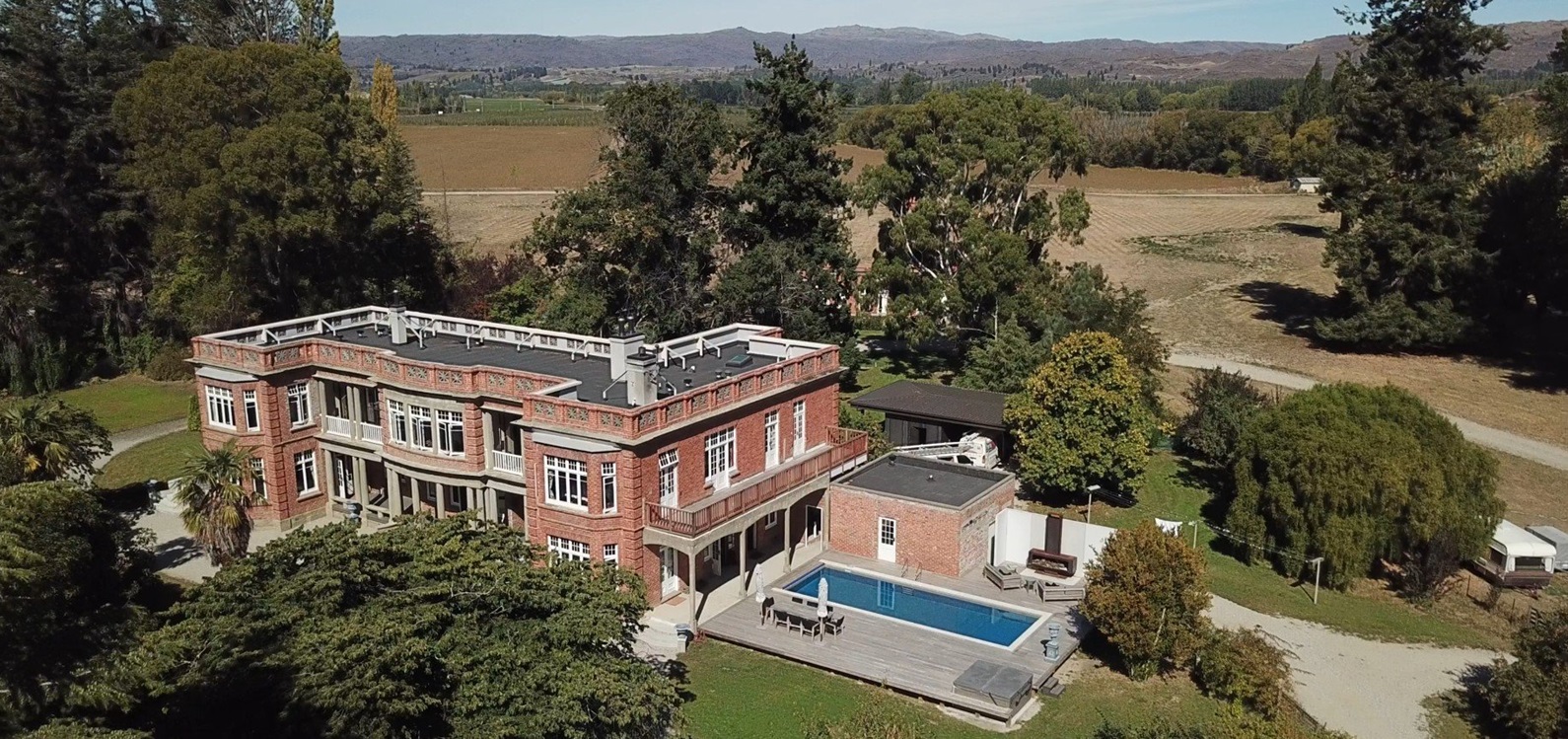
A combination of the Jacobean and Elizabethan styles popular at the time, the house was not officially a castle but dubbed one by locals.
Heritage New Zealand says the 21-room mansion was an "eccentric" design that had an imposing frontage but was just a room and-a-half deep.
Built after the 1918 influenza pandemic, it also highlighted Spain’s beliefs about the benefits of fresh air and sunlight: the first-floor bedrooms were accessed from open balconies instead of internal hallways, which must have been invigorating in winter.The property included servants’ quarters, a coach house and stables for Spain’s racehorses. The grounds, including a sweeping, tree-lined drive, were laid out by one of the country’s most influential landscape gardeners, Alfred Buxton.
Anscombe’s plans included a plastered facade and columns but, burnt by property speculation, the Great Depression and a market flooded with canned meat, Spain was unable to complete the building.
According to Heritage New Zealand, his display of "conspicuous consumption", and the fact the house was built on Crown leasehold land, quickly earned it the nickname "Spain’s Folly".
As the station’s fortunes faded, a deep rift reportedly tore through the family. After Spain’s death in 1940, his children and their spouses built a brick wall through the middle of the house, across the front verandah and out into the garden. This created separate living areas and kitchens, keeping contact between them to a minimum.
The current owners bought the Earnscleugh Station homestead and 12ha of land for $2.5m.
Early on, they decided Mr Creemers would move south to oversee the renovations while Mr Sanders would continue to run his multi-million-dollar tourism business from Auckland and commute to Central Otago twice a month. He eventually sold the touring side of his company to Intrepid Travel but continues to operate a chain of hostels and hotels under the brand name Haka House.
Mr Creemers, who left his job as projects director with one of New Zealand’s largest property leasing companies, says their first priority was renovating the coach house so they had somewhere to stay while working on the main house.
The homestead itself had 10 bedrooms but only three bathrooms. With the support of Heritage New Zealand, they revamped the first floor to make seven bedrooms, each with its own en suite.
They also removed internal walls on the ground floor, turning five former staff rooms into an open-plan kitchen and lounge.
The jobs were many and varied: insulating, electrical rewiring, reroofing with a "warm roof", restoring the decorative plaster ceilings, installing sprinklers, and stripping and staining the original woodwork — a mix of rimu, oak, oregon and redwood.
To honour the original design, they also opened up the first-floor balconies which a previous owner had closed in. However, a recessed glass wall with French doors now offers protection from the elements in winter.
The only remaining evidence of the Spain family feud was two bricked-up windows in the west wing and concrete between the exterior pillars — thought to be the remnants of the wall that went out into the garden.
While they removed the concrete, they left one window blocked up so that part of the story will live on for future generations.
Wanting to embrace imperfections and decorate in "faded glamour" style, the couple filled the house with embossed wallpapers, heavy floral curtains and antique furniture and lights imported from England and Europe.

"It’s a 1920s building and those properties had a lot of vibrant colour," Mr Sanders says.
"We didn’t want any white or beige walls."
The completed house includes an impressive formal dining room, a library with floor-to-ceiling timber shelving and a ballroom — once the Spains’ billiard room — which they plan to use for functions.
One of the biggest transformations took place in the entry, where they raised the ceiling above the central staircase and installed a 294kg French chandelier with 39 light bulbs.
To handle the weight and allow them to dust and change the bulbs easily, they also added a hoist in the ceiling.
The house will be heated by radiators, powered by a solar farm of 216 panels running a large heat pump and heat exchanger run off the Fraser River.
"Before, there were just electric heaters everywhere," Mr Creemers explains. "One chap who used to live here told me that they used to turn them on in March and off in November. They must have had big power bills."
Outside, they refurbished the dilapidated pool, added a terrace off the ballroom and rabbit-proofed the garden.
The "biggest drama" was their battle to be allowed to plaster the exterior of the house, as the architect originally intended.
A council heritage consultant said the unfinished look was part of the building’s heritage value and the bricks shouldn’t be covered.
While they eventually got consent and hope to make a start next summer, it delayed work by a year, cost them hundreds of thousands of dollars and caused a lot of stress.
"Before we decided that we were going to fight it, we were in a dark place."
"We thought we should maybe put it back on the market."
Because the property was always meant to be plastered, lower-quality bricks were used and the brick mortar was left rough and exposed to the weather, Mr Creemers says.
This has involved taking all the ceilings down and the architraves and skirting boards off and tying all the joists and rafters to the brick walls.
"Instead of installing rigid steel frames through the house, a more fluid system was used by bolting the brick walls to the internal timber structure.
"We also added carbon plates on the brick walls inside and plan to include carbon fibre mesh in the exterior plaster."
With the renovations costing about triple what they had budgeted, the previously mortgage-free couple now have a mortgage and have put retirement plans on hold. The three-bedroom coach house was opened to visitors last year and they’re preparing to welcome the first guests to the castle in September.
Offerings will include seven-day wellness retreats, complete with yoga, sound healing and vitamin infusions.
"We pretty much sold everything we had to fund our retirement — businesses, properties and stuff — to finish the house," Mr Creemers says, admitting they might not have started if they’d known this at the beginning.
Originally the property was just going to be their private home but they decided to run it as a bed and breakfast. Now they’re thinking of seeking consent to operate as a small hotel, which would allow them to have more than six guests in the main building.
"We did come into it having A, B and C plans ... We didn’t really think we’d end up using plan C but that’s life isn’t it? And we absolutely love living here."
More than 100 years after Spain built his stately home, the pair are pleased to have "finished the job" he started.
"From what I’ve read, it sounds like he was a bit of a rogue ...," Mr Creemers says, "but it [seems] like he was a good family man and into leaving a legacy".
"We have a lot of admiration for him because he was entrepreneurial. He turned something that was a problem into something that was very profitable and that’s clever."
Mr Sanders says they "couldn’t be more proud" of what they have achieved, adding the project was a four-year, "full-on" marathon.
"It was like sitting next to Liam Lawson, [riding] shotgun in a Formula One car with no roof, just holding on for dear life."


