
PHOTO

Whenever we have out of town visitors staying, I take them on an expedition to the Aramoana mole, at the mouth of Otago Harbour. There, without fail, we can see New Zealand fur-seals on the rocks basking in the sun. And, with luck, there will also be a New Zealand sea-lion hauled up on the sand of Spit Beach. A couple of times I have even seen a leopard seal there.
We in the South are fortunate to have such easy access to these marine mammals. Seals were a key source of protein for Māori, and a prime driver of early European exploration and colonisation of Aotearoa New Zealand. Overzealous hunting, however, meant these resources were soon almost exterminated.
Seals, or pinnipeds as scientists know them, are classified into three families. Fur-seals and sea-lions form the family Otariidae, the eared seals. There are 15 living species, which genetic research has shown are related to one another as shown in the diagram.
The second family comprises just one living species, the walrus. Adult walruses are instantly recognisable, having a pair of large tusks and extensive whiskers. They are confined to the Arctic and North Pacific Oceans.
The third family, the earless seals or Phocidae, has 18 living species. It includes the leopard seal and the even rarer (in New Zealand) southern elephant seal, the world’s largest seal.
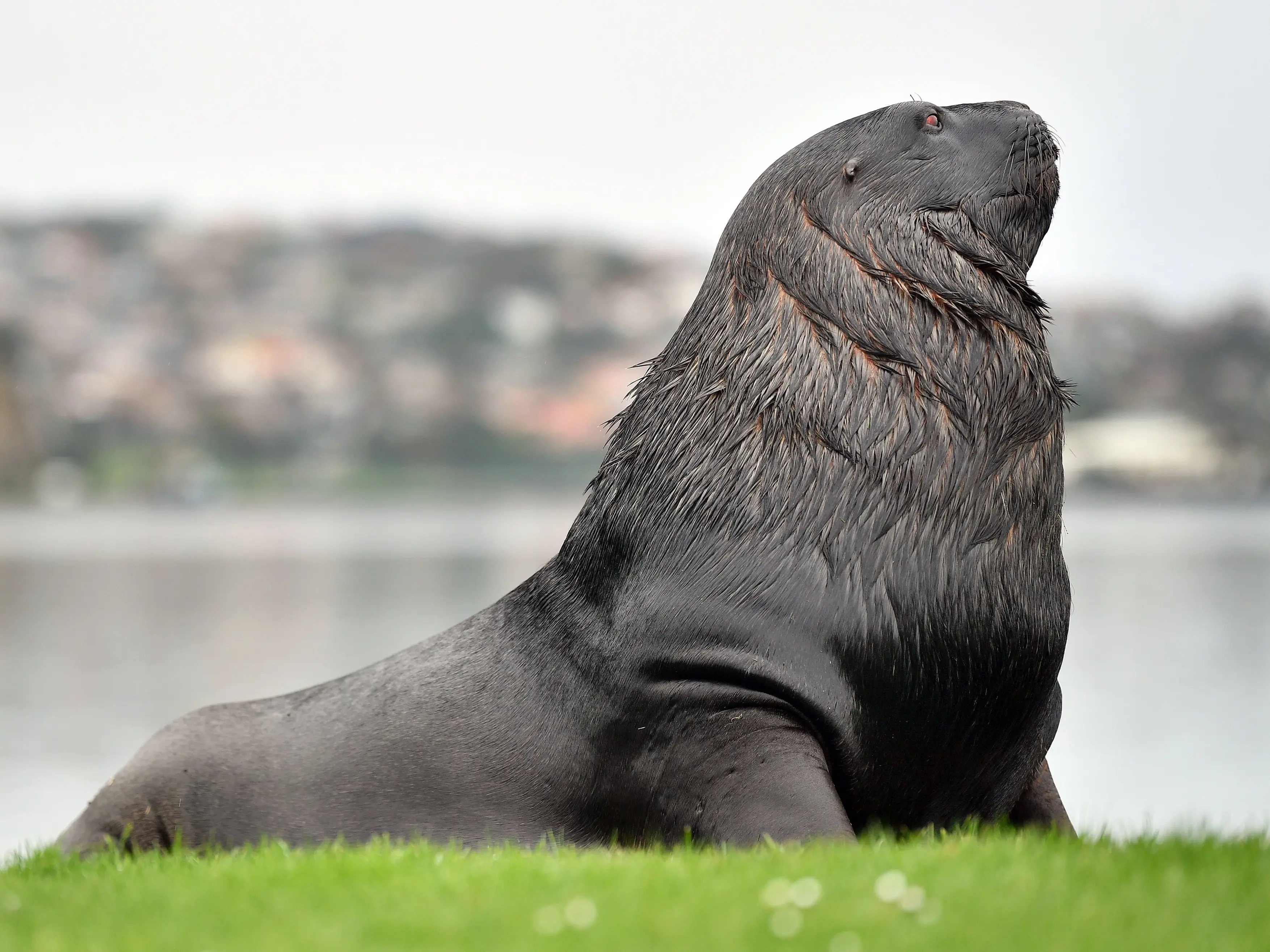
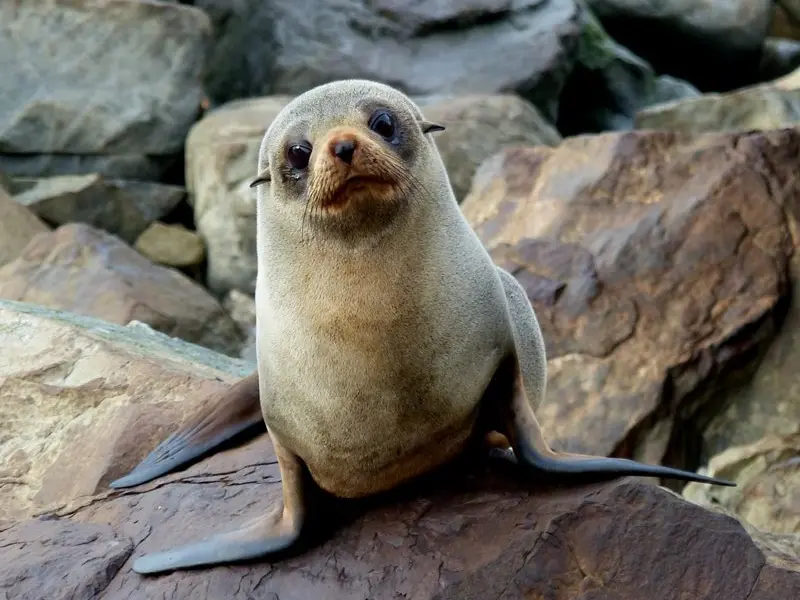
As their name implies, eared seals have visible external ears called pinnae, which you can see in the photographs. Of course, the earless seals actually do have ears, just not external pinnae.
The other obvious difference between eared and earless seals concerns their hind limbs. Fur-seals and sea-lions can rotate these limbs forward under their bodies, which allows them to walk easily on land. Earless seals, however, cannot do so and can look clumsy as they drag their rear flippers over the ground or ice.
The New Zealand fur-seal is known to Ngāi Tahu as kekeno and to scientists as Arctocephalus forsteri. The English name is somewhat of a misnomer because it occurs in southern Australia as well and is thus sometimes called the Australasian or Antipodean fur-seal. Numbers have recovered spectacularly over the past 50 years, and they are now fairly common on rocky shores around the South Island and the southern North Island.
The New Zealand sea-lion, pakake in Māori and Phocarctos hookeri to scientists, has not, however, bounced back from the impact of hunting so well. Also known as Hooker’s sea-lion, the species appears to be declining in its subantarctic stronghold in the Auckland Islands. Nevertheless, some have recolonised the Otago coast in the past 30 years or so, although numbers remain low.
The evolutionary tree in the diagram shows that the eight species of southern fur-seals, all in the genus Arctocephalus, are very closely related to three of the species of sea-lion, the New Zealand, Australian and South American.
Indeed, the data that underlie the relationships among these sea-lions and the different species of Arctocephalus imply that much of the diversification among these groups occurred very rapidly, between 2.5 and 3 million years ago. This explosive burst of evolutionary radiation is highlighted by the yellow box in the diagram.
This was a period of significant global cooling, with a consequent increase in plankton growth in the Southern Pacific Ocean. More plankton ultimately leads to more food for fur-seals, which would have allowed the establishment of new colonies. Subsequent adaptation to local conditions then produced new species.
You can see from the tree that kekeno are closest to the pair of the South American and Galapagos fur-seals. This divergence is even more recent, just over a million years ago, and represents a Pacific Ocean radiation.
The tree shows, too, that the ancestors of our pakake separated from those of the Australian sea-lion about 2 million or so years ago. Other estimates, using different data, suggest an older date, just under 5 million years. Whatever the case, much of the divergence among these eared seals is remarkably recent in evolutionary terms.
Sadly, the evolutionary tree is missing a species. The Japanese sea-lion was hunted to extinction just about 50 years ago. It was closely related to the California sea-lion and, poignantly, was only recognised as being a separate species after it became extinct. As Joni Mitchell sang in her environmental-protest song at about the same time, ‘‘You don’t know what you’ve got ‘til it’s gone’’.
Extinction of a species amounts to pruning a branch off the evolutionary tree, a branch that will never grow back. Our efforts to protect and nurture kekeno and pakake around Otago are thus aimed at keeping alive their branches in the evolutionary tree of eared seals.
- Hamish G. Spencer is Emeritus Professor in the Department of Zoology at the University of Otago.