

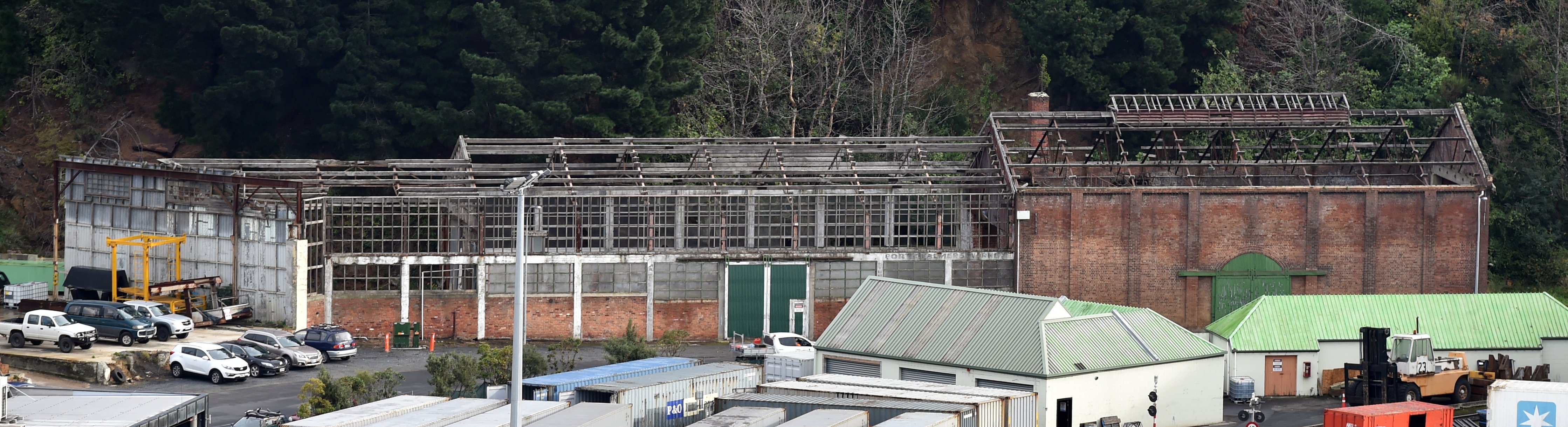
Anyone curious about what lies behind the big green doors of the historic Port Chalmers foundry building need only walk to the southern end and look in through the missing back wall.

Apart from that, it’s empty, with the dusts of time accumulating.
But in its day, it was a hive of activity in the port community.
The foundry building was constructed on the corner of Beach St and Macandrew Rd in 1880, and then about a decade later it was bought by partners Isaac Stevenson and John Cook, who ran an engineering company in it.
It quickly became a busy cluster of industry, with a dry dock, forge, moulding shop, boiler shop, smith’s shop, machine shop and plateyard, as well as offices and stores.

As well as undertaking some of the southern hemisphere’s biggest ship repair jobs, the company manufactured gold dredges for the Otago goldfields and constructed and fitted out ships for World Wars 1 and 2.
A major extension was added to the southern end of the building in the 1930s.
The Stevenson and Cook operation eventually ceased in 1958, due to diminishing workloads.
In their wake, Sims Engineering Ltd moved in, but it too eventually closed.

In March 2017, the asbestos roof and cladding were removed from the 1930s building extension.
And in June of 2025, it became a hive of activity again, as work began to prepare it for redevelopment.
The entire extension was demolished to allow for better access and make the redevelopment easier.

Initially, the site was earmarked to become a carpark until the Port Chalmers Foundry Society (PCFS) stepped in, driven by an alternative vision that celebrates history and invests in a creative future for Dunedin.
The DCC now has a memorandum of understanding with the PCFS, which has been fundraising and developing concept plans, to restore the building and convert it into a community venue.
The DCC is putting more than $700,000 towards the initial part of the restoration.


