
PHOTO
There is no crisis at Dunedin Hospital, and the Southern District Health Board still needs to clear its deficit, Prime Minister Bill English said in Dunedin yesterday in response to questions about ongoing health woes in Dunedin.
In urgent cases the board should send patients to other centres, even if it cost money, he said.
But when asked, he said he was not saying chief executive Chris Fleming could relax the stringent deficit elimination target.
"No. No. It’s up to the management to run the hospital, and meet the requirement to balance their budget, but in individual cases I would expect they take the steps they need to to ensure they get good care," Mr English told reporters.
High-profile cases include a woman who says her father died after his heart operation was postponed four times, and a group of prostate cancer patients waiting too long for surgery.
Asked if the hospital was in crisis, he said he had not "seen evidence that there’s a crisis".
Surprisingly, given publicity about a shortage of intensive care beds, Mr English did not seem well briefed on the $11 million redevelopment of the intensive care unit under way at Dunedin Hospital.
He emphasised to a group of retirement village residents in Mosgiel that spending money on the hospital was a "trade-off" because the much bigger redevelopment was in the works.
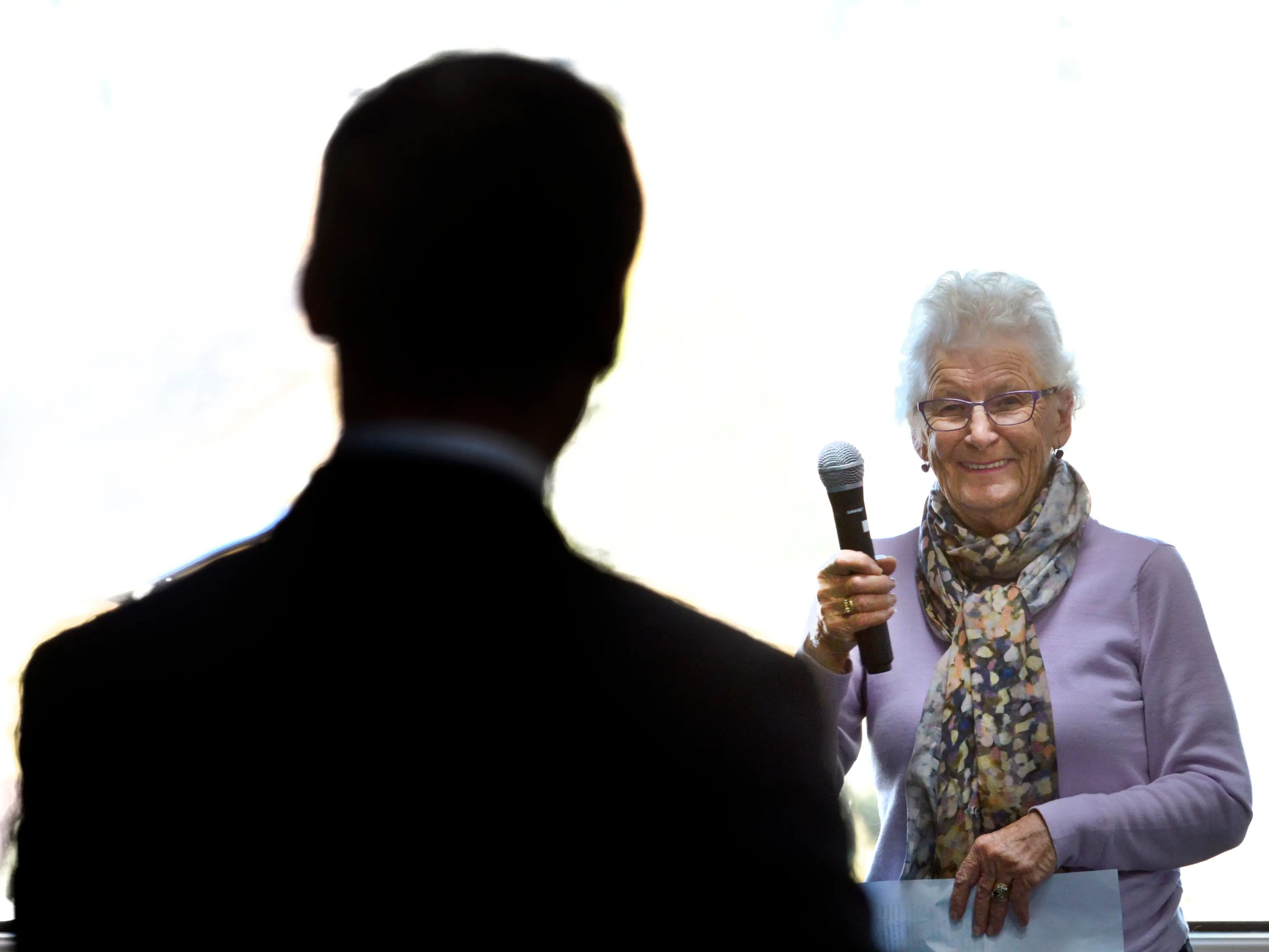
"There will be decisions about whether to spend money on the ICU now, which may be for a limited number of years but meets the need perhaps for more beds, if that’s there," he told residents.
An $11 million upgrade of the ICU got under way in June. It will open next year and is expected to relieve some pressure.
"If it’s started, I presume it’s going ahead, but I couldn’t comment in detail," he told the Otago Daily Times when asked to clarify.
The day’s most challenging questions were from two Chatsford Retirement Village residents: former National Party and now undecided voter Maureen Millichip, and retired farmer Bob Macfie (92).
Mrs Millichip said surgeons and anaesthetists waited nervously for phone calls cancelling scheduled operations.
She said Dunedin’s isolation made it difficult to transfer patients to other hospitals, and cited a case of a patient transferred to Auckland incurring airfares and accommodation costs. It cost almost as much as "another ICU bed in Dunedin", she said.
Mr English responded saying the Government put more money into health every year, and talked about the need not to spend too much on Dunedin Hospital when it is due for a rebuild. Afterwards, Mrs Millichip was not impressed.
"He didn’t say anything," she said.
She normally voted National, but was now undecided, she said. Mr Macfie took Mr English to task about the lack of a capital gains tax.
As a former landowner, Mr Macfie was uncomfortable about being subsidised by those who will "never own assets".
"I have benefited throughout my farming life by the absence of a capital gains tax."
Mr English said capital gains taxes were not always effective and were difficult to administer, but the Government had introduced the two-year "bright line" tax. Mr English’s speech to residents painted a rosy picture of the New Zealand economy, emphasising the flow-on effect to their superannuation entitlement.
Mr English also attended the Otago Medical Research Foundation lunch, at Forsyth Barr Stadium, before presenting the ODT Class Act awards. Later, he attended the Civil Contractors NZ conference, at the Dunedin Centre, and the Columba College Foundation launch.
No crisis?
• Urology under review because of wait times for treatment.
• Cardiac operations cancelled multiple times because of lack of intensive care beds.
• Ophthalmology dealing with aftermath of resource shortfall that caused dozens of patients to lose partial sight.
• Dunedin Hospital at risk of abrupt failure due to "crumbling" state, official assessment says.
• SDHB has break-even target of 2019-20; last year reduced the deficit by $11.5 million to $33.5 million.