

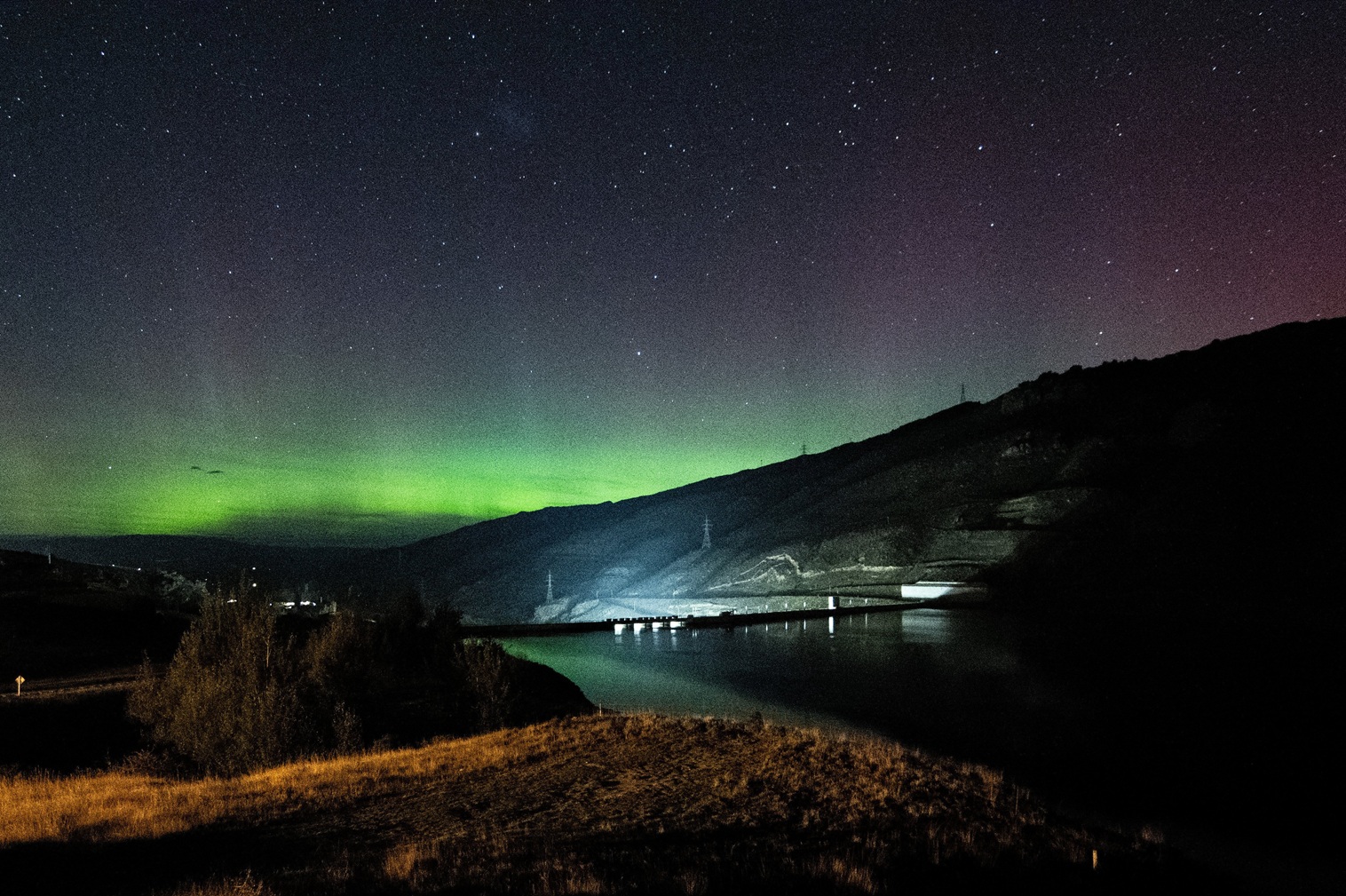
Dunedin astronomer and director of Tūhura Otago Museum Dr Ian Griffin said the radiation storm, which preceded the event, was very strong all afternoon and was "a good sign" that the skies would light up after dark.
But the big question was, would it hold out until darkness in New Zealand and would the skies be clear enough to see them?
While the forecast for Dunedin was quite cloudy, he was confident the skies would be clearer inland.
So he and other astrophotographers packed their cameras and headed to Central Otago.
Dr Griffin said the storm hit overnight in Europe first and family near London sent him photos of "beautiful red and green skies" in the northern hemisphere.
"This is something that's impacting the whole Earth."
Another "strong X1.2 solar flare" with its own CME was launched from the sun towards Earth early yesterday, prompting alerts from Nasa, the National Oceanic and Atmospheric Administration, and New Zealand’s National Emergency Management Agency (Nema).
Dr Griffin said it meant more aurora might be visible in southern skies for the next few days.
"There's a bunch of incoming stuff."
While rain was forecast for most of Otago, the skies above Southland were expected to be clear for most of the night.
The colourful phenomenon is caused by charged particles from coronal mass ejections of plasma colliding with gases like oxygen and nitrogen in the Earth's atmosphere.
That caused them to release energy in the form of light which created the colourful displays.
A severe geomagnetic storm could also affect power transmission lines, so Transpower and Nema said they were keeping a close eye on the storm and the electricity grid.
Transpower would sometimes remove South Island electricity transmission lines from service to prevent damage to critical equipment.
However, Nema believed this storm was unlikely to have any significant impacts.


