
PHOTO
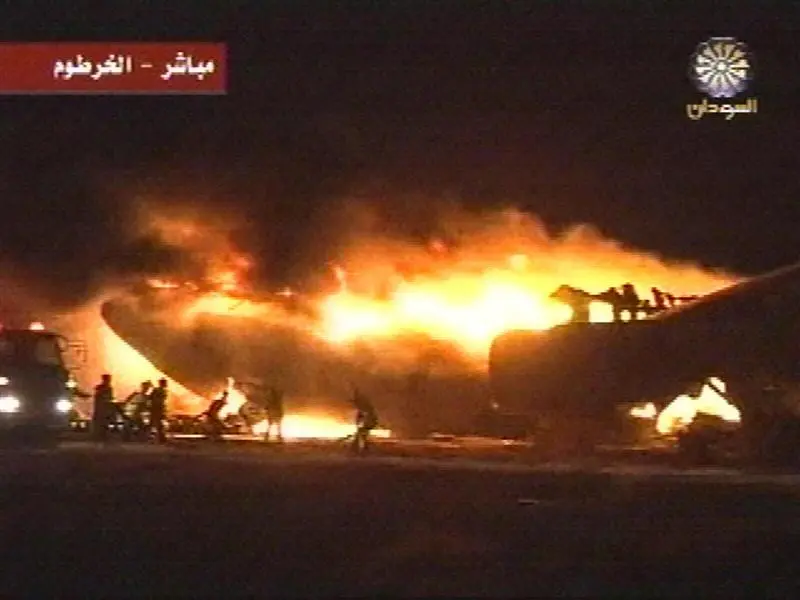
A Sudanese jetliner veered off a runway after landing amid thunderstorms in Khartoum and exploded into flames, killing scores of passengers on board.
Sudanese state television initially reported that as many as about 100 people were killed but deputy parliament speaker, Mohammed al-Hassan al-Ameen later said the death toll for the moment was "about 30 people." Al-Ameen provided no details.
Over 200 passengers were aboard the plane when it landed in bad weather and a higher casualty toll was feared. An Associated Press reporter at the scene said the plane was arriving from Amman, Jordan, and apparently left the runway as it landed in the Sudanese capital.
Ambulances and firetrucks rushed to the scene, but media were kept from closer access to the blaze.
Raqeeb Abdel-Latif, head of the Sudan Airways office in Damascus, Syria, said the plane was a Sudan Airbus A310 that joined the Sudanese national carrier fleet seven months ago.
It took off from Damascus with 203 passengers on board, mostly Africans and a few non-Sudanese nationals and 14 crew members. It stopped in Amman, where 34 additional passengers came on board.
The head of Sudanese police, Gen. Mohammad Najib, said bad weather "caused the plane to crash land, split into two and catch fire."
"We believe that most of the passengers were able to make it out and escape with their lives," said Najib, without disclosing further details on how they escaped.
But he stressed that officials could not say for sure how many were killed.
Youssef Ibrahim, director of the Khartoum airport, disputed that bad weather caused the crash. He told Sudanese TV that the plane had "landed safely" in Khartoum and that the pilot even talked to control tower and got his taxiway instructions.
"At this moment, one of the (plane's) engines exploded and the plane caught fire," Ibrahim said. "It's a technical reason," he added. He said there were survivors, but gave no figures.
Police spokesman Mohammed Abdel Majid al-Tayeb said five bodies have so far been pulled out of the wreckage, and that the front of the plane is totally damaged. Al-Tayeb said about 100 people were safe, and an unspecified number in hospitals.
"There are missing passengers who could be still inside the plane, or left the aircraft but did not inform officials that they were passengers," al-Tayeb added.
Flight attendant Sarrah Faisal, lying on a stretcher and wearing a plastic neck-collar told Sudanese TV, her voice shaking: "Thank God we were able to get all the passengers out." She gave no more details.
Maj. Gen. Fawzi Abdel-Raheem, director of police hospital was quoted by the TV as saying they didn't receive any dead, only one serious burn injury.
Spokesmen for the Federal Aviation Administration and the National Transportation Safety Board in Washington could not immediately provide any details of the incident, but said they were continuing to monitor the situation.
Sudan has a poor aviation safety record. In May, a plane crash in a remote area of southern Sudan killed 24 people, including key members of the southern Sudanese government.
In July 2003, a Sudan Airways Boeing 737 en route from Port Sudan to Khartoum crashed soon after takeoff, killing all 115 people on board.
After that crash, Sudanese officials blamed sanctions for restricting vital aircraft parts. The U.S. State Department said there was no ban on equipment needed for aviation safety.
In 1997, then U.S. President Bill Clinton issued an executive order barring the export of goods and technology to Sudan because of the country's "support for international terrorism, ongoing efforts to destabilize neighboring governments, and the prevalence of human rights violations."
In Washington, Sudanese Ambassador John Ukec Lueth Ukec said about 100 people were killed in the crash, which he said "will be investigated and we will find out what went wrong, whether it is a technical issue or human error."
He said that due to inclement weather, the aircraft stopped at Port Sudan Airport along the Red Sea picking up 35 passengers and refueling before heading to Khartoum, where the weather was bad.
Upon arrival the weather was "still very bad," said Ukec. "There was a lot of water on the runway and they still tried to land." He couldn't provide any additional details on the conditions of the runway.
The Airbus A310 is a twin-engine, widebody plane used by a number of carriers around the world. Typically configured with about 220 seats, it is a shorter version of the popular A300.