
President Donald Trump has castigated one of the United States' closest allies, comparing Prime Minister Sir Keir Starmer unfavourably to Sir Winston Churchill over Britain's limited support for US strikes on Iran.
"This is not Winston Churchill that we're dealing with," Trump said at the White House, referencing Starmer's legendary and revered World War 2 leader.
The Oval Office comments on Tuesday were Trump's third broadside against Starmer this week as Washington's campaign of air strikes against Iran stoked concerns among some US partners who see the war as reckless and a violation of international law.
Trump said neither the British military, nor its air bases, were involved in the initial US and Israeli strikes on Tehran that killed Iranian Supreme Leader Ayatollah Ali Khamenei on Sunday.
Trump and his aides have long scolded European allies over their immigration policies, lower-than-pledged military spending and hostility to far-right movements. And the president's often tepid support for Ukraine and his threats to seize the Danish territory of Greenland have raised fears in Europe about the stability of a transatlantic alliance facing growing threats from Russia.
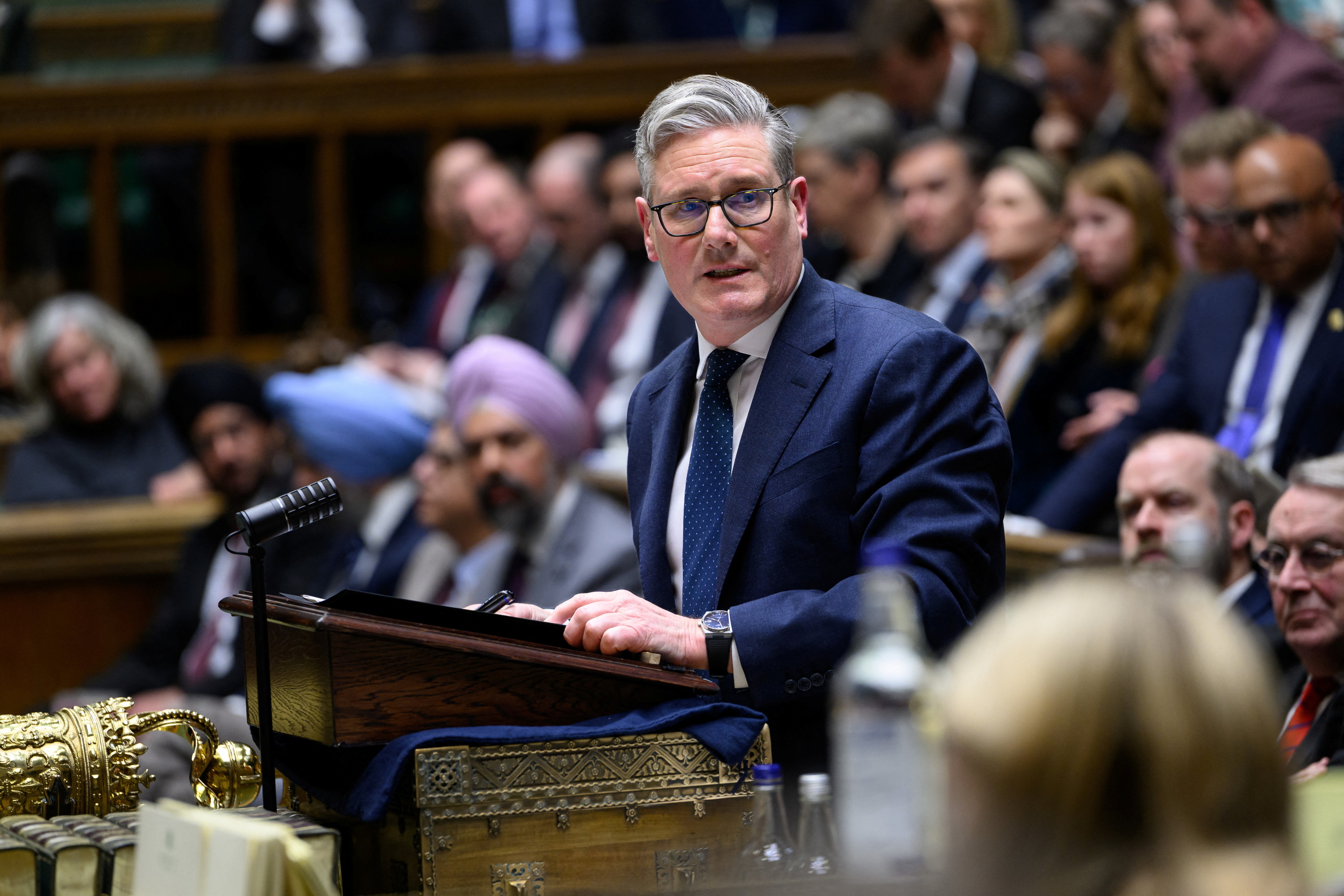
He told parliament on Monday he had to judge what was in Britain's national interest.
"That is what I have done, and I stand by it."
But he has since allowed the US to use bases in the UK to launch what he called limited and defensive strikes to weaken Tehran's capabilities, after Iran hit US allies in the region with drones and missiles. On Monday, a British base in Cyprus was hit by a drone that Cypriot officials said was likely launched by Iran-backed Lebanese group Hezbollah.
Polling published by YouGov on Tuesday showed people in Britain were opposed to the US strikes on Iran by 49% to 28%.
Senior minister Darren Jones said Britain had learned lessons from its involvement in the 2003 Iraq war, when it joined US action to remove Saddam Hussein, which was justified on false claims that the country had weapons of mass destruction.
"One of the lessons of Iraq was that it's better to be involved in these situations when you are aligned with international partners, and as I say, with a clear legal basis in the plan."
On Monday, a British base in Cyprus was hit by a drone that Cypriot officials said was likely launched by Iran-backed Lebanese group Hezbollah, prompting London to send a destroyer and more helicopters with counter-drone technology to the region.
Trump told reporters during a meeting in the Oval Office with German Chancellor Friedrich Merz on Tuesday that he was very disappointed with Britain.
He also criticised Starmer's decision to cede sovereignty of the Chagos Archipelago, home to the US-UK air base of Diego Garcia, saying they have "been very, very uncooperative with that stupid island".

TRUMP SAYS STRONGER PARTNERS IN EUROPE
Starmer has been criticised from all sides at home for his decision, with opponents on the left calling for him to condemn the military action while on the right, opposition leaders Kemi Badenoch and Nigel Farage attacked Starmer for failing to back Britain's key security and intelligence ally.
Britain has long prided itself on its relationship with the US, aided by British leaders such as Churchill, Margaret Thatcher and Tony Blair cultivating strong relationships with their counterparts, Franklin D. Roosevelt, Ronald Reagan and George W. Bush.
Starmer, a centre-left former lawyer, surprised his critics when he too struck up a solid relationship with Trump, but that has been tested in the last year as the US leader became more combative on a number of fronts.
Trump earlier told the Sun newspaper he never thought he would see Britain become a reluctant partner, instead heaping praise on France and Germany.
"This was the most solid relationship of all. And now we have very strong relationships with other countries in Europe.
"France has been great. They've all been great. The UK has been much different from others."
Britain, France and Germany released a joint statement in response to Iranian attacks on Saturday, saying they were in close contact with the US, Israel and partners in the region, and were calling for a resumption of negotiations.
THREAT TO CUT TRADE WITH SPAIN
Trump said said the US would cut off all trade with Spain after it refused to let the US military use its bases for missions linked to strikes on Iran.
"Spain has been terrible," Trump told reporters during a meeting with Merz, adding that he had told Treasury Secretary Scott Bessent to "cut off all dealings" with Spain.
"We're going to cut off all trade with Spain. We don't want anything to do with Spain."
The US relocated 15 aircraft, including refuelling tankers, from the Rota and Moron military bases in southern Spain after the country's Socialist leadership said it would not allow them to be used to attack Iran.
Trump again referenced Spain's refusal to heed US calls for all NATO members to spend 5% of their GDP on defence, and added: "Spain has absolutely nothing that we need."
Bessent said he would instruct the US Trade Representative and the Department of Commerce to begin investigations into how to penalise Spain.
Although the Supreme Court last month struck down Trump's ability to use the International Emergency Economic Powers Act to impose broad global tariffs, the president said the decision "totally reaffirmed" his ability to impose a full trade embargo under the law.
The Act, passed in 1977, has been heavily used for sanctions to cut Iranian, Russian and North Korean entities out of the US dollar-based financial system and to impose licensing requirements to control or halt exports of sensitive technologies to certain countries.
The Spanish government responded in a statement that the US must be mindful of the autonomy of private businesses, international law and bilateral trade agreements between the US and the European Union.
Madrid said it had the necessary resources to contain the potential impact of a trade embargo and support affected sectors, but said it would continue to push for free trade and economic cooperation with its partners.
Spain is the world's top exporter of olive oil and also sells auto parts, steel and chemicals to the US but is less vulnerable to Trump's threats of economic punishment than other European nations.


