

The escalation came as the powerful son of Iran's slain supreme leader emerged as a frontrunner to succeed him, suggesting Tehran was not about to buckle to pressure, five days after the US and Israel launched a military campaign that has killed hundreds and convulsed global markets.
The missile incident is the first time that Turkey - which borders Iran and has NATO's second-largest military - has been drawn into the conflict, but US Defense Secretary Pete Hegseth said there was no sense that it would trigger the Atlantic alliance's collective-defence clause.
In a sign of the conflict's expanding reach, Hegseth said the US submarine strike hit an Iranian vessel off Sri Lanka's southern coast, thousands of kilometres from the Gulf, as fighting paralysed shipping through the Strait of Hormuz for a fifth day, choking off vital Middle East oil and gas flows.
Meanwhile, a tanker at anchor off Kuwait has reported seeing a large explosion on its port side and was taking on water, the United Kingdom Maritime Trade Operations said.
The master observed a small craft leaving the area following the explosion, which occurred 56km southeast of Kuwait's Mubarak Al Kabeer port in the Gulf, UKMTO said.
"There is oil in the water coming from a cargo tank which could have some environmental impact, the vessel has taken on water, there are no fires reported and the crew are safe," it said in an advisory note.
Kuwait's interior ministry said in a later statement that the incident happened outside the country's territorial waters, at least 60km from Mubarak Al Kabeer port.
US President Donald Trump has pledged to provide insurance and naval escorts for ships exporting energy from the region to contain soaring costs, with oil prices still stuck on Wednesday at their highest in more than a year.
But at least 200 vessels remain anchored off the coast, according to Reuters estimates.
'NOT A FAIR FIGHT'
The US and Israel pressed on with their round-the-clock assaults on Iran, with Hegseth saying the US was winning the conflict.
"This was never meant to be a fair fight, and it is not a fair fight. We are punching them while they're down," Hegseth, sounding supremely confident, said at a briefing at the Pentagon. "We can sustain this fight easily for as long as we need to."
By contrast, Iran is firing fewer missiles, signalling its military capabilities are greatly diminished, said Dan Caine, the chairman of the US Joint Chiefs of Staff.
Reflecting that, the Israeli military said it was easing public safety instructions across Israel on Thursday through Saturday, allowing businesses to open as long as they were at a close enough distance to shelters and other protected areas while keeping schools closed.
The Israeli military said its aircraft had struck a compound in eastern Tehran housing all Iran's security bodies, including the Republican Guard, intelligence, cyber warfare and internal police in charge of cracking down on protests.
Israel also told residents to leave a swathe of southern Lebanon on Wednesday as it presses its assault on the Iran-backed group Hezbollah, which has again dragged Lebanon into conflict by firing drones and rockets into Israel on Monday.
A fall in global markets turned into a rout in Asia, including a record-breaking crash in Seoul, as some investors were unconvinced by Trump's assurances he would quickly reopen the world's most important shipping corridor.
European markets later stabilised and turned higher after two days of sharp losses, while US stocks closed up on Wednesday, on hopes that the war might end soon. Some traders said the improved sentiment followed a New York Times report that Iranian intelligence had reached out to the CIA early in the war about a path towards ending it.
A source from the Iranian intelligence ministry rejected the article as "absolute lies and psychological warfare in the midst of war", Iran's semi-official news agency Tasnim reported.
US SUBMARINE SINKS IRANIAN SHIP
US Central Command said in a statement it had "struck or sunk to the bottom of the ocean" more than 20 Iranian ships, including the warship sunk off Sri Lanka in the first such action by an American submarine since World War 2.
A Sri Lankan official identified the boat as the frigate IRIS Dena, saying it had been heading back to Iran from eastern India. Local authorities said 32 people had been rescued while 87 bodies had been recovered. About 60 sailors were unaccounted for from the estimated 180-strong crew.
"An American submarine sunk an Iranian warship that thought it was safe in international waters," said Hegseth. "Instead, it was sunk by a torpedo. Quiet death."
Despite voicing misgivings about the war on Iran, some European nations found themselves drawn militarily into the Middle East to safeguard their citizens and strategic interests.
Britain and France said they would use naval and air forces to help defend against Iranian retaliation. Greece has also moved aircraft and warships to nearby Cyprus.
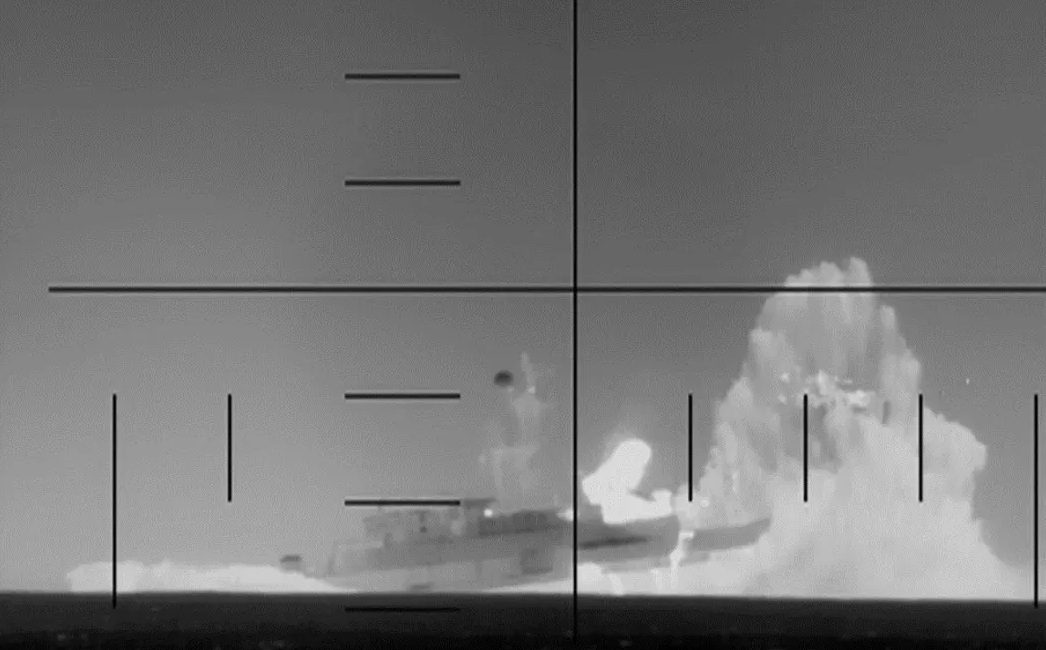
A Pentagon video purporting to have captured the attack showed the warship being hit by a huge explosion which blew apart the rear of the vessel, lifting it from the water, and caused it to begin sinking from the stern.
The exact date when the video was filmed and the type of warship could not be verified. However, the deck shape and mast of the vessel in the video matched file imagery of the same type of warship as the IRIS Dena.
The Iranian vessel had taken part in a naval exercise organised by India in the Bay of Bengal from February 18 to 25, according to the drill's website.
Sri Lanka said it had launched a search-and-rescue operation to locate survivors after receiving a distress call. Navy spokesman Commander Buddhika Sampath said boats that reached the location observed only an oil slick, adding that although the incident took place outside Sri Lankan waters, Colombo was still committed to providing support.
"We found people floating in the water and rescued them," Sampath told reporters. "Later on, we found upon inquiring that they belonged to the Iranian ship."
Rescuers brought bodies, covered in white sheets, in batches in a truck to the Karapitiya hospital in Galle where they were moved to the morgue. The commander of the warship and some senior officers were among the survivors and they told the Sri Lankan navy that they were hit by a submarine attack, two Sri Lankan sources told Reuters.

MOJTABA KHAMENEI NOT IN TEHRAN WHEN FATHER KILLED
As new explosions rang out in Tehran, plans were in doubt for a funeral for the elder Ayatollah Ali Khamenei, 86, killed by Israeli forces on Saturday in the first assassination of a nation's top ruler by an airstrike.
The body had been expected to lie in state in a vast Tehran mosque from Wednesday evening, but Iran announced that three days of farewell ceremonies had been indefinitely postponed and no funeral date has been announced.
Two Iranian sources, speaking on condition of anonymity, told Reuters that Mojtaba Khamenei, son of Iran's slain supreme leader, was not in Tehran when his father was killed.
Iran said the Assembly of Experts that will select the new leader would announce its decision soon, only the second time it will have done so since the Islamic Republic's founding in 1979.
Assembly member Ayatollah Ahmad Khatami told state TV the candidates had already been identified but did not name them.
Israel said it would hunt down whoever was chosen.
Other candidates for supreme leader include Hassan Khomeini, grandson of the Islamic Republic's founder and a champion of the reformist faction sidelined in recent decades.
The favourite, however, appears to be Mojtaba Khamenei, who has amassed power as a senior figure in the security forces and the vast business empire they control, the Iranian sources said. Choosing him would signal that hardliners remain in charge.
Some Iranians have openly celebrated the death of the supreme leader, whose security forces killed thousands of anti-government demonstrators only weeks ago in the biggest domestic unrest since the era of the revolution.
But Iranians angry with the government said there was unlikely to be much sign of protest while bombs are falling.
"We have nowhere to go to protect ourselves from strikes, how can we protest?" Farah, 45, said by phone from Tehran, adding the security forces "are everywhere. They will kill us. I hate this regime, but first I have to think about the safety of my two children."


