
PHOTO
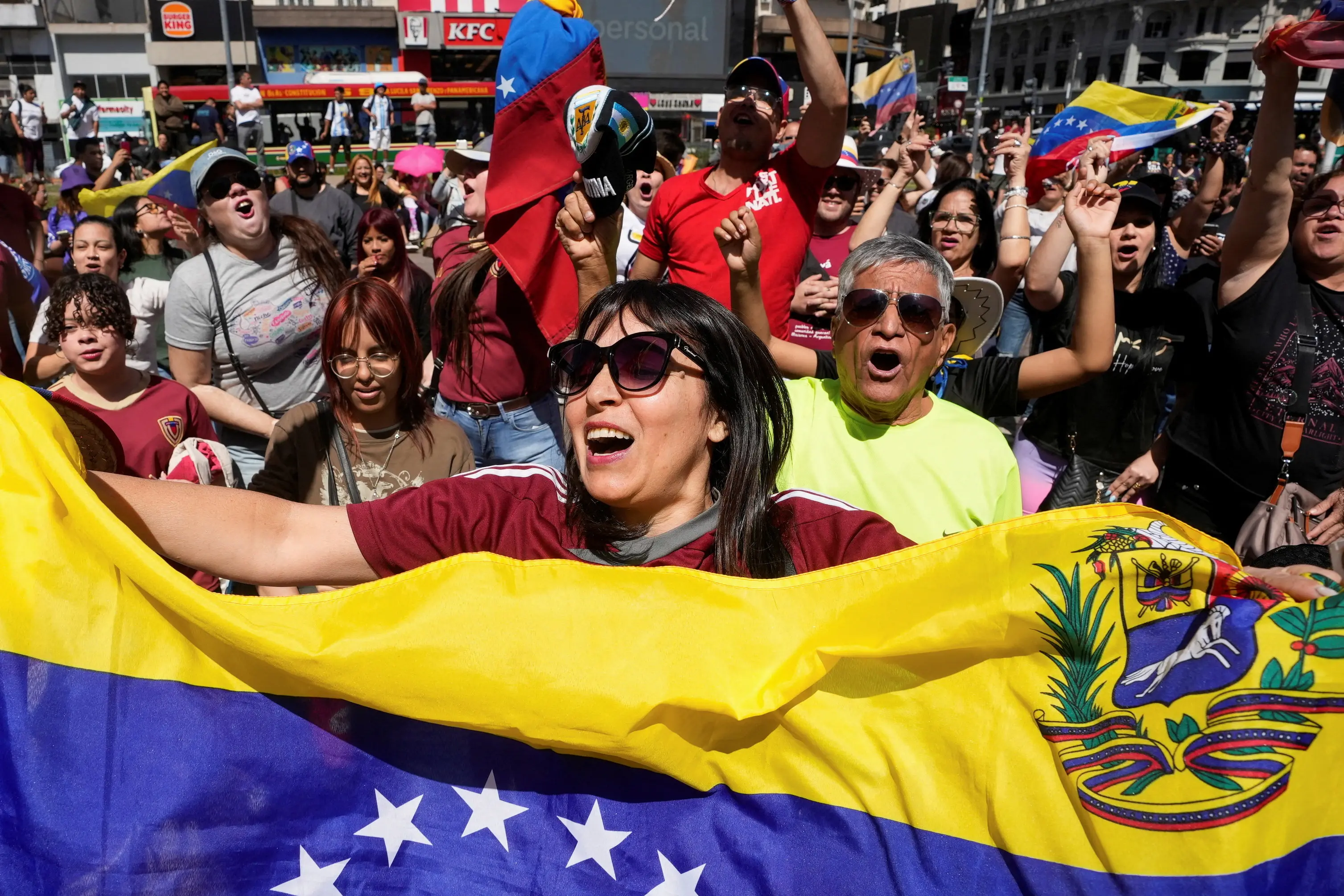
Venezuelan migrants around the world are celebrating following the US-led deposition of President Nicolas Maduro, whose government oversaw one of the world's largest migration exoduses in recent history.
Chants celebrating Maduro's capture on Saturday were heard in the streets of Chile's capital, where Venezuelans gathered to share their joy.
"We are free. We are all happy that the dictatorship has fallen and that we have a free country," said Khaty Yanez, a Venezuelan woman who has spent the last seven years in Chile.
"My joy is too big," her compatriot Jose Gregorio said. "After so many years, after so many struggles, after so much work, today is the day. Today is the day of freedom."
Since 2014, some 7.7 million Venezuelans or 20% of the population have left the country, unable to afford food or seeking better opportunities abroad, according to the United Nations International Organisation for Migration.
Neighbouring Colombia has received the largest share of the diaspora, with around 2.8 million Venezuelans, followed by 1.7 million in Peru, according to the R4V platform, a group of regional NGOs assisting migrants and refugees from Venezuela set up by the UN migration agency.
In Peru's capital Lima, dozens of Venezuelans gathered, many wrapped in their country's flag, to mark Maduro's deposition.
Venezuelan migrant Milagros Ortega, whose parents are still in Venezuela, said she hoped to go back.
"Knowing that my dad was alive to see the fall of Nicolas Maduro is very emotional. I would like to see his face," she said.
Peruvian President Jose Jeri said on X that his government would facilitate the immediate return of Venezuelans, regardless of their immigration status.
For years, the United States was a haven for Venezuelans but many were branded criminals and forced to seek refuge elsewhere during President Donald Trump's second term.
In Spain, thousands of people gathered at central Madrid's Puerta del Sol and applauded as they watched Trump's press conference live.
In the afternoon, groups of Venezuelans were expected to gather to celebrate in Argentina's capital Buenos Aires.
But Venezuelan officials condemned Saturday's intervention. "In the unity of the people we will find the strength to resist and to triumph," Defence Minister Vladimir Padrino said in a video message.

Trump says US will run country
Maduro was sworn in for a third term in January last year following a 2024 election widely condemned as fraudulent by international observers and the opposition. Thousands of people who protested against the government's declaration of victory were jailed.
US President Donald Trump on Saturday promised to put Venezuela under American control for now, including by deploying American forces if necessary.
"We're going to run the country until such time as we can do a safe, proper and judicious transition," Trump said during a news conference at his Mar-a-Lago resort in Florida.
"We can't take a chance that someone else takes over Venezuela who doesn't have the interests of Venezuelans in mind."
It is unclear how Trump plans to oversee Venezuela. Despite a dramatic overnight operation that knocked out electricity in part of Caracas and captured Maduro in or near one of his safe houses, US forces have no control over the country itself, and Maduro's government appears to still be in charge.
Trump's comments about an open-ended presence in Venezuela echoed past leadership changes in Iraq and Afghanistan, both of which ended in US withdrawals after years of occupation. He said he was open to the idea of sending US forces into Venezuela.
"We're not afraid of boots on the ground," he said.
Trump did not provide specific answers to repeated questions from reporters about how the US would run Venezuela.
Trump said US Secretary of State Marco Rubio had been in touch with Venezuelan Vice President Delcy Rodriguez - Maduro’s presumptive successor.
"'We'll do whatever you need,'" Trump quoted Rodriguez as saying. "She really doesn't have a choice."
The removal of Maduro, who led Venezuela with a heavy hand for more than 12 years, potentially opens a power vacuum in the Latin American country.
Any serious destabilisation in the nation of 28 million people threatens to hand Trump the type of quagmire that has marked US foreign policy for much of the 21st century, like the interventions in Afghanistan and Iraq.
The US has not made such a direct intervention in its backyard region since the invasion of Panama 37 years ago to depose military leader Manuel Noriega over allegations that he led a drug-running operation. The United States has levelled similar charges against Maduro, accusing him of running a "narco-state" and rigging the 2024 election.
Maduro, a 63-year-old former bus driver handpicked by the dying Hugo Chavez to succeed him in 2013, has denied those claims and said Washington was intent on taking control of his nation's oil reserves, the largest in the world.
Throughout his career, Maduro was often flanked by his wife, Cilia Flores, who held numerous high-ranking positions, including attorney general and chief of parliament, and was often seen as a power broker with as much influence as her spouse.
Trump said on Saturday Flores was also captured and flown out of the country.
Speculation about future
After the initial joy, doubts about Venezuela's future also set in, as Venezuelans abroad wondered what the future would hold for their country and its citizens.
Andres Losada, who has lived in Spain for three years and is among the 400,000 Venezuelans residing in the country according to official data, said he is struggling between worry and joy about the situation in Venezuela.
"Although what people are going through in Caracas is tough, I believe that beyond that there is a light that will lead us to freedom," he added.
Venezuelan security forces patrolled largely empty streets at dawn in the capital, Caracas, on Saturday. Most residents stayed home, devouring the latest information on their phones, while some went to stock up on groceries in case they need to hunker down for a prolonged period.
Speaking to a local TV station in Spain, Agustin Rodriguez, the vice president of a Venezuelan cultural association, expressed concern about the strikes but said they "may be necessary to find a way out for the country in which there can be a return to power alternation, where there can be a future."