

Relocating the cemetery, which now sits only 20m from the sea, is one recommended option.
The cemetery is one of 12 “high-risk” coastline areas across the district threatened by erosion and possibly requiring about $146 million to shore up over the long term, a report by specialist engineers Beca states.
The costs in the report — first published two years ago and again brought before the new council this week — were described as “scary” by the council’s chief executive.
Beach Rd, another high-risk area highlighted, has been closed off since last year, much to the consternation of the local community.
The 2024 report, which uses 2019 climate change projections for the Otago region, said sea levels and wave heights were expected to increase, along with erosion rates, threatening critical infrastructure, community assets and places of deep cultural significance.
Any “ad-hoc, site-by-site” decision-making could “expose ratepayers to escalating costs and erode community confidence”, a staff report prepared for Tuesday’s council workshop said.
It argued for a “consistent framework” to the issue.
Without a consistent approach, future ratepayers faced “escalating” financial liability, it said.
Communities would be left “uncertain” about how the council planned to address the issue.
“Despite the evidence base developed through the Beca report in 2024, council has not yet adopted an investment decision-making framework to guide how it responds to coastal hazards,” the staff report said.
During the workshop, council policy lead Victoria van der Spek said it was “really difficult” to give time-frames regarding coastal erosion but there were “trigger points” and elected representatives needed an “agreed position on what we're going to do”.
No decisions were made at the workshop, the first of three, but councillors agreed to use the Beca report to develop a wider framework.

A coastline of 10m high exposed cliffs had eroded to the extent that it sat about 20m from the cemetery boundary, and the embankment “will continue to erode during storm events”, the 2024 Waitaki Coastal Hazard Strategy report from Beca stated.
An option, recommended in the 2024 report, of relocating Hampden Cemetery as part of a “managed retreat” approach could cost about $2m.
The Beca report stated that closing Beach Rd and instead using Stonewall Rd and Thousand Acre Rd as the main road into Kakanui, along with creating a shared path for walking and cycling on the undamaged road, would cost $1m.
This option cost significantly less than the $12.3m required to create a new 3km road set back from potential erosion.
‘Scary’ costs
The Beca report did not state who should be responsible for funding and it is unclear at this stage what the council would fund.
Council chief executive Alex Parmley said the costs in the Beca report were higher than water infrastructure investments — “so it’s quite scary”.
He said there would be an expectation from some parts of the community for the council to “defend all of the coast”, adding that other councils — including on the west coast — were “taking action”, giving opportunities for whole communities to move.
The chief executive added that this would come at a “big cost” and was part of a wider piece of work about what councils “can afford to do”.
Costs could be even higher due to the rate of inflation since the report was published.
The cost of coastal erosion
Elsewhere in the Beca report, options put forward by the consultant included rebuilding Oamaru’s wastewater treatment plant behind potential coastal erosion lines, which could cost about $80m.
Building coastal defences along a 2.1km stretch to protect the KiwiRail Yard, southern railway line and Orwell St wastewater pump station could cost $22.7m over its 50-year design life.
The site is “adjacent to the heart of the Oamaru township, housing not only the aforementioned infrastructure but also numerous commercial operations that support the local economy”.
This was preferred to moving the rail line to the other side of Oamaru and constructing a new rail yard and depot — at a cost of hundreds of millions.
“The existing KiwiRail Main South Line is at risk without intervention across the full length of this site. This area of coastline is directly adjacent to the heart of the Oamaru township, housing not only the aforementioned infrastructure but also numerous commercial operations that support the local economy and the Ara Institute of Canterbury Oamaru Campus.”
A stretch of the coastline adjacent to the Oamaru Showground and Waitaki Boys High School “is currently unprotected and in places large erosion scarps are presenting erosion risk to buildings” and the Regina Lane wastewater pump station, the report stated.
Filling eroded embankments in front of infrastructure, relocating the wastewater pump station and loss of property could cost about $11.6m.
‘Significant cultural importance’
The report also highlighted that the Moeraki Kaik and Urupā, “of significant cultural importance”, was within both erosion and inundation zones.
“Coastal hazards pose threats to urupā, wāhi pakaka, pā and tauraka waka values. The main site hazard at the Moeraki Kaik and Urupā is both coastal erosion and inundation. There are two small settlements both with properties that extend to the beach foreshore,” the report stated.
The report added that the three options, moving the community inland, building a seawall and ad hoc relocations, could cost about $5m and benefit from input from the community.
Native dunes and a new SH1 detour
Planting of native dune grasses and putting in coastal protections along the northern stretch of Katiki Beach could cost $8m, while a similar figure is required for the southern stretch.
Upgrading Seadown and Fortification Roads at Beach Road South could cost about $2.4m.
Closing Waianakarua Rd and creating a new State Highway 1 detour including Woodburn, Claireview, Falconers and Robertson Rd, widening 8.3km of road in total, could cost roughly $5.3m.
Tuesday was the first of three workshops to be held by the council, by the end of which elected representatives should have agreed a “coastal investment decision-making framework” and develop an overall strategy for high-risk sites.
“The question facing Waitaki District Council is not whether to act, but how to act wisely — on behalf of today’s communities and the generations that will follow,” the staff report said.
Options assessed
At each site, a minimum of three options were evaluated by Beca:
Status quo — continuing current practice, ranging from do-nothing monitoring through to ongoing emergency rock placement.
Rock revetment (or equivalent hard engineering) — a designed coastal protection structure placed at the toe of the cliff to defend against wave action and erosion.
Managed retreat — the planned relocation of infrastructure, assets or communities away from the coastal hazard zone.
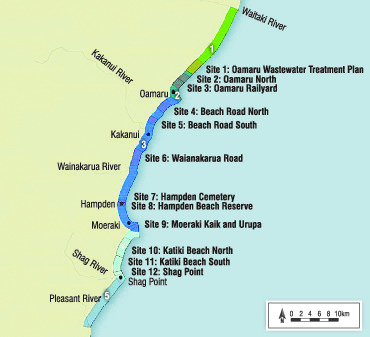
The twelve high-risk coastal sites identified in the 2024 report:
• Oamaru Wastewater Treatment Plant
• Oamaru North
• Oamaru KiwiRail Yard
• Beach Road North
• Beach Road South
• Waianakarua Road
• Hampden Cemetery
• Hampden Beach Reserve
• Moeraki Kaik and Urupā
• Katiki Beach North
• Katiki Beach South
• Shag Point Road


