
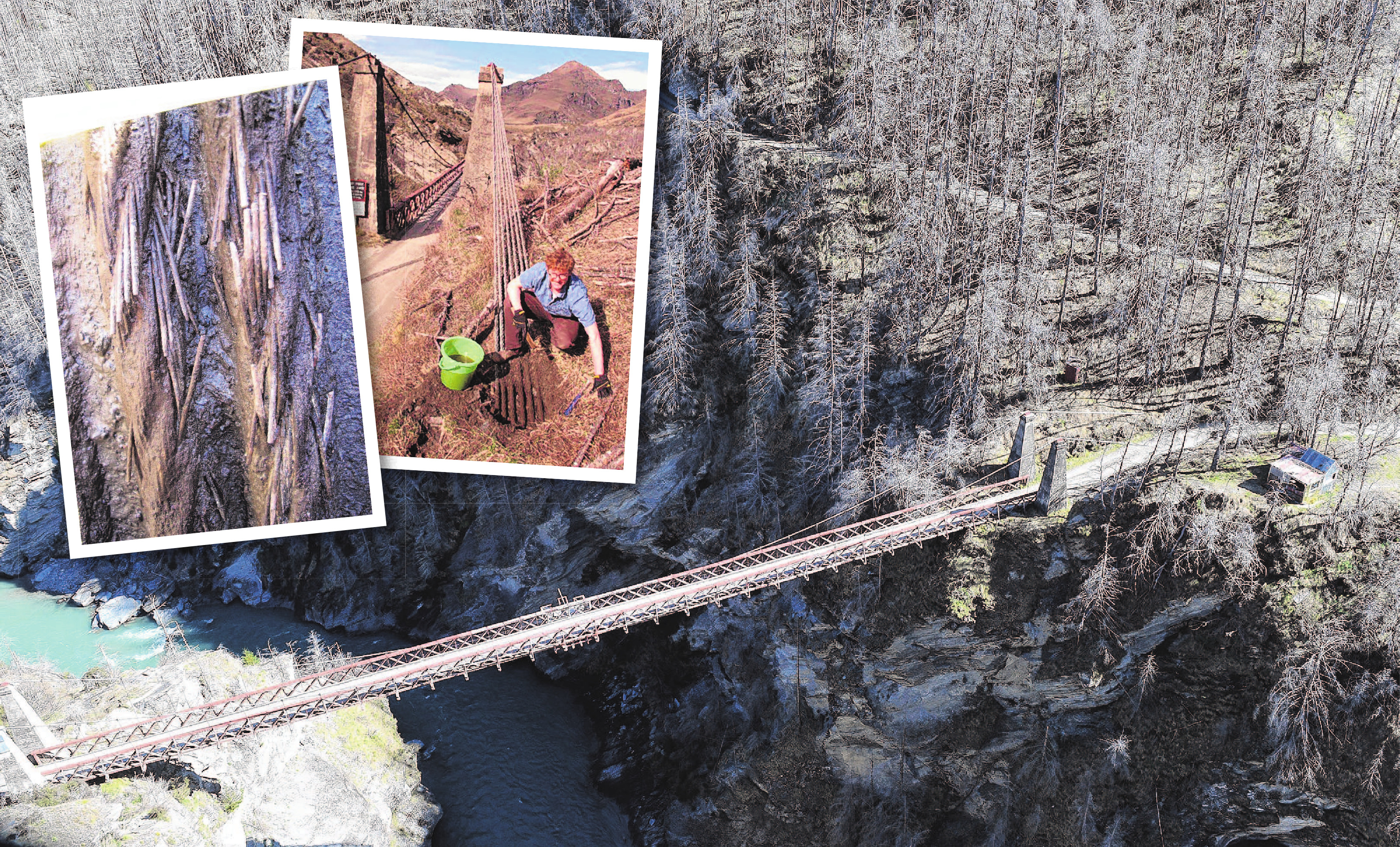
Skipper Bridge — which was built in 1901 and is New Zealand’s highest suspension bridge — has been closed to all vehicles, cyclists and motorists until further notice due to the risk of the bridge failing.
The bridge links Queenstown to Skippers Valley and the Mount Aurum Recreation Reserve.
Yesterday, Queenstown Lakes District Council released an engineering report which detailed a raft of issues.
The report by Stantec New Zealand said there was an "extensive brittle failure" of the wires, which meant engineers were unable to test and confirm what the load capacity would be.
"Load testing will not necessarily prove the capacity of the bridge, because of the risk of unpredictable brittle failure of the cables.
"[Also], there is a risk of load testing causing a catastrophic collapse."
There had been concerns for some time about the condition and remaining life the bridge would have.
The report revealed that there was "significant" damage to the wires on the true left and upstream section of the bridge, the only section where cables are both buried and pass over a roll plate.
The wires in this section showed cracking and rust. However, other sections appeared to be largely fine.
Of the seven cables, four were estimated to have between 50% to 60% section loss, and the others had about 30%.
Cable damage was believed to have been caused by stress corrosion cracking — due to a combination of tension stress and a corrosion to the metal.
The cracking could lead to sudden and catastrophic collapse of the bridge, the report said.
The report recommended the underground wires needed to be exposed as much as possible to confirm the extent of the damage, and to decide whether the bridge could be repaired for use.
"The existing cables cannot be either replaced or adjusted as the cables are bundled together and secured directly to the anchorage beneath the ground."
The council also needed to consider the seismic and geotechnical risks.
Currently, the approach to the bridge was under constant maintenance, and the report said they could continue this, but it would come with a hefty price tag.
About $62,000 is spent annually on maintenance of the bridge, but significantly more will be needed to keep it open to traffic over the next 20 years.
The largest cost would be replacing the trusses, and costs would reach into the hundreds of thousands of dollars, the report said.
"We ... think that it is unlikely that building consent would be granted for a replacement structure because of the potential instability of the foundations and the requirements of the modern New Zealand Building Code."
Closing the bridge for vehicle access left very few places to establish a carpark, would impact multiple tour operators and foot access would be difficult due to the steep terrain.
Other options included building a new bridge,
However it would be implausible to build it in the current location, and it would need to be constructed in the old location downriver.
The bridge would need to be 100m wide and extensive re-working of the road would be needed.
The future of the bridge would be decided by elected members through the annual planning process, with community consultation on the draft plan expected to begin in March.


