
PHOTO
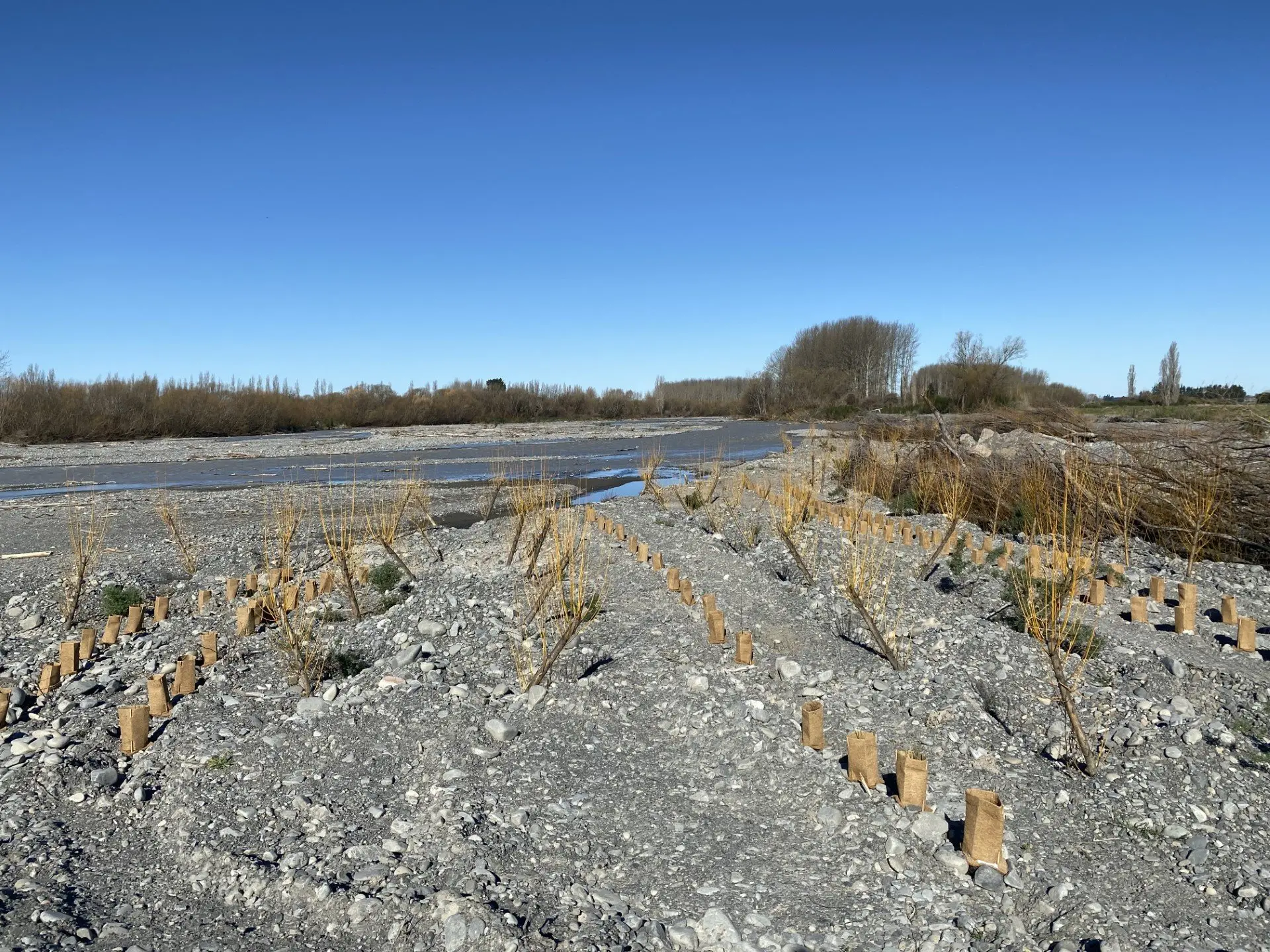
Environment Canterbury has successfully undertaken one of its biggest seasons of willow planting in history.
In an effort to protect South Canterbury rivers from flooding close to 50,000 willow poles were planted this season.
In a normal pole-planting season only about 10,000 to 15,000 are planted but with significant flooding events in recent years, a larger effort was needed this season.
Poles are young tree stems which are older and more robust than just seedlings.
When mature, the willow trees will play an important role in flood protection and helping to strengthen the region’s rivers in the face of climate change.
River works supervisor Ben Macleod said willows were fast growing and their dense root structures protected bare soil from erosion and stabilised the riverbank.
"Willows act as a buffer, slowing water flow and protecting the river edge from the full brunt of the current.
"They remain one of the most reliable options for stabilising banks in erosion-prone areas or where flooding poses a significant threat."

Mr Macleod said it had been the biggest planting year for more than a decade.
"We had one year where we did 33,000 and this has blown that out of the water, not just in terms of numbers but also logistically.
"Along with our own people, at one point we had six or seven local contractors working across all our sites. It’s been an amazing team effort from start to finish."
Local depot teams tasked with the pole planting also worked in tandem with the region-wide planting and berm transition team, which identified areas between the poles suitable for planting natives.
As well as being planted, cut willows are also used to increase the amount of flood protection being provided.
Anchored tree protection involves cut willows being anchored to the riverbank with wire rope and concrete blocks, drums or railway irons.
Mr Macleod said that as the trees continued to grow and form a stable mass of plant material, the bank was stabilised to help prevent further erosion and slumping.
"Willows are one of the best and most cost-effective forms of flood protection we have."