

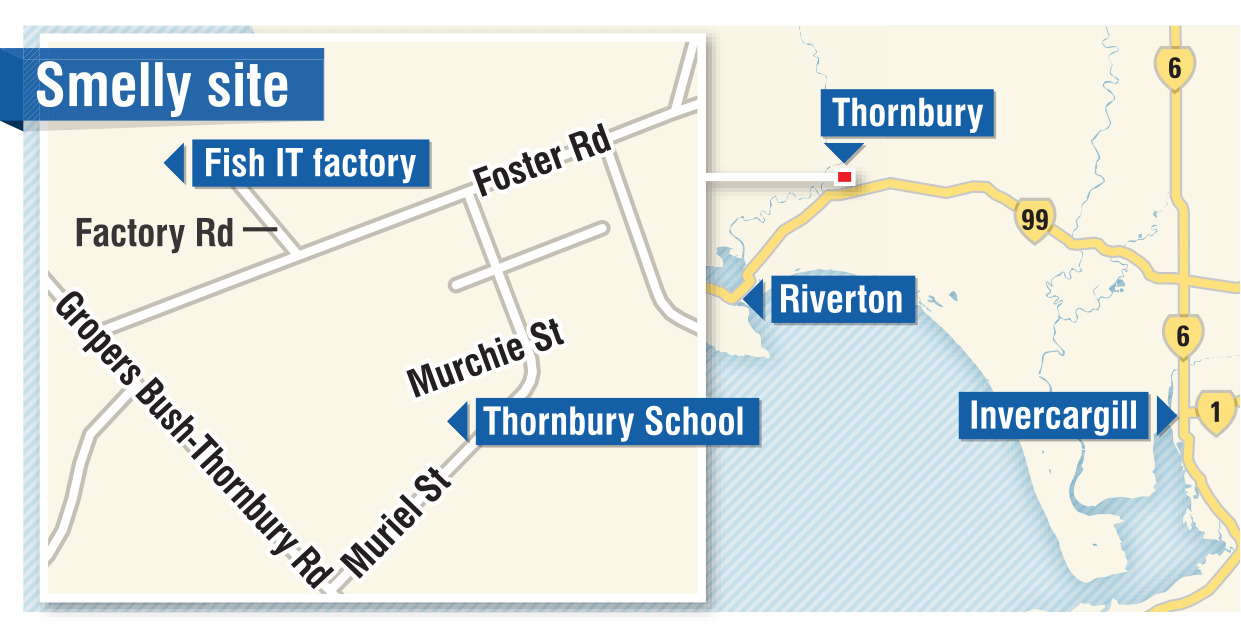
In the past year, 72 complaints have been filed with Environment Southland pleading for action to be taken against a Thornbury fish waste-processing factory, which started operations on a former tannery site a year ago.
One long-time resident of the small town, about 30km west of Invercargill, described the stench as vomit-inducing and said it made it too unpleasant to go outside when it was at its worst.
The company which operates the site, Fish IT, said it was doing all it could to suppress the smell and had halted production of the fertiliser product it made. It uses salmon byproducts to produce an amino acid-rich liquid fertiliser for use on farms.
The council declined to answer any further questions from the Otago Daily Times as the issue was "an active investigation".
The council received the first complaint on June 22 last year.
Thornbury Primary School principal Kay Teviotdale said she was often hit by the stench when driving through the Thornbury village on the way to the school grounds.
Children were known to search the school grounds looking for decomposing animal carcasses, she said.
"We do have days when we go ‘pooh, that’s a little bit rotten today’. And we do have days where we do go looking for dead livestock."
Most of the children at the school lived on farms and were used to dealing with country smells.
"It is definitely more than just a country smell. It’s not like the cows on the break. It’s a real rotten smell that gets into your nose."
How much it affected the school premises largely depended on wind direction — summer was a particularly bad period.
Pupils would comment "it stinks out here" and then "take it in their stride and carry on".
Environment Southland had visited the school midterm to discuss the issue with the staff, Mrs Teviotdale said. But the school had yet to file a complaint as she had told the council the smell had not been extreme enough yet.
Long-time Thornbury resident Ian Bulling said the smell from the factory had had become unbearable at times.
"It’s putrid — it makes you want to vomit sometimes. A rotten, stinking fish smell."
Summer was particularly bad — it was too unpleasant to go outside. Calm mornings were also bad.
Residents had been encouraged to call the council when they noticed the fouling — which he and his wife had done numerous times.
"I’ve lost count [how many times I have called]. I got sick of it in the end."
He had noticed the air had become clearer since production was suspended.
He believed the community was in favour of seeing new business and the former tannery site being used again. But the stink had to be controlled.
Fish IT general manager Richard Diack said the company had been working hard to address the smell and had made significant changes to buildings and production equipment to limit the amount of air exposure the product had been getting.
The company had also decided to suspend its twice-weekly production operations until it could work out a filtration system to prevent fouling the township’s air.
The company had been searching worldwide for an answer to the smell but had yet to discover anything that would work. It had also installed a wind sock and weather station to assess the wind direction.
Production would resume temporarily while potential solutions were tested, Mr Diack said.
He believed the production process on the repurposed site was a world first.
"We want the community to be proud of us."
The product the company made offset the negative effects of synthetic fertilisers and allowed dairy farmers to maintain production levels with less nitrogen waste, he said.
Thornbury residents had been invited to an open day at the former tannery site but only one family turned up, he said.
The company which produced the salmon byproduct had stopped supplies until a solution to the stink could be found.
- Toni McDonald


