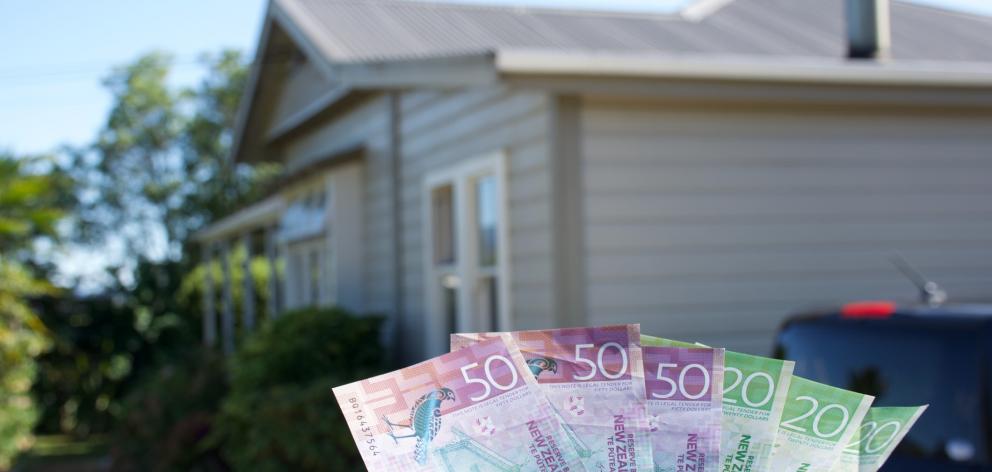
The number of people with a seven-figure mortgage has ballooned over recent years.
Credit bureau Centrix has released its latest update, that shows the number of people with a mortgage larger than $1 million has increased 15% year-on-year.
There are now 134,000 homeowners in that category. Joint borrowers who own a house together could be counted twice.
At the end of 2019, fewer than 51,000 people had a mortgage over $1m.
At an interest rate of 5.62%, a $1m mortgage would cost $5754 a month to service over 30 years.
Another 18,000 people are responsible for mortgages above $2m. That was up from about 5000 in 2017, 6000 in 2019 and 13,000 in 2022.
A $2m mortgage on the same terms would be $11,500 a month.
"There's been significant growth over the years," Centrix chief operating officer Monika Lacey said.
It follows Westpac earlier telling RNZ that one in six of its new mortgages were for more than $1m.
"That was 37,000 individuals [with a $1m mortgage] in 2017 and 100,000 in 2022," Lacey said.
"I think what that indicates is that those points in time where we've had a sudden growth period potentially were where we've had lower interest rates over Covid and then again towards the end of last year … people are taking advantage of those situations."
Infometrics chief forecaster Gareth Kiernan said there also seemed to be a correlation between the number of house sales in those price brackets and mortgages at the $1m and $2m level.
"The lag from changes in sales to changes in the mortgage stock seems longer than I might have envisaged, even allowing for the gap between the sale going unconditional and settlement or mortgage drawdown occurring.
"Growth in the stock of mortgages is not as amplified as changes in the number of house sales. That makes sense, given that not everybody buying a $2m-plus house will also have a $2m-plus mortgage. It's also interesting that when sales numbers fall, the number of mortgages in the upper price bands doesn't. But I suppose once you've got the $2.2m mortgage, it's a lot of payments and interest until it goes below $2m."
He said there might have been an element in recent years of Reserve Bank mortgage regulations moving more towards debt-to-income ratios rather than loan-to-value ratios, which require higher deposits.
"The Reserve Bank seems to be comfortable with the increasing proportion of buyers with low deposits, which probably reflects their view that house prices are within their range of long-run sustainable estimates, so the risk of a sharp price fall and borrowers being left in a negative equity position is relatively low; and that if debt-to-income ratios have been properly assessed, then borrowers should be able to withstand expected interest rate increases."
Lacey said Centrix data could not break down whether those loans were for a single house or were financing a range of things.
Simplicity chief economist Shamubeel Eaqub said the increase in loan size could also be due to the geographic distribution of borrowers. He said most activity had occurred in more expensive markets such as Queenstown and Auckland.
He said it was not necessarily a concern provided the borrowers had the income and wealth to support the debt.
For first-home buyers, the average loan size was down slightly from the $560,000 of earlier in the year.
Centrix data showed household arrears were trending down, with 11.25% of people behind on their payments in April, down from 11.72% a month earlier.
The total number in arrears has dropped to 443,000 and is now 9.5% lower year-on-year, which Lacey said was supported by improving economic conditions.
In some areas households continued to be in arrears due to limited employment opportunities in their region and the fact they were still recovering after being hit by severe weather events, she said.
Residential mortgage arrears improved, dropping to 1.29% from 1.39% the previous month. There are 21,100 home loan accounts past due, a 13% year-on-year improvement.
"The data is definitely showing an improving trend, consumer arrears continue to improve, which is really pleasing to see… Hardships are declining as well, overall consumers are faring better and that'll start to flow into the economy as well."
There were 443,000 Kiwis who were in any stage of arrears, but that included people who may have just paid a bill a bit late, she said.
The 96,000 New Zealanders or 2% of the population who were more than 90 days overdue in paying was more concerning, she said.
"But the good news is the credit providers are really well set up to help those individuals, so the big message there is really make sure that you contact your credit providers, talk to people early, because they are there to help you try and navigate through those difficult situations."
The Centrix data showed small-business owners were facing higher pressure, particularly where they had borrowed against their homes.
Mortgage stress, measured as loans that were more than 30 days overdue, was much higher among sole proprietors than non-business owners.
Centrix said that pressure intensified for those operating multiple businesses, with mortgage stress levels more than double that of non-business borrowers.
"New Zealand is made up of small businesses and a lot of those business owners will be leveraging their property equity to fund their business," Lacey said.
"Those business owners have higher mortgages than non-business owners but they also have more recently higher levels of arrears, not hugely, but just ever so slightly. So it's just a reflection of the economic times, business owners have got a bit more pressure. Consumers aren't spending as much at the moment."
The areas with the highest level of arrears were Wairoa, at 17.35%, Kawerau at 16.99%, Ōpōtiki at 15.94% and South Waikato at 15.62%.
Personal loan arrears improved to 9.2% in April, down 8% year-on-year, indicating a gradual easing in repayment pressure. Buy now pay later arrears dropped 5% year-on-year to 8.3%.
Business credit defaults trended down but company liquidations are still elevated, up 17% year-on-year. Hospitality business liquidations were up 49%. Retail was up 37%.
"This divergence highlights improving repayment behaviour among active companies, even as business closures continue to reflect the lagged impact of economic pressure," Centrix said.
Agriculture was the top performer, with defaults down about a third year-on-year and liquidations stable. Liquidations lifted 7% for construction and 8% for transport.
"Businesses are still having a little bit of a tough time, but definitely the more recent indicators, such as credit defaults, are showing an improving trend, whereas the liquidations are still relatively high, but that is a real lag indicator… liquidations indicate financial positions of some time ago and they're just starting to flow through now," Lacey said.
This story was first published on rnz.co.nz |  |