


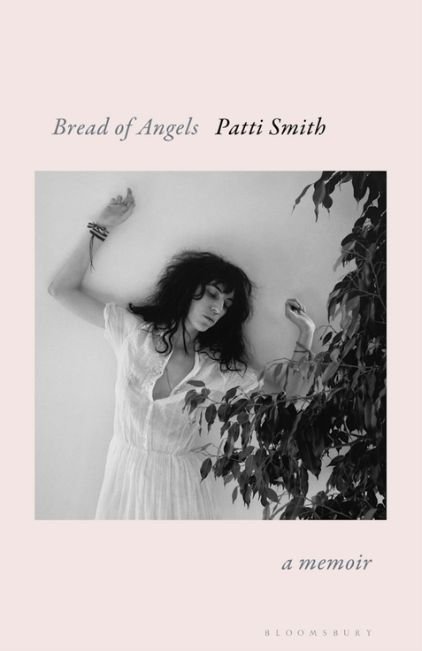
BREAD OF ANGELS
Patti Smith
Bloomsbury
Part of what made Patti Smith’s 2010 National Book Award winning Just Kids so captivating was stumbling across all the familiar faces throughout its pages, as if bumping into them on a street corner.
You could find Allen Ginsberg at an automat, or Jimi Hendrix, Janis Joplin, Salvador Dali and countless others at New York’s Hotel Chelsea.
Similar moments are imbued within Bread of Angels, touted as "the most intimate of Smith’s memoirs" by publisher Bloomsbury, bookended by passages of discovery and rumination akin to those of 2015’s M Train.
And intimate it is.
A memoir, it takes us back to before the events of Just Kids, to the Godmother of Punk’s earliest childhood memories, from birthdays at Leary’s Bookstore and meeting the "tortoise king" to the painful realisation she is no longer the fastest runner.
This a childhood of magical thinking and religious guilt.
"I was six and a half years old with seven stitches, and for that one hour, on that two-wheeler, I was a champion," Smith writes.
It is during her family’s one visit to the Philadelphia Museum of Art, in "the hall of Picasso", where Smith pledges her allegiance to art at hardly 13.
She articulates the legacy of art and her role within a long line of interlocutors, from Arthur Rimbaud to Bob Dylan, inviting us to trace her influences.
The middle third of the book, its pace suddenly quickening, covers a period similar to Just Kids yet never feels as though the exact same ground is rehashed.
We hear in detail about the conception of tracks from her debut album Horses and the recording of Radio Ethiopia during Hurricane Belle, the title track Smith later lamenting as having been deemed "unlistenable" by critics.
The Ramones deliver a bottle of tequila and an issue of Punk magazine to her hospital room — Tom Verlaine instead opting for books — after a fall from stage leaves her with a skull fracture, severe concussion and four spinal fractures.
Just as she once cast off her religion, Smith ultimately gives up the mantle of fame and fortune and starts a new life with soon to be husband Fred "Sonic" Smith, of rock stalwart MC5.
Here are beautiful and tender moments, the Smiths furnishing their East Jefferson apartment with its five-spot floor, listening to John Coltrane, and their boat Nawadir moored in the front yard of their house with its one blue sail.
Bruce Springsteen even takes their son, Jack, on a motorcycle ride — something Fred had, before his death, promised the boy for his 13th birthday.
An unexpected highlight is Smith’s account of a "tipsy" Robert McNamara (former US Secretary of Defence) mistaking the Dalai Lama for a Japanese monk.
The novel closes with the revelation that Smith and her sister Linda are half-siblings, a discovery she only makes fresh into her 70s through a genetic test.
Her reunion with the child she placed into adoption as a teenager is another poignant moment and one that allows them to pinpoint the identity of Smith’s biological father, Sidney.
Longtime fans will appreciate the breadth of both Smith’s life and career that Bread of Angels canvasses, perhaps her most comprehensive autobiographical work to date.
Some readers may find her, at times, enigmatic and flittering writing style challenging to digest (particularly the final chapter), but it is her ability to conjure little moments of magic and worlds between words where Smith is unmatched.


