

Her very many musical influences continue to help her say what needs to be said, Santi White tells Tom McKinlay.
For her NPR Tiny Desk show a couple of years ago, Santigold reached way, way back into the catalogue to pull out Ain’t Got Enough, a song by her first band, the punk four-piece Stiffed.
The video is still available online and in it, defying the cramped space Tiny Desk shows afford, she recaptures the teen spirit of the song, whirling tambourine in hand in front of original drummer and pro-skater Chuck Treece.
It’s the sort of energy the frontwoman promises to bring to Rhythm & Alps later this month, though while she intends to mix it up, Stiffed may not make the set list for the Wānaka show.
‘‘I was doing a Stiffed song for a while,’’ she says, ‘‘but you’ve got to be in pretty good shape to do that one. By the end of that song, I’d be like - sometimes even on the stage - I would just lay on the ground because it’s so hard. I can’t believe I used to do whole sets of that speed and energy.
‘‘But yeah, my set is really broad, and it’s across all the records, other stuff not on the records, mixtapes, all the different styles of songs that I have.’’
There are a lot of styles. While Stiffed made waves in the US East Coast’s punk scene, no one genre was going confine Santi White’s output - there were then already too many musical influences rattling around inside her head.
So, in the event, it was as Santigold that White started attracting wider attention, first with the Devo-channelling single L.E.S. Artistes - Rolling Stone’s No 2 single of the year - and the Caribbean-accented rapping of Creator from the slightly confusingly titled 2008 album Santogold. The album made room for all White’s muses - helping to explain the breadth of her rippling cultural influence since.
Beyond her own output, she’s collaborated with Pharrell Williams, Jay Z, Mark Ronson and David Bryne, among many others, and was name-checked by Beyonce in 2022 track Break My Soul (The Queens Remix) as one of her creative heroes.
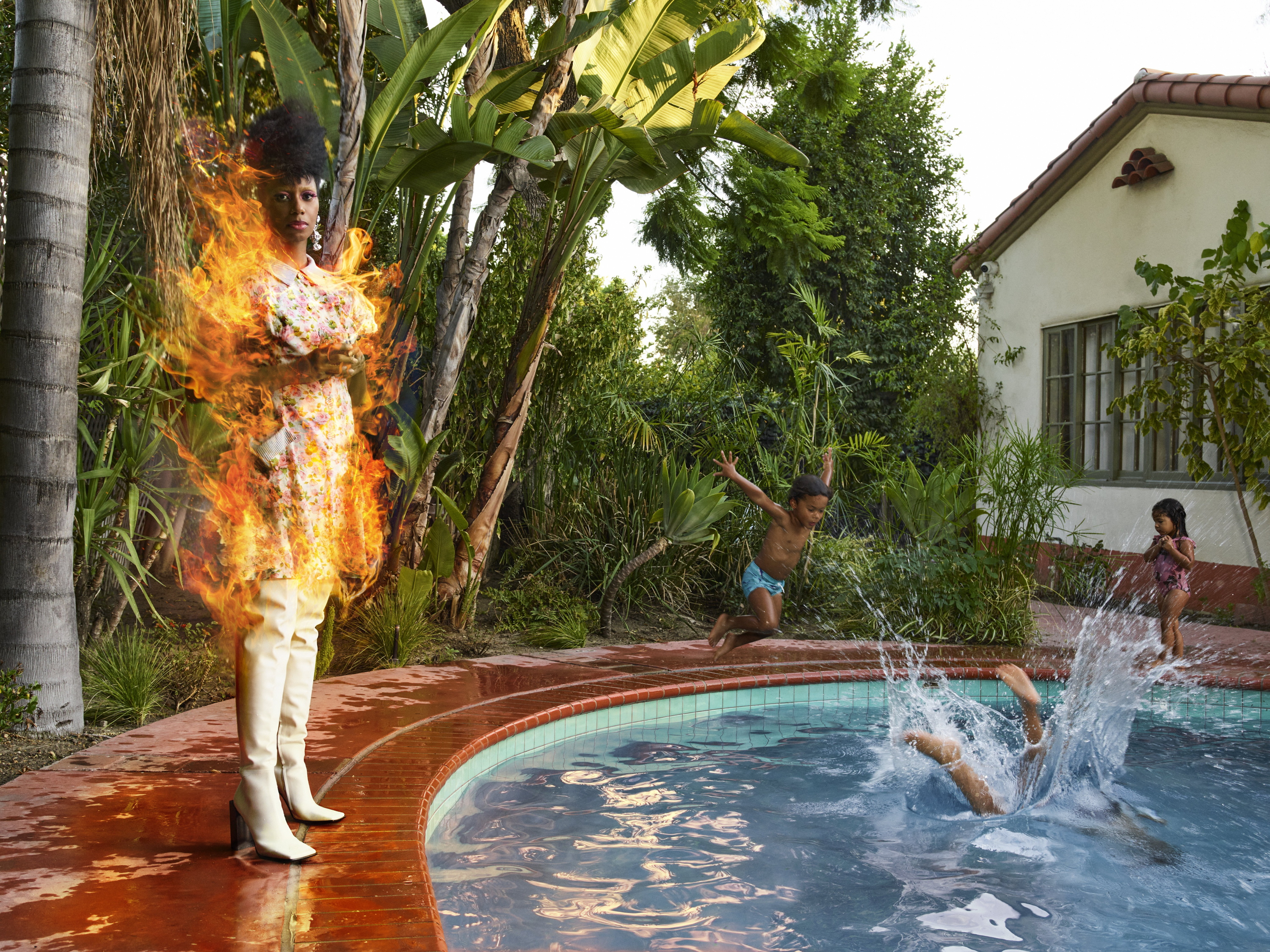
That same year, she released her most recent album, Spirituals, to more critical acclaim, an album rooted in African folk music that nevertheless drew widely from contemporary Western stylings to respond to the maelstrom that was America at the time - a country of wildfires and Black Lives Matter protests.
Speaking from her LA base, White explains that a comprehensive inter-generational domestic grounding in music was the foundation for her own peripatetic musical journeyings.
‘‘I grew up listening to so many different kinds of music in my house,’’ she says. ‘‘My father loved music and introduced me to music early, but he was for sure not listening to punk music. He was listening mostly to just all different kinds of black music.’’
That stretched from the reggae of Steel Pulse and Bob Marley to the afrobeat of Fela Kuti, James Brown’s funk, the proto-hip-hop beat poetry of The Last Poets and Nina Simone.
‘‘Just black music, you know, Temptations, everything across that.’’
And then there was her big sister’s record collection.
‘‘And she had Bad Brains, Suicidal Tendencies, Bauhaus, you know, Jimi Hendrix, Joni Mitchell, The Smiths. She had all that, but she also had, you know, everything else.’’
Pre-teen White began to compile her own collection through Columbia House, a pre-internet mail-order music club that would send out cassette tapes of new music for next to nothing.
‘‘You literally could send an actual penny in the mail,’’ White recalls.
‘‘It was actually a way to get children because the children obviously don’t have a way to pay for anything, but any child could get access to a penny.’’
Then they’d come after your parents, she says with a laugh.
‘‘But I got Talking Heads. I got U2. I got The Cure. I got all this stuff.’’
So when the time came and White started first writing then making her own music, the punk and new wave influences were there, but reggae too and hip-hop.
It felt to her, she says, that they all occupied the same energy.
‘‘It was more like my life. It just felt more adventurous and fun and grimy and all those things. And to me, they were the same, even though they were different types of music.
‘‘Energetically, they offered the same sort of release and sensibility. And so as a musician, I really gravitated to those three genres in particular.’’
‘‘I think it’s because I grew up listening to such topical music,’’ she says. ‘‘You know, Nina Simone and Marvin Gaye and James Brown.
‘‘I thought music was for that, was for speaking on issues.’’
With crews like Public Enemy keeping the flag flying for consciousness, there was no reason to believe that had changed.
So while her music has also been a vehicle for self-exploration over the years, the political element has remained.
A case in point, the video for gospel-honouring single Shake, from Spirituals, recreates infamous imagery from the US civil rights struggle when fire hoses were turned on protesters. White wears the water for her art.
In recent years, White has extended her reach across the cultural landscape with a future-focused podcast series - Noble Champions, a ‘‘modern day salon’’ - in which she has interviewed an inclusive cast of characters, musicians, activists, actors and artists, including Seun Kuti, of the Nigerian music-making dynasty, Flea, of Chili Peppers fame, and actors Olivia Wilde and Idris Elba.
There are so many people who are such brilliant thinkers, all around us, she says.
‘‘But if you don’t take the time to have the conversations or to let other people hear the conversations we end up hearing the same take or actually the same noise instead of the thoughts.’’
It’s a response informed by White’s deep dissatisfaction with what passes for popular culture, a critique that extends to the music industry’s perennial churn of meritless product.
The currency of art has been debased when anyone’s prosaic postings can blow up and go viral, she says.
‘‘What matters is different than what used to matter.
‘‘And I think it’s part of why we’re in a situation that we’re in - because the values are off.’’
The social media that drive so much of this are built for an engagement no deeper than endless scrolling - when it’s not promoting conflict, she says.
‘‘I mean, I think it’s built for fighting.
‘‘We’re in a not great place culturally, partially because of technology and all these things that came so quickly that, you know, that we don’t really know how to manage so far.’’
White’s suspicion is that some of this is intentional, that it serves certain interests to have us swamped by so much junk noise we don’t move forward.
White pushes on though, making music, trusting the process.
‘‘Music is, I’ve said this before, it’s almost like it’s a language of my soul. And I have to do it because there’s things that need to be put out of my body into the world that there’s no other way to get it out. There’s no other way to share that energy into the space other than through music.’’
It is the only reason she does it now, she says.
‘‘I just open up and I let whatever comes through come through and I don’t put myself in the front of it.
‘‘And it just works out that whatever needs to be said, without fail falls out in that way.
‘‘So I think when you do that, even if it’s just for yourself and if you think you’re just writing for yourself, that’s when it touches people the most, because everyone is able to connect. And those vulnerable emotional moments are just as big as a societal commentary, you know.’’
The show
• Santigold plays the Alpine Arena at Rhythm & Alps on December 31.
• Rhythm & Alps runs December 29-31 across five stages at the Cardrona Valley site.


