
PHOTO
This content is supplied by Reputio.
Introduction: Collaboration at the Heart of Kiwi Education
Picture a group of students in a New Zealand classroom, juggling lecture slides, notes, and chat messages while collaborating on a shared project. This scene captures the essence of Kiwi education, where teamwork, inclusion, and shared responsibility are core learning values.
As outlined in the Tertiary Education Strategy, New Zealand’s education system places strong emphasis on collaboration, equitable access, and lifelong learning. It encourages students to co-create knowledge, think critically, and learn through meaningful partnerships.
Yet, even with access to digital tools, students often struggle to stay organised, share updates, and manage resources effectively. Studocu AI bridges that gap by combining intelligent summaries, shared workspaces, and AI-powered organisation tools that make teamwork simple and smooth.
According to the HEPI Student Generative AI Survey 2025, 92% of students now use AI to explain or summarise content, showing how technology has become an everyday learning companion in classrooms across the world.
Collaboration has always been central to New Zealand education. By using tools like these AI tools, students can maintain the same collaborative spirit while working smarter and staying more organized in a digital world.
How Studocu AI Enhances Collaborative Learning in NZ Classrooms
Studocu AI turns group work into an engaging and efficient learning experience. It simplifies how students share materials, stay on track, and learn together through a few powerful features. Let’s review some key features of the tool that can prove beneficial for students working in collaborative environments.
Shared Workspaces for Group Projects
Students can create shared spaces for any subject. Once slides, readings, or PDFs are uploaded, the tool summarizes and arranges the information automatically. Everyone in the class can comment, edit, and add examples, helping teams stay connected and accountable.
Tip: Click “New Project”, upload your course materials, and invite your classmates to join and contribute.
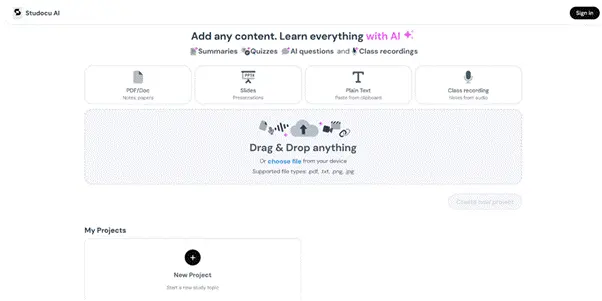
Students can simply copy the shareable link with their classmates or group partners, and they can access the common project they have to work on together. From there, each member can contribute their notes, add insights, or refine key sections.
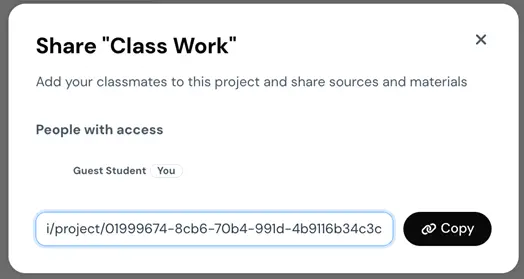
The benefit of this shared workspace goes beyond convenience; it builds confidence. According to a study published in SpringerOpen, AI-assisted pair learning significantly improves student motivation and reduces anxiety, showing how technology-supported collaboration helps learners perform better together.
Thus, teams can also combine multiple readings into one well-organized outline or create shared quizzes to test each other’s understanding, turning collaboration into a dynamic and supportive study experience.
Real-Time Lecture Note Summarization
During lessons, students can upload lecture slides or record discussions in real time.
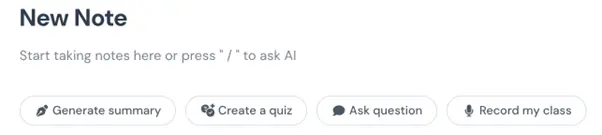
Once done, they can prompt the AI to produce clear, structured notes. Key terms and main ideas are highlighted for easy review, allowing students to focus on understanding instead of writing down every word. Teachers can later verify or comment on shared notes.
Staying Synced and Accountable
The platform tracks recent edits and notifies users about updates, ensuring every group member stays informed.

This feature is especially useful for blended and distance learning programs, which are becoming common across New Zealand universities and polytechnics.
Thus, it helps students work together efficiently by simplifying group management and creating space for genuine collaboration. It ensures that learning remains active, inclusive, and student-driven.
Use Cases of Studocu AI in NZ Classrooms
Across New Zealand, schools and universities are increasingly turning to AI to enhance collaboration and make learning more inclusive. Studocu AI can help bridge the gap between independent study and group work. From secondary schools to universities, here is how it can make an impact.
Secondary Schools (NCEA Level 2 & 3)
Students preparing for NCEA assessments often juggle research notes, readings, and essay drafts across different platforms. With the AI tool, they can upload all study materials into one shared workspace, where the tool summarizes readings and helps groups co-write essays or presentations.
Teachers can also view shared notes, monitor contributions, and provide real-time feedback, making group work both transparent and equitable.
University Tutorials and Seminars
University students can use the AI tool to combine lecture notes and research summaries into one organised outline. This supports New Zealand’s student-led learning model, where peers discuss, challenge, and build on each other’s ideas. Tutors can quickly assess individual and group contributions, ensuring participation is balanced and learning outcomes are met.
Remote & Cross-Campus Collaboration
Students at Massey University and Otago Polytechnic often work together from different campuses. The AI tool enables students to upload documents, summarize research collectively, and build cohesive shared outlines - all in one workspace. The tool can also merge feedback from multiple participants, helping online students work together seamlessly across campuses and time zones.
Educational Value in Context
AI-supported collaboration promotes inclusion, adaptability, and learner agency. Research published by Springer Nature Link found that generative AI tools that adapt content to student interests increase motivation and academic performance compared to non-personalized approaches.
Tools like Studocu AI exemplify this shift by providing adaptive, accessible, and empowering ways for all learners to succeed, no matter where or how they study. Hence, redefining how students collaborate, create, and learn. It can also support a more connected, confident, and equitable education system across New Zealand.
Conclusion: Smarter Collaboration for a Connected Generation
Collaboration has always been at the heart of New Zealand’s education system, and technology is now helping that spirit grow stronger. The AI tool can help bring together Kiwi teamwork and smart innovation, turning scattered ideas into organised, shared learning experiences that boost confidence, curiosity, and creativity.
It simplifies group projects and connects students across classrooms, campuses, and even cities, making learning more inclusive and efficient. Teachers gain clearer insight into progress, while students stay engaged and accountable to one another.
In essence, AI-driven collaboration reflects the future of Kiwi education: one where every learner can connect, create, and succeed together. Studocu AI does not replace teamwork; it empowers it, helping New Zealand students learn smarter and achieve more wherever they study.