
PHOTO
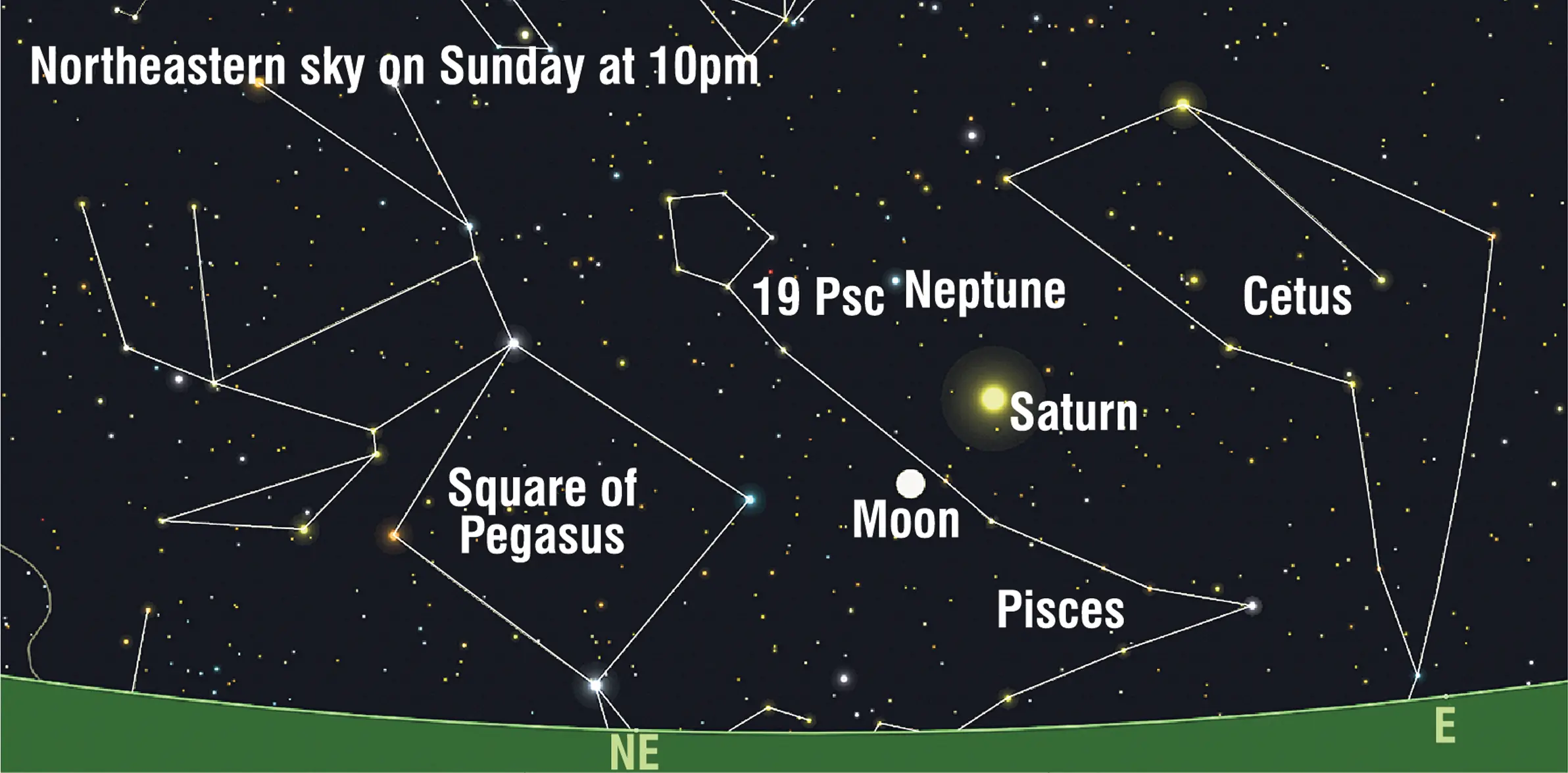
Head outside on Sunday at 10pm, and you will find a veritable feast of celestial morsels in the northeastern sky.
The almost-full Moon will dominate the scene. Above and to its right, Saturn will glow as a steady, cream-coloured point of light. If you have brought binoculars, look for a much fainter blue-green spark nearby. That is Neptune. Moon, Saturn and Neptune: three worlds arranged in a loose triangle, almost as though they had planned it.
They haven’t, of course. It is opposition season. Earth is passing between the Sun and the outer planets, so Saturn and Neptune rise as the Sun sets, remain in the sky all night and are about as close and bright as they get all year.
The Moon is performing much the same trick on a smaller scale. It becomes full on Monday, and a full Moon is simply the Moon at its own opposition: the Sun behind us and the Moon almost directly ahead, its Earth-facing hemisphere flooded with sunlight — three very different worlds obeying the same simple geometry, whether or not anyone is watching.
In cosmic terms, the Moon is close enough to touch; a little over one light-second away, so near that its light began its journey before you finished blinking.
Saturn’s light has been travelling for well over an hour. Neptune’s has taken roughly four. The tiny blue-green dot in your binoculars is therefore a postcard mailed earlier that evening, arriving at the precise moment you look up. Three objects occupying one small patch of sky, separated by distances large enough to make every journey you have ever taken seem no more than a step across the room.
Saturn is easily visible: cream-coloured, patient and unblinking. Neptune is far too faint to see with the unaided eye, and the glare of the nearly full Moon will make finding it a challenge. Steady the binoculars, use the chart and take your time.
Then drift northward into the darkness between the Great Square of Pegasus and Cetus the whale. There you will find 19 Piscium, also known as TX Piscium: a carbon star glowing with one of the deepest red colours in the night sky. It is an ageing sun surrounded by carbon-rich material — a dying star wearing its own soot like a winter coat.