
PHOTO
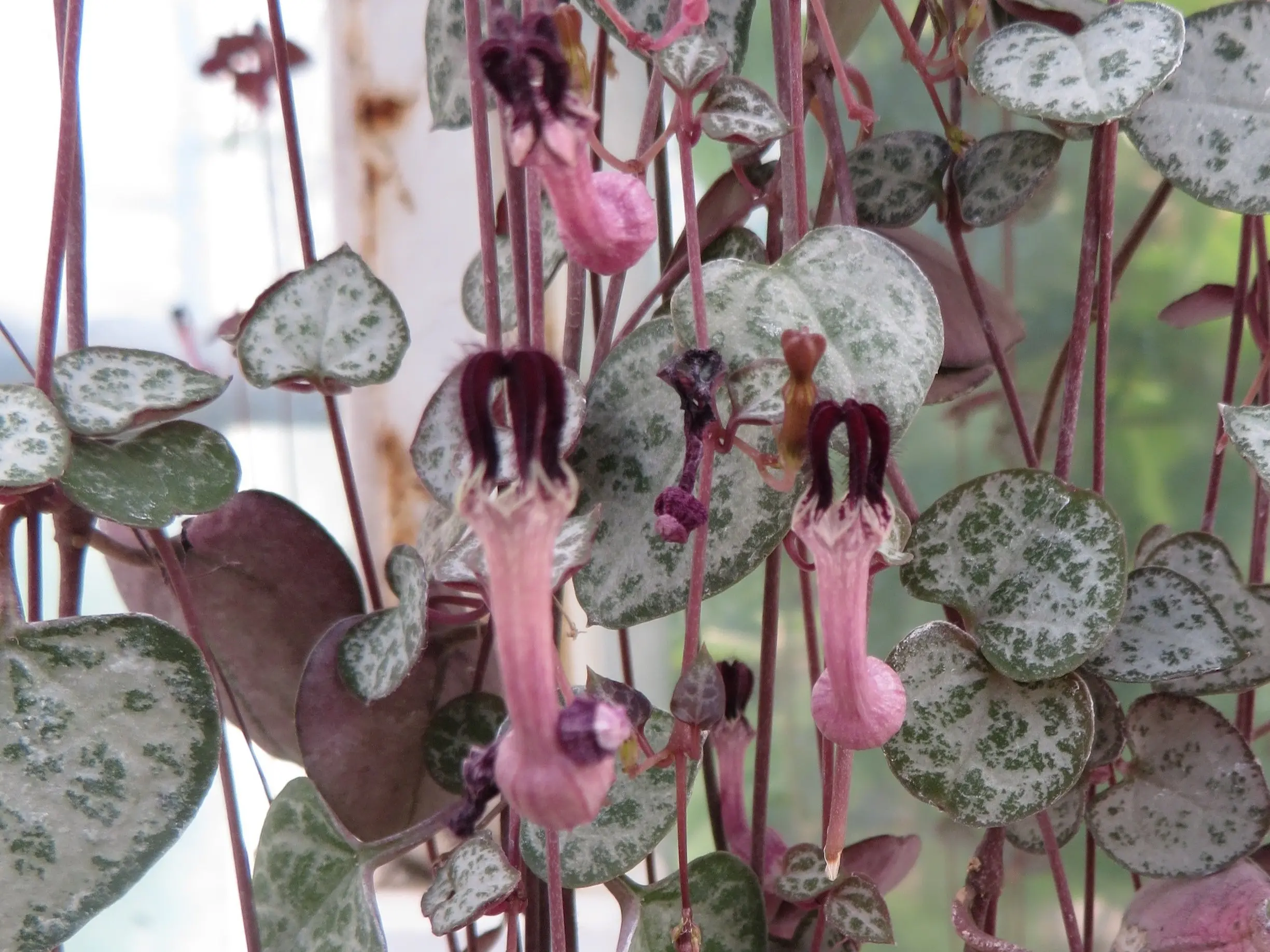
Native to South Africa, this little cutie can be found displayed in hanging baskets, trailed along shelves and windowsills. This evergreen succulent can grow up to 4mlong. Commonly known as chain of hearts,it has several interesting qualities.
Small tubers that look like beads or galls grow from nodes along the vine. These tubers store water and nutrients for the plant, probably as an adaptation to its semi-arid native distribution. The cool thing about these tubers is they are a good way to propagate the plant. When cut from the vine and placed in soil or water, new fine roots will develop, producing a new plant for you.
Ceropegia woodii produces unusual flowers. Small, 1cm to 2cm long and pale pink to soft magenta in colour, they resemble tiny lanterns or delicate vases. Each flower has a swollen, bulb-like base that tapers into a narrow tube, topped with five dark purple petals fused together at their tips and lined with fine hairs giving the flower a fuzzy look. This intricate structure plays an important role in pollination. As tiny insects enter the tubular flower, they brush against the internal hairs and reproductive structures, becoming dusted with pollen before moving on to the next flower.
In the wild the tubers of this plant are known as a survival or famine food — for humans and animals alike. Porcupines, baboons and rodents will forage on these tubers due to the high water content, a valuable resource in dry seasons.
In Zulu traditional medicine the leaves and stems are pounded to make an infusion that is taken as an emetic in the case of suspected poisoning.
Care: Chain of hearts may look delicate, but it is surprisingly resilient when its basic needs are met. The key is understanding that, despite its fine trailing stems, this plant behaves more like a succulent than a traditional leafy houseplant. A position near a bright window with filtered sun is ideal. Morning sun is usually tolerated, but harsh afternoon sun can scorch the leaves.
Watering: This is where most people go wrong. Ceropegia woodii stores water in small tubers along its stems and within its root system, meaning it prefers to dry out between waterings. Always check the soil before watering. If the top few centimetres are dry, it’s ready. In winter, reduce watering significantly. Overwatering, especially in colder months, can quickly lead to root rot.
When you do water, water thoroughly and allow excess to drain away completely.
Good drainage is non-negotiable. A cactus or succulent potting mix works well, or you can improve standard potting mix by adding perlite or pumice. Use a pot with drainage holes. Terracotta pots are helpful, as they let moisture evaporate quickly. Repotting is rarely urgent because this plant doesn’t mind being slightly root-bound.
If stems become too long or sparse, just trim them back. This encourages fuller growth. The cuttings can be used for propagation.
- Snip a vine and lay it across soil, pinning it gently in place until roots form. Mist daily.
- Place cuttings in water until roots develop, then transfer to soil.
- Press the small aerial tuber (bead-like bumps along the vine) directly into soil to grow roots. Mist daily.
To sum up, variegated Ceropegia woodii thrives when treated like the succulent it is. It likes bright indirect light, sharp drainage, and restraint with watering. Give it these basics, and it will reward you with cascading vines and beautifully marbled heart leaves and fuzzy flowers for years.