


Later, moving to Australia, she set up business Cecilia Fox and became one of Australia’s most influential florists, before moving her business to Auckland in 2021.
Her recently released book Pretty Dirty highlights her holistic approach, her favourite flowers, and contains interviews with ‘‘flower folk’’ in New Zealand and Australia. It aims to inspire florists, growers, and flower-lovers to care about nature while ‘‘enveloping themselves in exquisite beauty’’.
Working with flowers encompasses both a knowledge of nature and the skill to create arrangements and botanical works, but this no longer feels enough: it is now vital to do this holistically. The world, including the floral design world, must move swiftly and urgently towards a more holistic and circular economy. After more than two decades working in weddings and large-scale events, I can confirm that some of the practices we have adopted as an industry are no longer fit for purpose and that, for an industry that relies on the land for our livelihood, it’s imperative that we change the way we work and the way we think. Our legacy will be how our art and our businesses act as stewards of the natural world.
This has always been how I’ve moved through the world: to work with care, for the Earth, for the industry and for what we make paying attention to what’s around me, to the materials I use, to the waste I create. I’ve been a florist all my life, and while styles come and go and the seasons continue in their quiet rhythm, the trend to a more sustainable, holistic way of working keeps me focused on a better world and a blooming industry now and into the future.
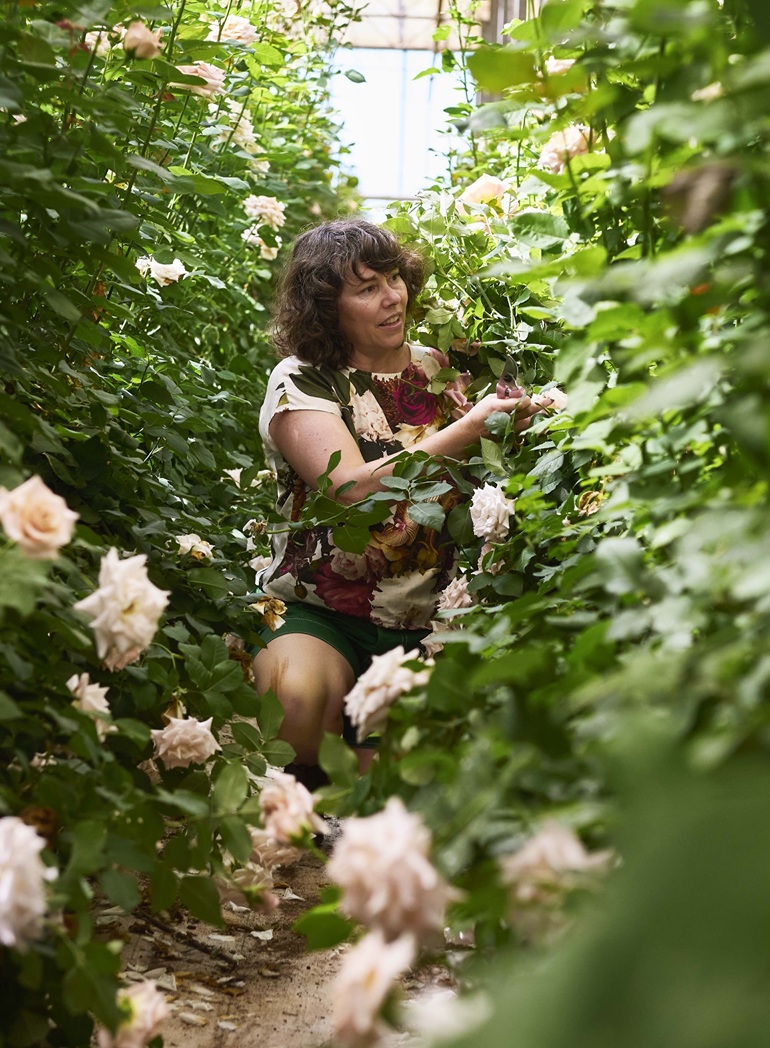
Community, creativity and compost
These three words sit at the centre of my practice and are the quiet architecture behind this book.
Community because floristry will never be a solo act — nothing happens without the flowers and those who propagate, cultivate, grow, sell, transport and love them. Fellow florists, clients and collaborators — the relationships are what give the work meaning. Working holistically, knowing I am part of something bigger, that my work exists in relationship with community and the natural world, is vital. It’s also a reminder that we make change together, not apart.
Creativity is the root of this work. It’s not only about how we arrange flowers, but how we imagine new ways of working with them, how we create new systems and how we create a new bold way of thinking. How we integrate and embrace new knowledge and continued respect for seasonality and place.
Compost is my quiet favourite. It’s transformation in action. It reminds me that nothing is wasted — that decay is not the end, but a beginning. It is a metaphor, of course, but also a practice of hope for a bright future for generations to come.

Turning point
There came a point in my career when I stopped trying to tell people outside of floristry how hard it was. I used to complain about the hours, about the thorns, about ragged nails and shoes filled with water. Sleepless nights and aching feet and back. Sometimes in life I have to work hard to look on the bright side, so I decided that, if someone said to me, ‘‘It must be so lovely to be a florist’’, or ‘‘I’ve always wanted to be a florist!’’, I would say, ‘‘It is! It’s the most wonderful job; it’s the most beautiful career. Every day is different — the flowers, the flowers, the flowers’’.
Once an interviewer asked me if I ever felt like I was in a meditation when I worked with flowers. This both amused and frustrated me — she couldn’t see all the hard work that went into floristry and running a flower business. A little later on, I realised that this is the magic with floristry: all the hard labour is carefully disguised behind vast quantities of beauty. Sort of poetic, don’t you think?
Now, as life is much slower, I do make flowers more intentionally and, dare I say it, find myself in a kind of meditation. I pay closer attention, and I take things slower. Not on the day of installing a huge wedding or driving across the country to pick up flowers, of course, but I’ve certainly been able to cultivate a more aware creative process.

Another thing that has become important to me as my practice evolves is creating work that speaks to the local environment, whether that’s in Australia, New Zealand or anywhere else. To reflect the land you are on is essential for a floristry practice based on respect for nature, community, seasonality and place.
In my 30 years as a florist, I have strived to create works of great beauty that not only engage all the senses but also are intentionally organic. I aim to create a dreamscape of nature, not to simply mimic it. For me, a dreamscape is something made from your wildest imaginings where tropical flora can collide with English country garden, where the jumble of all your ideas about nature and beauty can take shape and spring to life. My work is an homage to the natural world, from the pretty and nice to the dirty, ugly and messy parts. THE BOOK
This is an edited extract from Pretty Dirty - The life of flowers from creation to compost by Melanie Cecilia Stapleton, published by Hardie Grant Books. RRP: $70


