

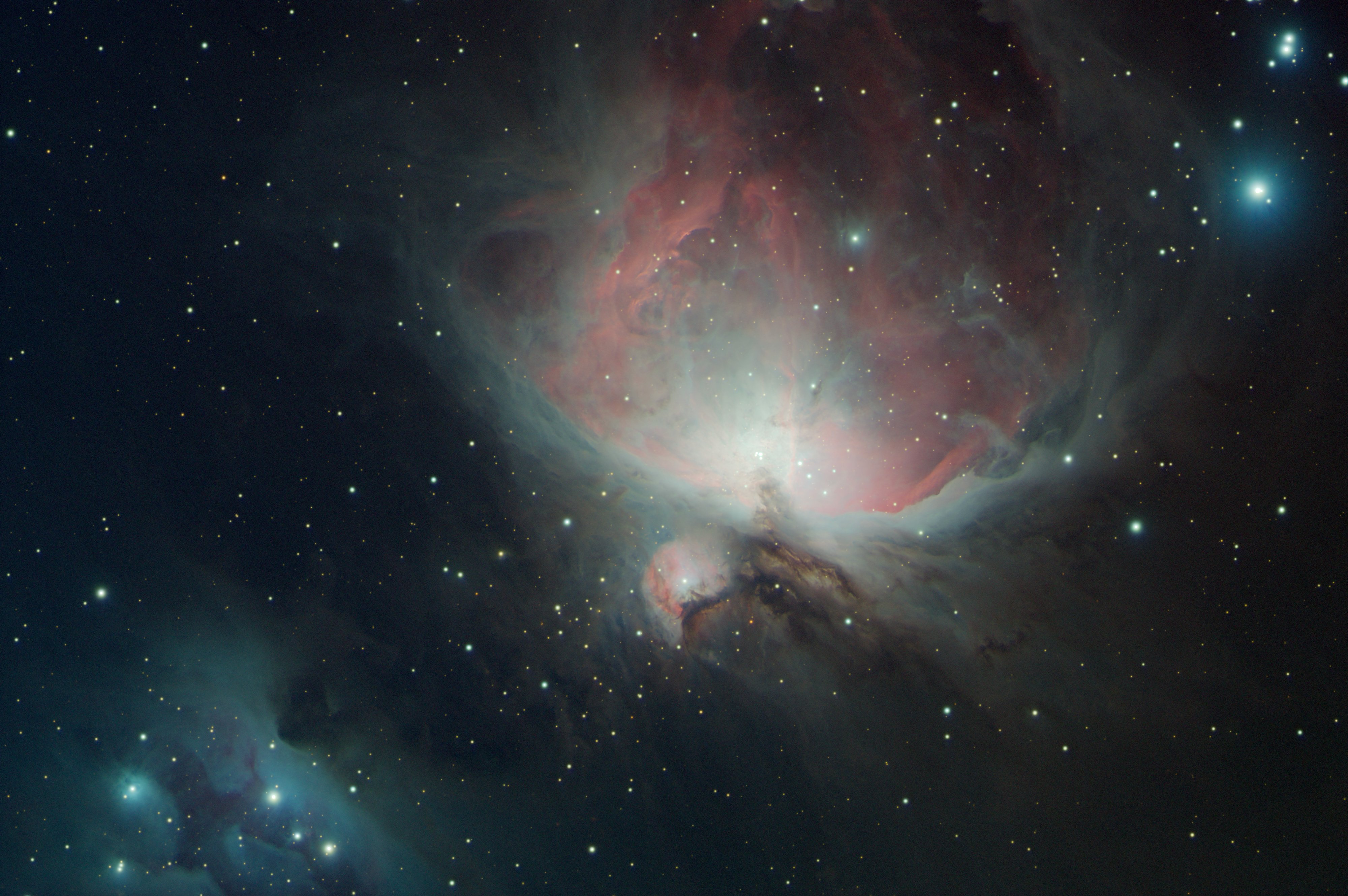
The Orion Nebula is one of astronomy’s greatest maternity wards, a place where stars are being born right now. Peer into its billowing gas and dust and you’re looking at stellar infancy — collapsing knots of material igniting into brilliant new suns. These newborn stars will take wildly different paths through life. The heaviest, burning through their fuel with reckless haste, will blaze for only a few million years before dying in spectacular supernovae. More modest stars, like our own sun, live slower, steadier lives, eventually shrugging off their outer layers to form delicate planetary nebulae — cosmic retirement homes glowing briefly before fading away.
Photographs reveal the Orion Nebula in rich hues: ruby from hydrogen, teal from oxygen, hints of violet all stirred by fierce ultraviolet light from young stars. Even through a small telescope, the structure is unmistakable — filaments and curls of material shaped by winds and gravity, testimony to astronomical forces at play on a grand scale.
In te ao Māori, Orion is often associated with Tautoru, the three bright belt stars that signal the arrival of summer and the season of cultivation. Some iwi see the pattern as Te Kupenga a Taramainuku — the great fishing net cast across the sky.
And like all stories, this one will change. One day — far beyond our lifetimes, but soon in cosmic terms — the nebula’s gas will have been used up forging new stars or blown away into the void. Future sky-watchers will no longer see a glowing cloud in Orion’s sword, but instead a tight, glittering cluster: the children of today’s nursery, shining proudly once the curtains have been drawn.
Finding M42 is easy. In the southern hemisphere, Orion becomes "the Pot", his famous belt forming the base and the three "handle" stars rising above. The nebula sits in the middle of that steam — the Pot’s handle, if you like — a fuzzy patch visible even to the unaided eye from a dark spot.


