
PHOTO
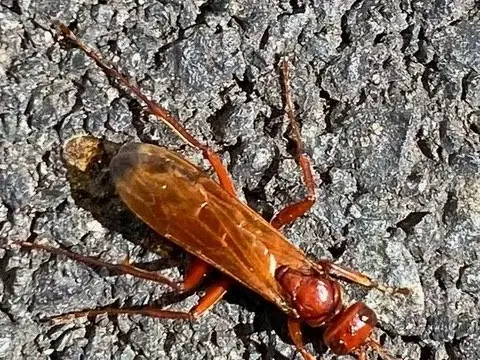
Dr Keith Probert took this excellent photograph of a bright red female spider wasp.
It had been dragging a spider much larger than itself across the ground and then temporarily abandoned it, no doubt to return to a nest hole it had dug in the ground for it, to check that the nest cell at the end was of sufficient size.

This wasp, Sphictostethus nitidus, is a ground nester. It hunts a variety of spiders, often species of Miturga. When successful, it stings the spider to paralysis, drinks from its mouthparts, drags the spider to a site where it is partially hidden, then digs a nest hole in the ground.
It makes a widened hole at the end of the burrow then returns for the spider, which it drags to the edge of the burrow by a leg base and runs inside, sometimes enlarging the cell. It next drags in the spider by the spinnerets at the end of the spider’s abdomen and lays a single egg on the side.
It then fills in the burrow with pieces of dead leaves and twigs, which it compresses. Finally, it disguises the nest by dragging several dead leaves and twigs from different directions across the entrance, which it examines for the effectiveness of its disguise.