
PHOTO
King Nestor features prominently in Homer’s Iliad and Odyssey, as his drama of the Trojan wars unfolded.
It was Heinrich Schliemann who set out to turn those myths into facts and in 1870, he began his epic excavations at Troy, followed with Agamemnon’s capital at Mycenae. However, he never managed to find Pylos, the palace of Nestor. Perhaps because Homer described it as "sandy Pylos", he searched for it along the shore of Messenia in southwestern Greece.
It was left until April 4, 1939 when Carl Blegen, from the University of Cincinnati, opened an excavation in Messenia and immediately encountered tablets inscribed in linear B, the script of ancient Greece. He had to wait 13 years before Michael Ventris unlocked the key to deciphering that script and found that they actually named Pylos. Blegen had found the palace archives.

Ten years ago, excavations turned from the palace to its surroundings. It was the sharp eyes of the directors, Jack Davis and Sharon Stocker, that noted three stones forming a corner in an olive grove. This led to an amazing discovery. As they probed deeper, they began to realise that they were opening the intact grave of a warrior prince who had lain there since about 1450BC.
One of the belongings that accompanied him to his grave was an ivory container decorated with a lion attacking a griffin, hence the name "Griffin Warrior" by which this grave is known.
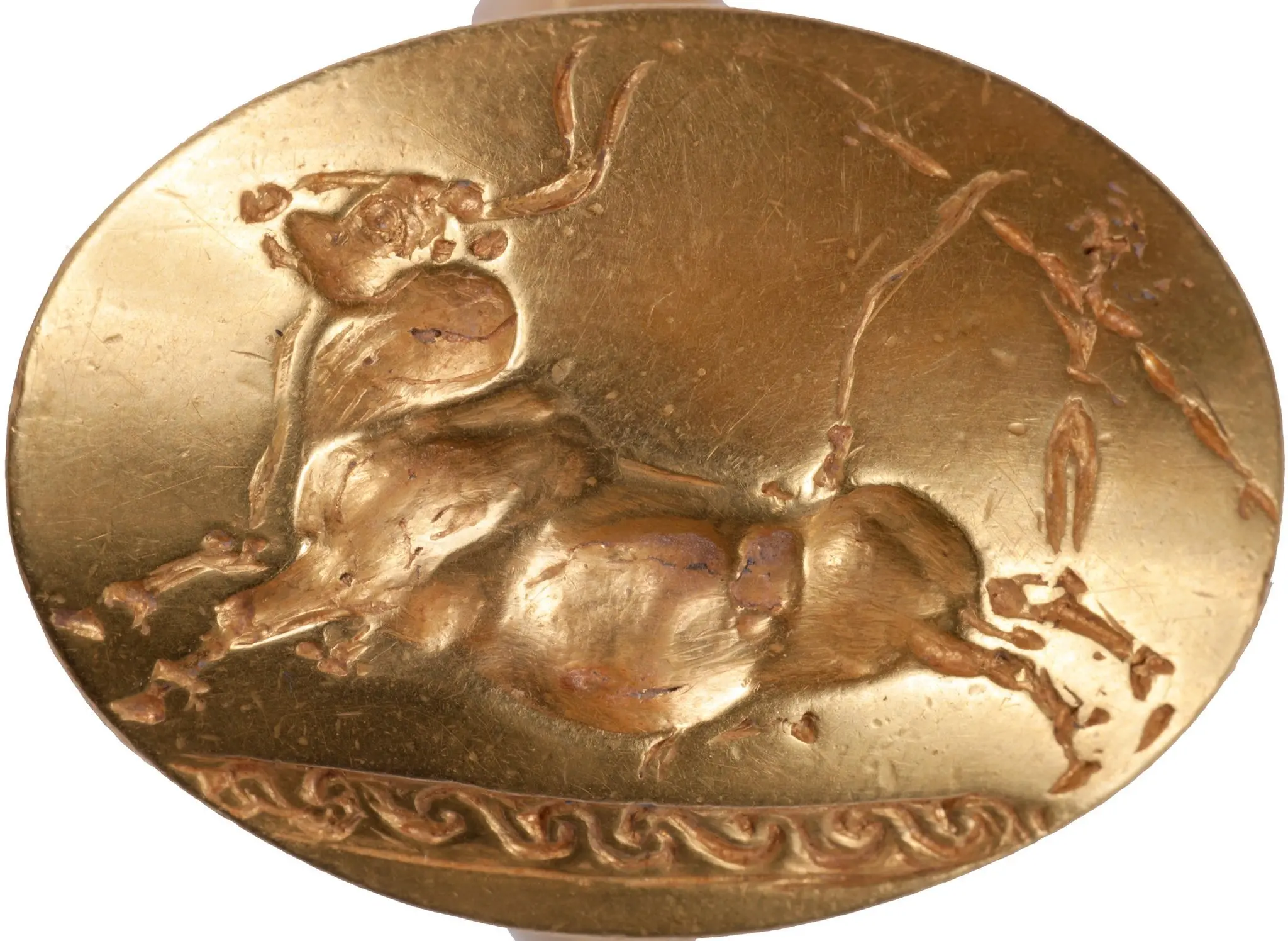
His elevated status is seen in the bronze head of a bull that once decorated the sceptre placed by his shoulder. There was then a bull cult, seen in the paintings at the Minoan palace of Knossos on Crete, that involved a man leaping over a charging bull, and this same scene is seen on his golden ring.
But perhaps his pre-eminent jewel is the minutely carved combat agate seal, just 3.6cm wide. In quite stunning detail, it portrays a battle in which one warrior lies dead while the hero thrusts his sword into a second adversary. The details are so incredible that under magnification, you can see that the warrior is wearing a bracelet with a seal stone under a millimetre wide with its own decoration.
The Griffin Warrior has until last week been on display in the Getty Museum, Los Angeles, and if you are lucky enough to visit Athens this spring, the exhibition will be open there.