
PHOTO
Liquid gypsum is used today to improve the quality of clay soil, but in Roman times, it had a quite different application.
When a high-status Roman living in York 1600 years ago died, the body was wrapped tightly in fine fabric and then placed in a lead coffin.
Before interment, the coffin was then filled with liquid gypsum.

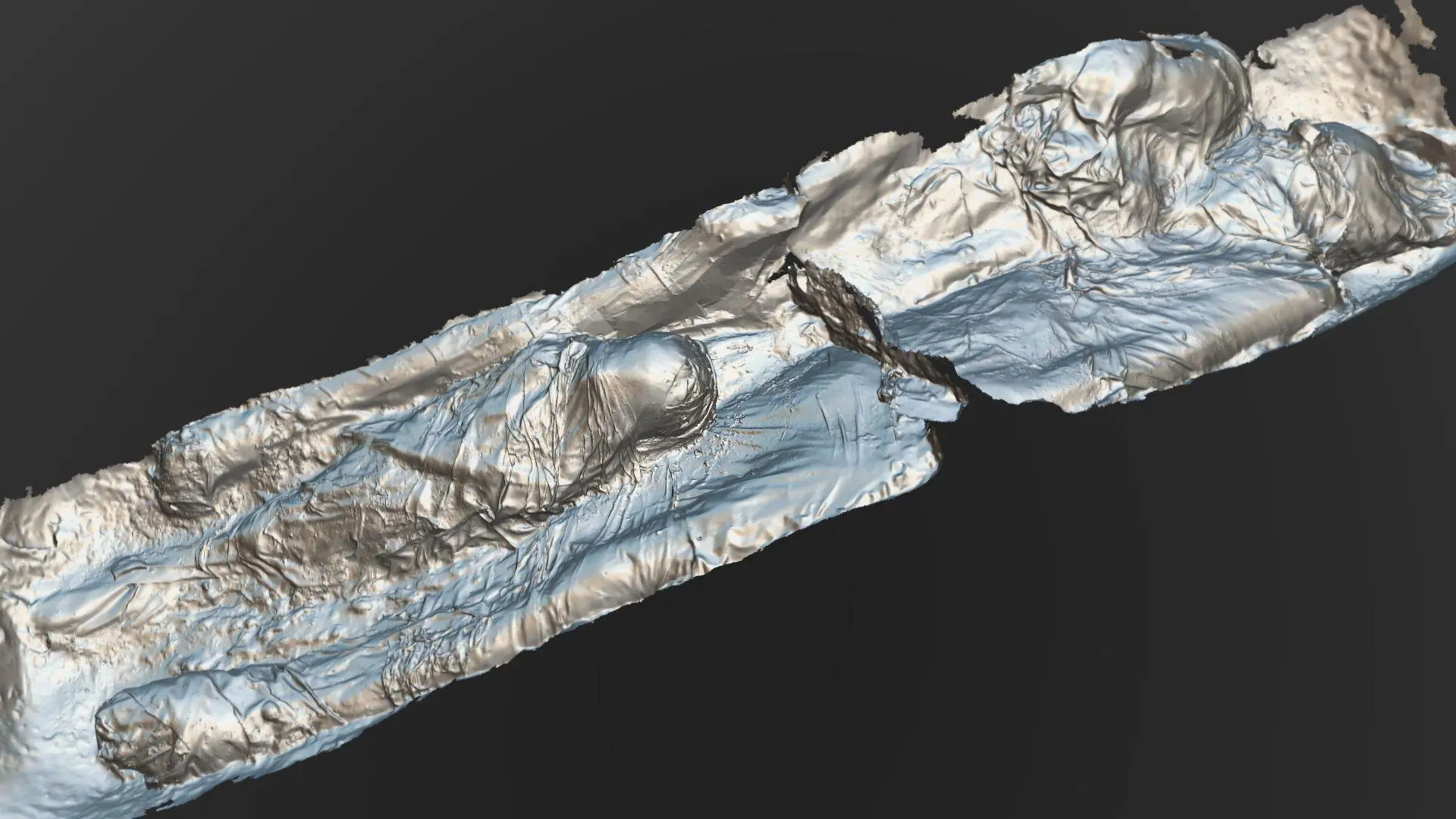
Just like plaster of Paris, the gypsum soon turned to the consistency of concrete, thus preserving the outer contours of the corpse. Today, when you excavate one of these burials, there is a hollow cavity within which lies the skeleton.
The University of York has recently completed a remarkable research project that has taken 3-D scans of the interior of the gypsum, revealing what would not survive in other contexts. One burial in particular has attracted widespread interest.
The coffin contained the casts of two adults, with a 4-month-old infant buried between them. They must have died at the same time in a family tragedy.
In the same cemetery, a young girl was buried with fine jewellery fashioned from jet, glass, silver and gold. Her boots and sandals lay beside her, along with the skeleton of a chicken. An infant wore a woollen cloak embellished with gold thread and tassels.
There is so much in these burials that illuminates life in the later Roman Empire.
The fine imprints of the clothing worn by the dead allows a precise reconstruction of the fabrics preferred at the time. DNA from the bones identifies close family relations, and aspects of health and ancestry.
It is possible to reconstruct trade routes by tracking down the source of the gypsum. Stable isotopes derived from the teeth inform us on the Roman diet. If there is one missing aspect to the study, it is that their faces were covered in a shroud.
Imagine if the gypsum had also preserved the complete faces, then we could really know what they looked like.
The only other example of the survival of the complete outline of a body that comes to mind is from Pompeii, where the volcanic ash encased those who died during the eruption of Vesuvius.
Archaeologists encountering a void in the solidified ash pour in plaster of Paris, thus revealing the body in 3D.
However, nothing there has survived in the same detail as the gypsum graves of York