
PHOTO
Tiny telescope, big discoveries.
It seems odd that a telescope no bigger than a kettle could promise to reveal the universe.
Mine arrived last week. It’s a small, neat device called a Seestar, with a lens only 30mm wide. It feels more like an appliance than a scientific instrument.
But still.

In 1610, Galileo Galilei used a telescope only a little larger, with a 37mm aperture, to look at the sky and quietly change our understanding of the universe. He saw mountains on the moon and moons around Jupiter. Suddenly, it seemed that not everything revolved around us.
But Galileo had one handicap we have largely forgotten: his eyes.
The human eye is not particularly sensitive. For every 200 photons that reach it, the brain registers only one — an efficiency of just half a percent. Worse still, it cannot store light. Each moment stands alone, and whatever is too faint simply slips away.
Modern detectors are much more capable. The sensor in your phone can capture up to 90% of the light that hits it, and — crucially — it can hold on to that light, building up an image over time. In its own quiet, electronic way, it is almost 200 times more attentive than we are. So what happens when you combine a telescope not so different from Galileo’s with a detector that hardly misses anything?
Honestly, it’s astonishing.
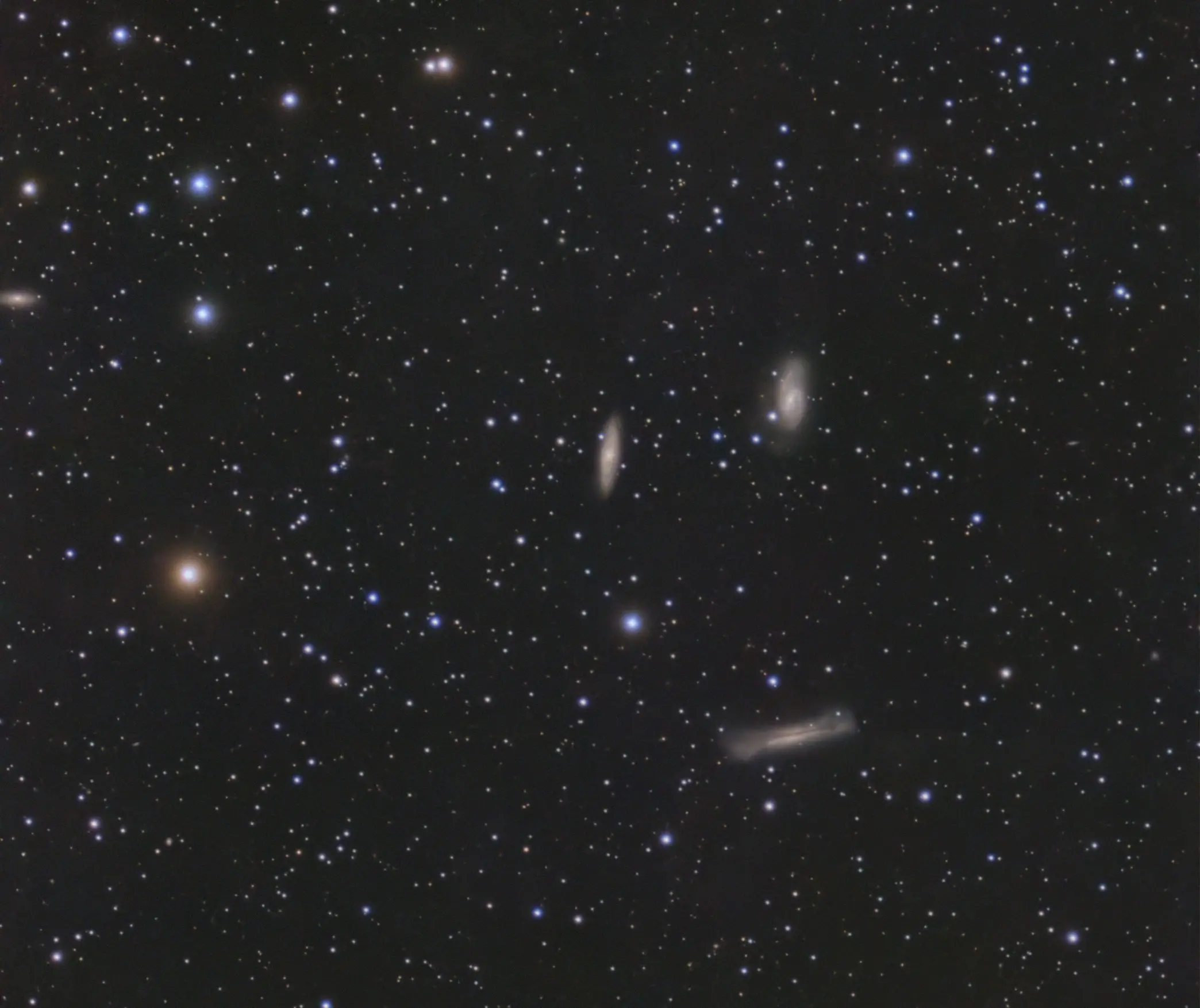
I pointed this little device towards the Leo Triplet, a group of three distant galaxies in the constellation Leo, some 35 million light-years from Earth. Galileo could not see them, and for a long time, neither could I. But after a couple of hours of quietly collecting light — photon by photon, like rain filling a barrel — they appeared. Not just as faint smudges, but with real structure: spirals, asymmetries, hints of motion, all carried across space in light.
In a way, it feels like cheating. But it also feels like progress.
We are entering a new era of astronomy, where discovery is no longer confined to mountaintop observatories. Now it can happen in a backyard, with the help of an app and a cup of tea. The instruments are smaller, the sky is unchanged, yet our sense of wonder continues to grow.