
PHOTO
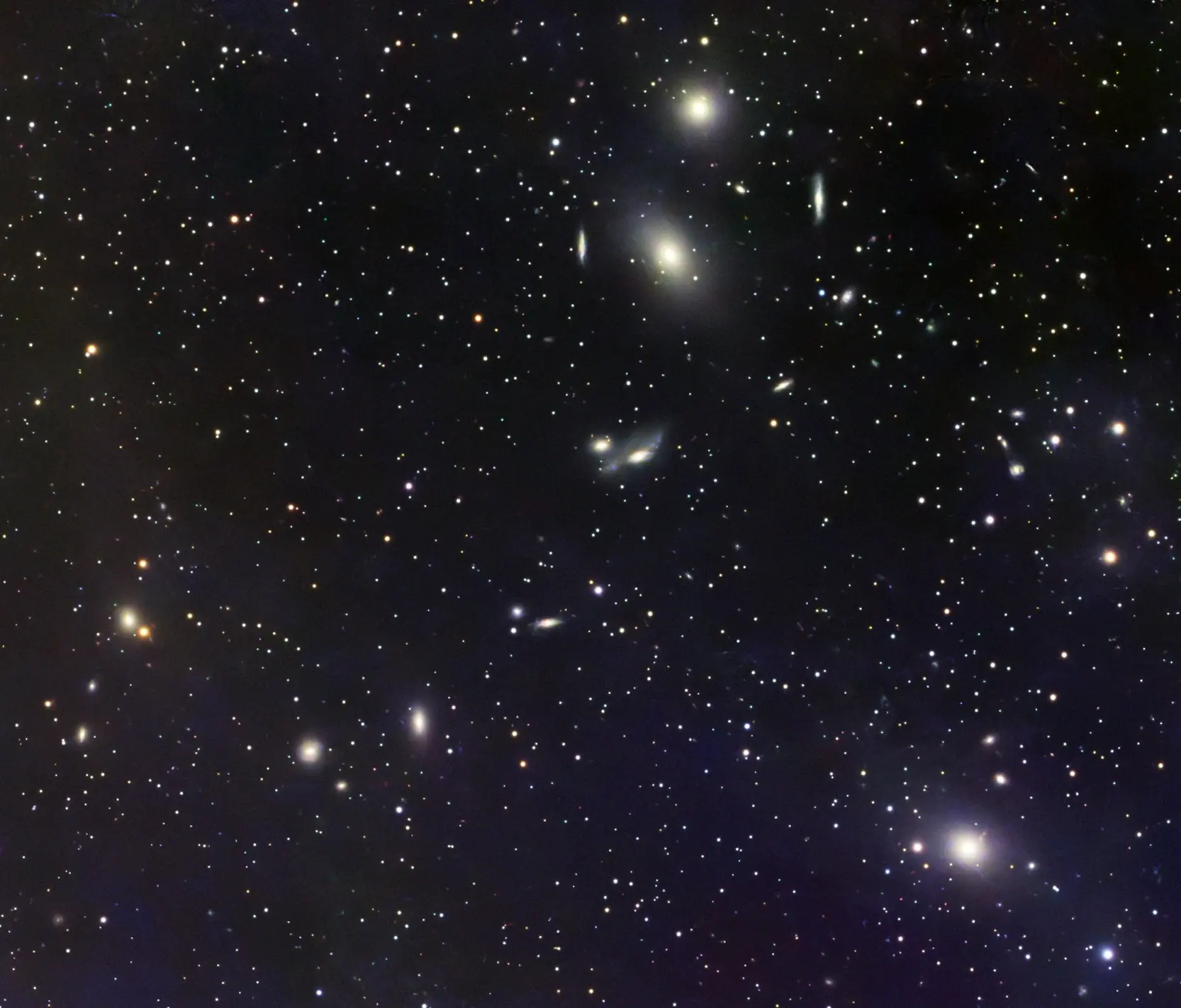
It strikes me as quietly ridiculous, sitting in Middlemarch with a telescope barely bigger than a coffee mug, peering 60 million light-years into the dark.
But there I was last week, watching a gentle arc of galaxies sweep across Virgo, trailing through the sky like a wisp of smoke from some cosmic campfire.
It is called Markarian’s Chain.

The name belongs to the Armenian astronomer Benjamin Markarian, who in the 1960s used one of the great survey instruments of the Soviet era to map groups of galaxies that appeared physically connected rather than merely scattered by chance across the heavens.
Markarian’s Chain belongs to the Virgo Cluster, a gathering of more than a thousand galaxies, all huddled together some 55 to 65 million light-years from here.
Through the eyepiece, it shows up as a gentle curve of faint, glowing smudges. Each one is a galaxy, home to billions, perhaps even trillions of stars.
Some are giant ellipticals. Others are spirals, their arms busy with newborn stars and streaks of darkness.
A few are tangled up in slow-motion collisions, galaxies nudging and pulling at each other, bound to become one someday.
Near the middle of the chain, you’ll find the well-known pair M84 and M86, big elliptical galaxies drifting among smaller neighbours like lanterns glowing in a thick fog.
Looking at clusters like Virgo has changed the way we see the universe. We used to think of galaxies as lonely islands floating in the dark, but now we know they gather in clusters, and those clusters gather into even bigger superclusters, all drifting through a universe shaped by gravity and something unseen — dark matter.
And here is the remarkable thing. Last week, I took a picture of Markarian’s Chain with a little robotic telescope sitting quietly in the Otago dark.
The light that reached its sensor set out from those galaxies about 60 million years ago; long before the first humans — even before the first primates — and finished its journey on a gadget running off a USB cable.
Benjamin Markarian needed a Soviet-era survey telescope to trace the motions in this beautiful patch of sky.
I found it with something that fits in my backpack.