
PHOTO
I learnt a new word this week. It is not a poetic word, not one that rolls off the tongue or finds its way easily into a sentence. It sounds more like something you would scrape off a laboratory bench. The word is passivation.
I came to it by way of the western sky.

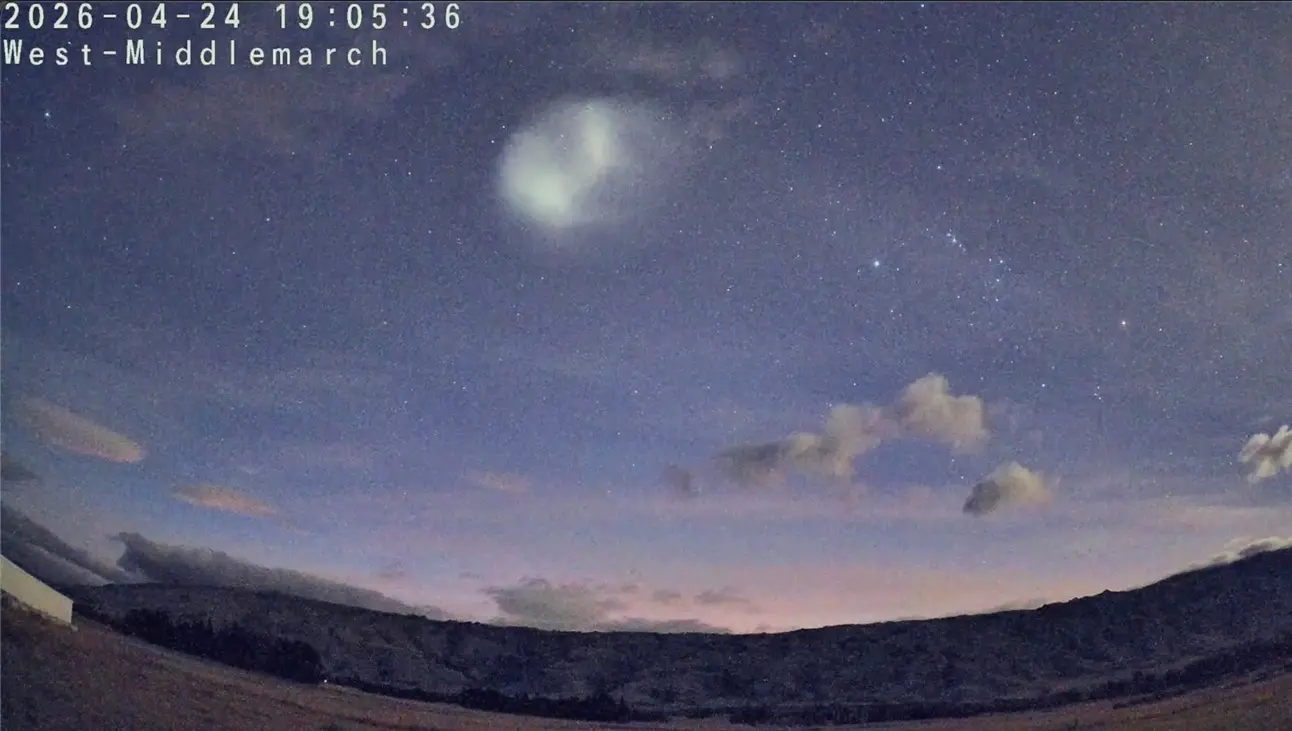
Last weekend, just after sunset, I saw something that did not belong. A bright, shifting cloud was moving steadily above the Rock and Pillar Range. Not drifting, as clouds do, but travelling with purpose. It had a faint internal glow, as if lit from within and it changed shape as I watched.
For a moment, it felt nearly alive, which is usually a sign that it is not.
My first thought was rockets. Ten years ago, that would have seemed an extravagant guess. Now it is almost the default explanation.
We have grown used to strange apparitions: spirals, plumes, luminous threads stretching across the dark. The sky has acquired a new kind of traffic.
This particular visitor turned out to be a launch from China, a Long March rocket that had lifted off about half an hour earlier.
By the time it rose into our view, the main work was already done. What we were seeing was not propulsion, but aftermath.
That is where passivation comes in.
After a rocket stage has finished its job, it is not simply left to drift as a pressurised, volatile shell. Engineers go through a process of making it safe.
Residual fuels and gases are vented into space. Pressures are released. The stage is, in a sense, calmed down. Made passive. The word is precise, even if it lacks romance.
But the act itself is unexpectedly beautiful.
Those vented gases expand rapidly in the near-vacuum, catching the last light of the Sun. They spread into vast, delicate forms — part cloud, part apparition. For a few minutes, high above our ordinary weather, chemistry becomes spectacle.
It is an odd thing to witness. A safety procedure, rendered as a kind of accidental art. A reminder of how even the most technical of human activities can leave traces that feel, briefly, like wonder.