
Taking your dog on holiday is becoming easier, thanks to the rising number of pet-friendly options. But travelling with a cat? That’s a different story altogether.
Fats is no ordinary feline. She’s always up for an adventure, provided it doesn’t take her too far from her food bowl. As her name suggests, she’s more of an eater than a hunter. I met Fats while living in Sydney; she belonged to my housemate and I had no intention of adopting. But within days, she had decided otherwise - I was hers.
We had a milestone birthday in the house, so Dan and I planned a weekend getaway for everyone - including Fats, of course. Wanting to minimise travel time (Fats isn’t exactly a fan of the car), we searched within a few hours’ drive of Dunedin. One place jumped out: St Bathans, a former gold mining town steeped in history and mystery, famous for its hauntingly beautiful Blue Lake.

St Bathans was established in the 1860s during the Central Otago gold rush, when thousands flocked to the region in search of fortune. The town, originally called Dunstan Creek, was renamed in honour of the Scottish estate of early surveyor John Turnbull Thomson.
At its height, St Bathans had more than 2000 residents, 25 hotels and a courthouse - many of which are long gone, though the Vulcan Hotel and the old Post Office still stand today.
Gold mining was so intense here that Kildare Hill - once 120m high - was entirely dug out by hand and hydraulic sluicing, eventually forming what we now know as the Blue Lake. Its surreal colour comes from mineral-rich deposits in the remaining silt.
Airbnb had plenty of dog-friendly listings, but finding a place for a cat was trickier. Eventually, I found a charming option - Coombes Cottage - that accepted pets by arrangement. A quick message to owners Dave and Lorna, and Fats was given the green light. We booked for two nights, intending to "wing" the third.
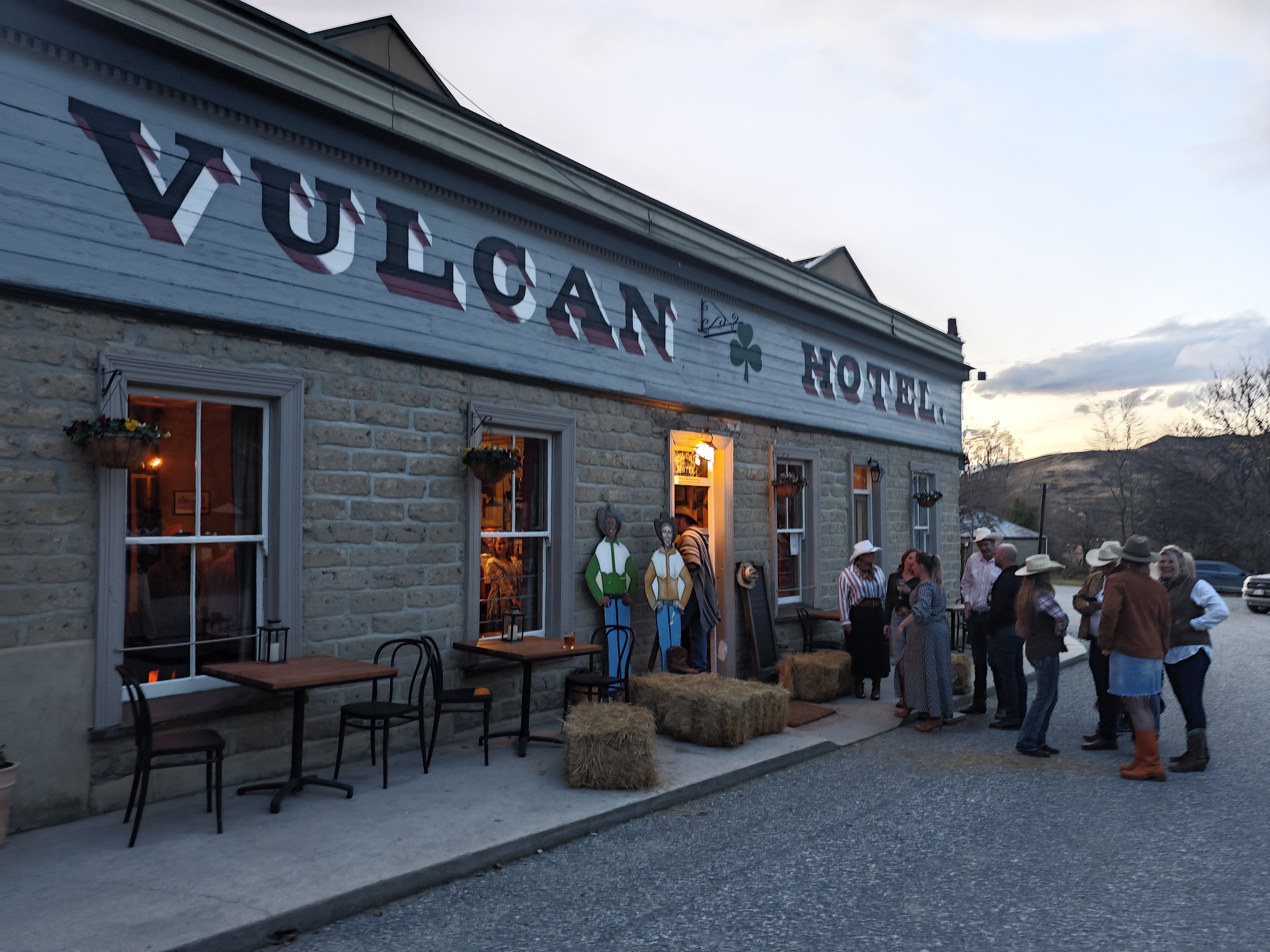
Before heading to the cottage, we booked a birthday lunch at the Vulcan Hotel - New Zealand’s most haunted pub. We took the scenic Middlemarch route, and while there was a minor incident en route (saved only by a strategic layering of jeans and long-johns), we arrived in good spirits.

The Vulcan, built in 1882 to replace an earlier stone version destroyed by fire, is the last remaining building of what was once a thriving goldfields township. It has a long-standing reputation for ghostly encounters, most notably in Room One, where the spirit of "The Rose of St Bathans" - a young prostitute named Rosie - is said to linger.
Legend has it Rosie, a popular singer and entertainer, was murdered by a client who stole her gold and dumped her body in the lake. Her killer was never found, and her presence is still keenly felt by those brave (or foolish) enough to sleep in her room.
Many who’ve stayed in Room One report unexplained experiences, particularly men who claim they’ve been pushed down into the bed by an unseen force. Unaware of this lore, and our feline companion also welcome, we booked Room Two for our third night - purely for its size.

The next morning, we ventured on foot a short distance to Cambrians, once known as Welshman’s Gully. This area was originally settled by Welsh miners during the gold rush, and its heritage is still evident in the flags adorning many cottages.
A collection of quaint, brightly coloured homes - some holiday lets, some rumoured to belong to retired All Blacks - stand as reminders of the past. Cambrians once had a school, a hall and several businesses, but today it’s a peaceful retreat surrounded by sweeping hills and stone ruins that hint at a livelier time.

He’d spent decades returning his 30 acres to native forest and has planted thousands of bulbs. We were lucky to arrive just in time for the snowdrops, though Bob said the real show comes with the bluebells in late October.

The following day, we left Fats sunbathing and snoring in her bed and set off to explore more of the region’s rich history. We lunched at the White Horse Hotel in Becks, where the publican shared a tale about an English surveyor who initially gave the local pubs Māori names. When instructed to rename them to appeal to European settlers, he simply replaced them with animal names - hence, the White Horse and others like it.

We made a loop from Omakau to Oturehua, pausing at Ophir, where the 1880s stone post office still operates. The historic bridge over the Manuherikia River remains a working reminder of the area’s boom days. In Becks, we refreshed ourselves at the Art Deco-era Blacks Hotel, where we met Daisy the pug, a resident with more charm than most tourists.
In Oturehua, we visited the historic Oturehua Hotel and the iconic Gilchrist’s General Store. Both were for sale as their longtime owners look to retire. Gilchrist’s is a treasure trove of nostalgia: jars of boiled sweets, a still-functioning post office counter, and a tiny museum of everyday items from Otago’s goldfield era. The store has served the community since the late 1800s and remains one of the oldest continually operating general stores in New Zealand.

We slept well and were unaware of Rosie’s presence - perhaps she was a fan of felines. Fats roamed the corridors in the morning before we drove home - leisurely this time and without incident.
Our weekend ended quietly, just as it had begun - with Fats dozing by the fire at home and us warmed by the discovery that adventure doesn’t need to be far from home. In these quiet, gold-dusted corners of Central Otago, the past is never far away - and apparently, neither are the cats.


