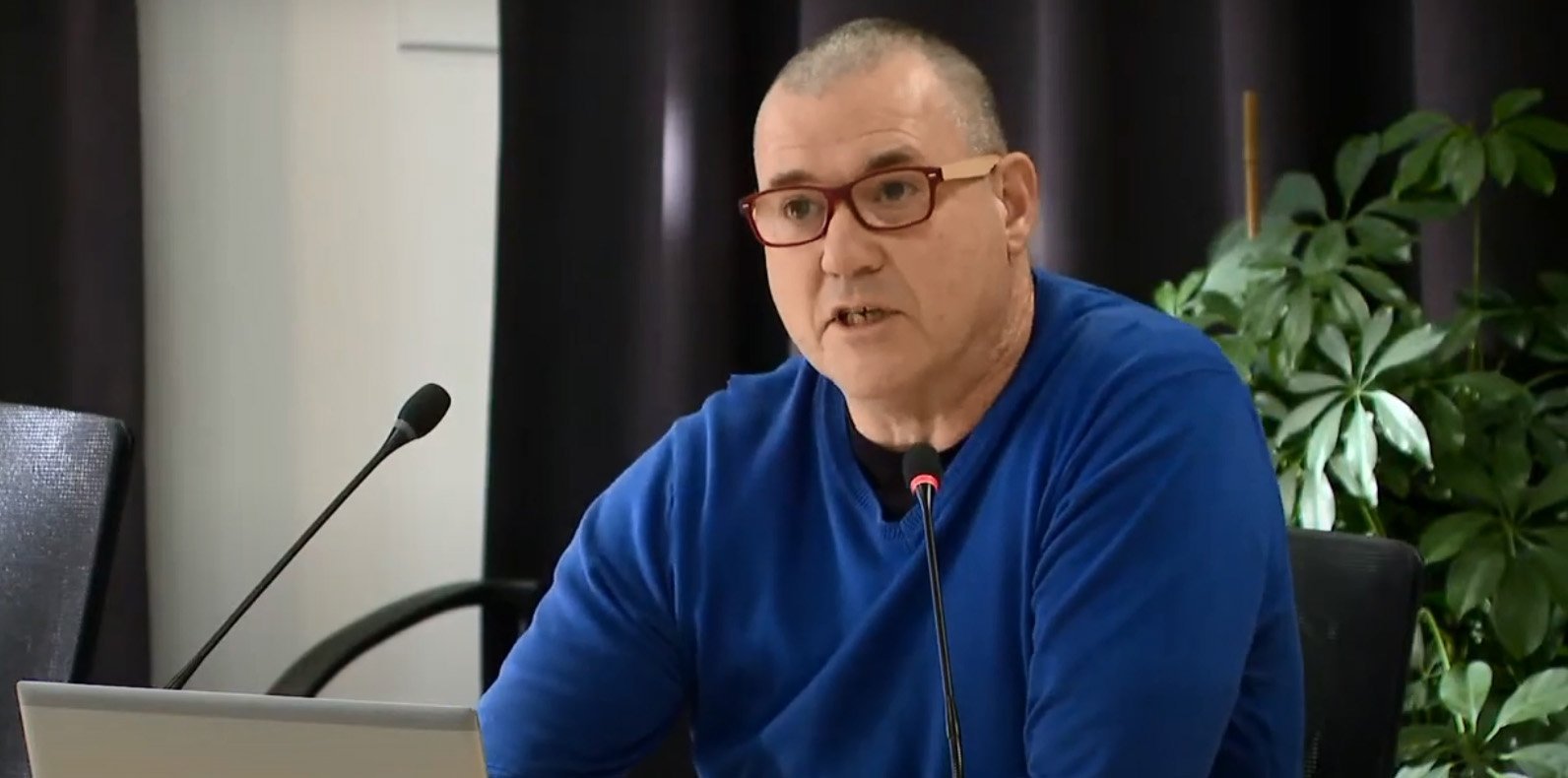
Straight-shooting professional theatre practitioner Jeremy Anderson cut to the chase.
Various audience seating configurations were thrown up on a screen and Mr Anderson told Dunedin city councillors being able to shift seats around easily was fundamental for a flexible space.
"Build a great big empty building out of shipping containers," he said.
It could serve as a temporary home for theatre initiatives until a permanent new build could be achieved.
Mr Anderson said professional practitioners were united in wanting a flexible space and he doubted they were keen on having existing buildings retro-fitted.
Refurbishing a building or three remains a live option for Dunedin and his audience may have been engaged, or exercised, by his counter-narrative on that score, particularly his dismissal of the Mayfair Theatre as a potentially meritorious redevelopment project.
If the Dunedin City Council was receptive, this could be because the city has been grappling with how it might best plug the hole created by the 2018 demise of the professional Fortune Theatre.
Mr Anderson has experience with Wellington’s Bats and Circa theatres and there has been much discussion about what is needed to establish better infrastructure for performing arts and live music — and still no resolution.
Professional theatre was sustained in Wellington through a shared-risk model where the host theatres took 15% of the box office and practitioners 85% while they steered clear of venue hire fees, he said.
Mr Anderson has often operated behind the scenes as a production manager or stage manager, but he was not backward in coming forward to give the Dunedin City Council advice last week as to how about $17 million might best be spent. He proposed allocating $5 million to building, land and equipment, putting $6 million in a term deposit to assist with venue running costs and providing $6 million to help renovate the Playhouse Theatre in North Dunedin.
This would get a facility suitable for professional theatre up and running, support talent and leave some money for the Playhouse, which would be geared more towards hobbyists, amateur and semi-professional theatre, he said.
"It makes space for our people to tell our stories."
That is one set of ideas.
The city council has yet to settle on what it should do with $17.1 million it set aside in its 2021-31 long-term plan for development of a mid-sized theatre.
In the consultation for this document, redeveloping the Athenaeum building in the Octagon was presented to the public as the preferred option, and alternatively the Mayfair Theatre in South Dunedin.
The reviews came in, mostly negative, prompting the council to decide re-engaging with the performing arts sector was warranted.
There had already been $300,000 worth of engagement led by consultancy Charcoalblue, commissioned by the council and Creative New Zealand to explore theatre solutions after the Fortune’s closure.
Unnerved by public feedback to this work, particularly from advocates for live music, the council took a step back and hoped harmony in the broader sector might develop. It began to treat live music as a separate issue.
As Dunedin Repertory Society president Jemma Adams put it, discussion of the mid-sized theatre went quiet.
Into the void stepped the Dunedin Theatre Network, an alliance formed by the owners of the Playhouse Theatre (the repertory society), Athenaeum building and Mayfair Theatre.
The venues were at risk of closure if investment was not forthcoming, it was argued.
A staged redevelopment of all three heritage venues was proposed.
The city council did not initially take to it but the network refined its proposals after running its own engagement exercises, including seeking feedback from professional theatre operatives.
They were supportive, up to a point.
However, there remained a conviction the $17.1 million was aimed at supporting professional theatre.
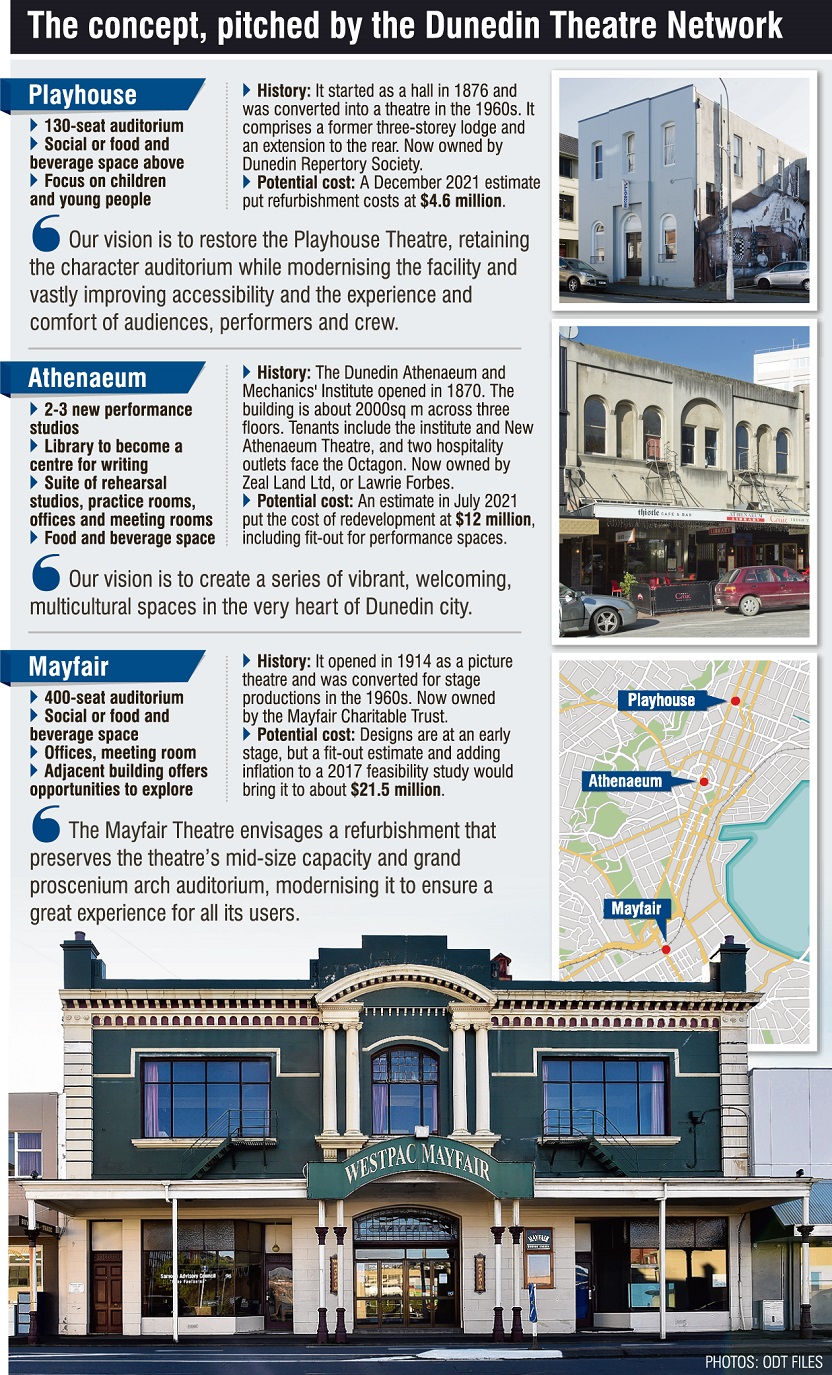
However, the council chipping in as a significant investor remained central to the concept. Indicative costs collectively approached $40 million and other potential funders had said some support from the local authority would be necessary.
"The project is still premised on council cornerstone investment," Ms Adams said.
What was needed in the interim was $100,000 from the council to help the network determine what work should be done on the three venues and how much this would cost.
Last month, the council decided it should part with the $100,000 and develop a memorandum of understanding with the network.
Councillors also decided council staff should provide an update within a year about what was happening concerning the $17.1 million allocation. This would need to be done in time for the council to decide what options might be pursued in the 2024-34 long-term plan.
Deputy mayor Sophie Barker said the arts sector needed the council to step up and deliver on its strategy promises.
"I think the process has been messy and it’s time to get clarity," she said.
Asked if it was clear what the $100,000 was for, Crs Steve Walker and Christine Garey were among those who believed it was. The council’s resolution referred to structural assessments of the three venues.
The owner of the Athenaeum building, Lawrie Forbes, did not quite characterise it this way. Some engineering assessment had been done and he described the work needed now as "architectural", or drawings and plans, and their costs.
Asked if the $100,000 would be helpful in determining where about $17 million might best be directed, Cr Garey believed so.
Cr Brent Weatherall said live music deserved a slice of the multimillion-dollar pie.
"I sincerely hope the ratepayers of Dunedin will get bang for their buck from the $100,000 grant helping council to get some clarity towards the future needs for live theatre to thrive in Dunedin," he said.
Dunedin Theatre Network project chairwoman Helen Scott agreed such clarity was important. The work would show what the venues could offer and what they realistically could not, she said.
An amended vision for the Athenaeum building was partly the result of feedback from the professional theatre sector.
Mr Forbes said a mid-sized theatre there, which Charcoalblue looked into, would have required drastic work on the building to achieve.
The network’s vision — which included studio space — would be more sympathetic to the heritage status of the building, he said.
Mr Anderson has not been alone in arguing for a new build. This was also favoured by a group that made a presentation to the council last month.
Stage South board member Karen Elliot, film producer and actor Peter Hayden and lighting designer and director Marty Roberts were particularly impressed by Te Raukura ki Kāpiti, a two-theatre $12 million facility that opened north of Wellington in 2020.
They wanted to see what lessons could be applied to Dunedin.
For Carnegie Centre owner Darryl Jones, the trio’s vision aligned quite well with his proposal for theatres to be built at the back of his Moray Pl site. Council staff have signalled this will not fly.
Ms Scott pointed out facilities regarded as community venues could still be suitable for professional users.
Cr Jim O’Malley vented a little frustration that, even now, little consensus had coalesced around one of three approaches — a new build, a pop-up theatre or retro-fit.
Cr Carmen Houlahan felt the $17.1 million had been intended to support professional theatre.
Cr Walker agreed.
"With my positive hat on, I see no reason why we can’t support some of the aspirations as highlighted by the Dunedin Theatre Network, and the needs of the professional theatre network — it just takes the will, collaboration and, of course, the dollars."