
PHOTO
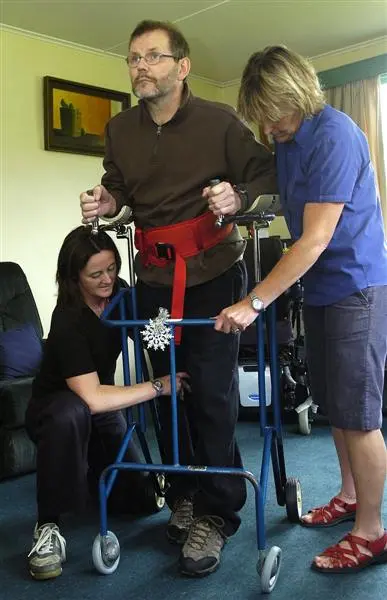
Nearly a year after having a massive brainstem stroke, Warren Palmer's sense of humour is as lively as ever.
Not that his adult sons are likely to admit it.
"His jokes are still terrible," says Nick.
"You mean he's got more than one joke?" says other son Chris.
When Mr Palmer hands me a limerick he's written about me and tells me the most challenging thing about limerick writing is keeping them clean, I wonder if I should be worried.
Writing some 30 limericks about friends, family and those aiding his recovery is just one of the things Mr Palmer has been working on recently.
He has also almost completed writing a book about his stroke experience, clocking up more than 61,000 words so far, and he is putting much of his physical energy into exercises to assist his progress towards learning to walk again.
When the Otago Daily Times called, he was having his second attempt at walking, using a frame and the help of rehabilitation staff (although he has had quite a bit of practice at standing with a frame).
He managed to go further on this session than his earlier one, completing three trips across his lounge to the kitchen, one of at least 16 steps.
Wife Loas told him she felt more tearful watching him in this session because "you did it so well".
Walking again is something Mr Palmer is determined to do.
"I imagine I can walk, therefore I can walk."
Mr Palmer, who is a senior statistics and mathematics teaching fellow at the University of Otago, had his stroke on January 26 last year, an event which resulted in him later having "`locked-in syndrome", a condition in which he was paralysed, but with his hearing intact, and only able to communicate with his eyes, blinking yes or no answers to questions.
More sophisticated communication methods followed, including an eye-transfer frame where the patient selects letters by blinking.
Once he gained some movement in his left hand, the right-handed Mr Palmer was set up with a computer and was able to tap out words.
It was March 20 before he spoke again, once his tracheostomy tube was removed.
The stroke left him with considerable right-sided weakness, which he is working to overcome.
He has had to teach himself to do things with his left hand. He can now click the fingers of his left hand, something he could not do before the stroke.
Learning to eat again has also been a major part of his rehabilitation. Swallowing requires the use of 33 pairs of muscles.
Now, he is eating most things, including chocolate.
A recent treat was a visit to a restaurant where he was able to eat risotto. He has also managed a hamburger after it was cut into small pieces.
Those working with Mr Palmer have been amazed at his progress, saying his determination, sense of humour and family support (including that of daughter Rebecca, who visited again recently) and his ability to focus on small achievements have been major contributors.
For the record, my Palmer limerick was pristine.