
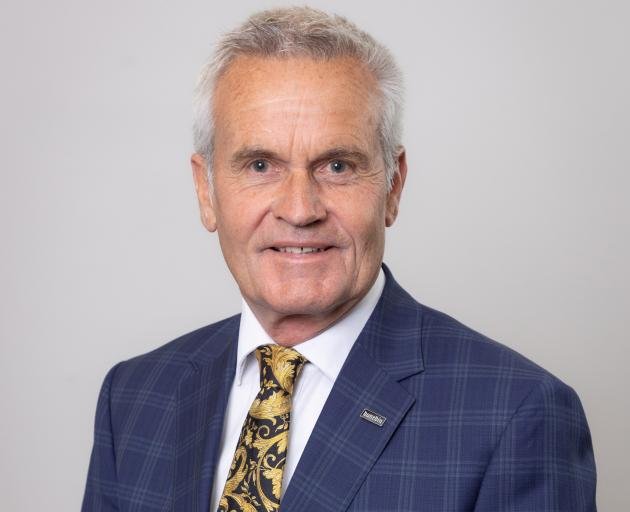
Minister for Infrastructure Chris Bishop said there was no evidence truck movements on the state highway network through Mosgiel were ‘‘unusual for this type of road’’.
He also cited data from the NZ Transport Agency Waka Kotahi (NZTA) that truck movements were about 3.4% of traffic in Gordon Rd, State Highway 87.
If the proposed inland port near Mosgiel went ahead, this would add about 150 truck movements a day, increasing the share to about 4.4%, Mr Bishop said.
The comments were contained in a letter he sent in response to one earlier this month from Taieri MP Ingrid Leary.
Several Dunedin city councillors took issue with Mr Bishop’s framing of the matter.
Cr Brent Weatherall said the present situation was untenable.
‘‘Taking percentages out of the equation, the addition of 150 extra truck movements created from an inland port could turn the ticking time-bomb of Gordon Rd into an all-out nuclear event, taking the risk of accidental deaths from a possibility to a certainty,’’ he said.
Cr Andrew Simms said Mr Bishop was ‘‘hiding behind percentages as the politician’s friend’’.
The latest NZTA count was 492 heavy vehicles a day were using the main street of Mosgiel, he said.
‘‘In daylight hours, this is one heavy vehicle every two minutes.’’
Cr Simms said Gordon Rd was completely unsuitable for large heavy trucks.
Cr Mickey Treadwell said Mr Bishop was cherry-picking his data.
‘‘The issue is that truck movements have increased markedly on a road that was never meant for them in the first place, creating serious safety concerns, as well as congestion.’’
Mosgiel-Taieri Community Board chairwoman Rebecca Shepherd said a Dunedin City Council transport study in 2013 recommended heavy traffic be separated from the vulnerable Mosgiel population.
‘‘The population of Mosgiel has grown by close to 50% since that study and associated traffic volumes have increased, yet nothing significant has been done to address the issue,’’ she said.
Ms Leary highlighted other comments from Mr Bishop.
The government was committed to realising the advantages of the inland port, assuming it gained consent, while mitigating any potential impact on the safety and resilience of the Mosgiel transport network, he said.
‘‘The responsibility for downstream impacts, in this instance, lies with local councils,’’ Mr Bishop said.
The council could identify its concerns through the fast-track consent process and propose proactive mitigation measures, he said.
The minister appeared to be signalling local councils could carry much of the responsibility for managing the downstream transport impacts of the fast-track process, Ms Leary said.
‘‘That raises legitimate concerns about whether communities could be left dealing with the infrastructure consequences of a nationally significant freight project without clear commitments from central government or NZTA around mitigation, upgrades or funding,’’ she said.
Cr Treadwell said this was ‘‘a feature of the fast-track programme — not a bug’’.
Cr Doug Hall was worried about the same issue.
‘‘If central government wants to enable major growth and freight projects through fast-track processes, there also needs to be a genuine partnership around infrastructure planning, mitigation and funding support.’’
Mrs Shepherd said if both central and local government were short of funds, then Mosgiel residents could ‘‘wind up paying for the increased residential and commercial development by way of heavier traffic, greater congestion, reduced safety and a considerably compromised main-street environment’’.
Ms Leary said fragmented consenting and piecemeal infrastructure planning did not make sense.
‘‘Communities deserve confidence that the long-term implications for road safety, freight routing and infrastructure investment are being addressed upfront — not retrospectively once growth pressures and safety risks have already intensified.’’


