Where none can see behind the sturdy facade
The country masses at the township's gates, the solid facade of the Palmerston Town Hall, the...
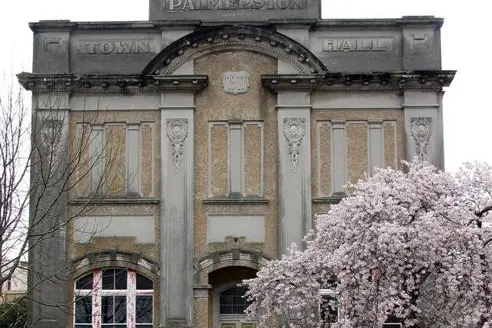
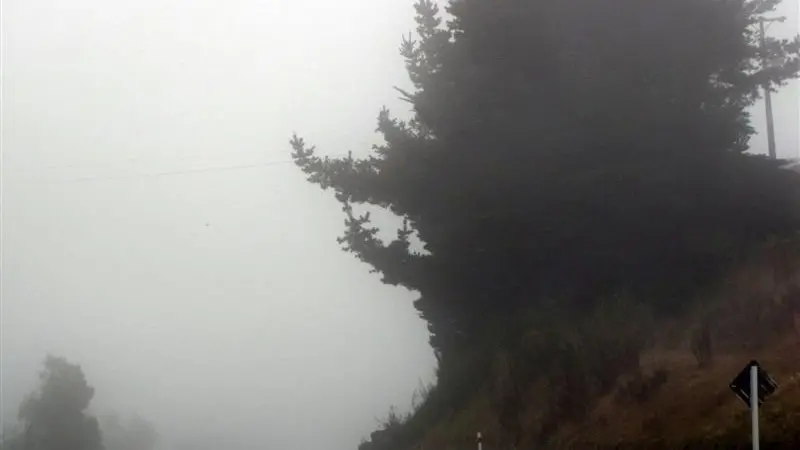
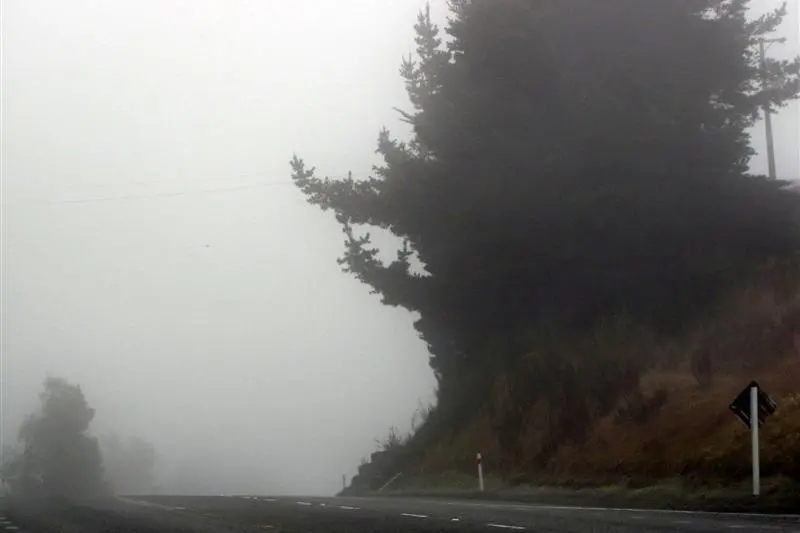
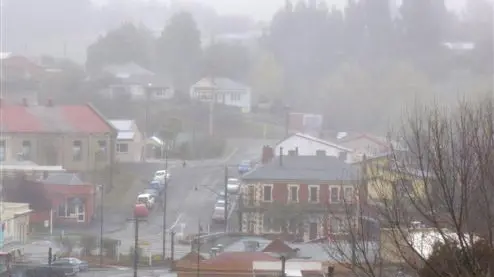
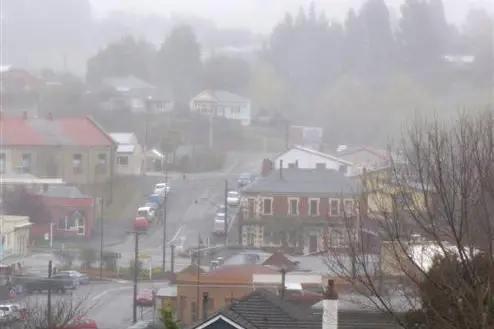
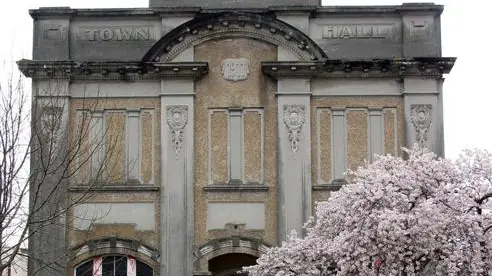
The country masses at the township's gates, the solid facade of the Palmerston Town Hall, the grey mist descends, and the curious grid pattern town forced by planners on an unruly set of slopes. Photos by David Loughrey/Google Maps.
The country masses at the township's gates, the solid facade of the Palmerston Town Hall, the...
The country masses at the township's gates, the solid facade of the Palmerston Town Hall, the grey mist descends, and the curious grid pattern town forced by planners on an unruly set of slopes.
The country masses at the township's gates, the solid facade of the Palmerston Town Hall, the...
The country masses at the township's gates, the solid facade of the Palmerston Town Hall, the grey mist descends, and the curious grid pattern town forced by planners on an unruly set of slopes.

From a small city with a solidly built facade, DavidLoughrey heads north though mist, motorways and rolling meadows to find a small township with a solidly built facade. Through a heavy mist he glimpsed some strange sights, but learned a lesson in staying quiet.

The road at the stop sign at the intersection of Kirkwall and Runbrake Sts is on a slight slope.

Near the corner a macrocarpa hedge sways over a bare clay bank, where a single root breaks through, then burrows back into the soil.

It is the sort of bank schoolchildren might scuff and poke with sticks on a slow walk home, or where an elderly man may stop, sit and ponder the incoherence of his youth.

It is the sort of spot one can happily sit in a car at the stop sign for ages without fear of upsetting other traffic - without fear of upsetting anyone, really - where the rural meets the only-just-urban, where very occasional motor cars wheeze and patient horses snort.

It is Palmerston.

East Otago.

The home of rolling hills.

A grid pattern town forced by planners on an unruly set of slopes.

If you have a quiet afternoon, you can go there for something to eat, and a bit of a look, and the glimpse through the mist at your own little town.

From Dunedin, the route north quickly ascends into a grey, wet fog, from which car lights swerve and stock and logging trucks thunder.

Massive trees take on the darkest aspect, and the world contracts to a grey-framed flash of white lines and cats' eyes.

Paradise ducks honk in the distance like mournful trumpet players in an out-of tune duck band.

As East Otago sails by, the hills begin to smooth and flatten.

The Waikouaiti-Palmerston Rd rises from the final valley on the journey, reaches a peak, and a wet little town comes into view.

The upper slopes of the local hill, Puketapu, are lost in the mist.

What do we know of Palmerston?

Here are some facts: The population is 795.*

On the main street, there is a shop advertising a display of model ships and gypsy caravans.

Nobody from Palmerston identified their ethnicity as Middle Eastern, Latin American or African in the 2013 census.

Palmerston is 52km from Dunedin, according to local road signs.

New Zealand Sign Language is used by less than 1% of residents.

It is a town of young and old.

At 3pm, a thicket of hooded youths are on the march down Ronaldsay St, sailing who-knows-where through the thick mist.

The median age is 49.1 years, compared with, say, Dunedin, where it is a vigorous 35.

A full 28.8% of people in Palmerston are aged 65 years and over.

A quiet observation of the main street of Palmerston uncovers more about this small, solid town that huddles in the lee of Puketapu, sheltered from the winds of change.

An elderly couple weaves slowly, gently down the street towards the pharmacy.

A man with a beanie and muddy trousers follows.

A tired brown dog sits.

Of course, the main street is not all on country time.

Palmerston serves the heady rush of cars racing to and from Oamaru, and other centres of regions to the north.

Those cars sweep boldly through the mist before braking suddenly and lurching into a row of angle parks, attracted maybe by the opportunity to buy a hot dog on a stick, pre-dipped in tomato sauce and kept warm for the customer in a cabinet near the cheese rolls.

Wet riders straddling muscular Japanese rockets lean into the petrol station for a top-up, before rumbling down to the railway station for a coffee.

None can see behind the sturdy facades of buildings like the very substantial Palmerston Town Hall (built in 1911).

But drive up any side street in Palmerston and you will discover the town is just a tiny village with delusions of grandeur, situated in a paddock.

Drive up any side street and you'll see crowds of sheep pushing against the town's fences, baying to get in.

Sharp-eyed chickens patrol every hilltop, looking for the slightest gap in defences that might allow entry.

A small pig hides behind a bush, peering through the branches at a padlock on a gate, wondering how he might steal the key.

For the country is so very close at hand - despite the grand plans of early settlers.

Of course, every town has its facades, and every centre its closely held delusions.

Perhaps, through a quiet decent politeness, we accept the facade and don't question or blithely dismiss it.

We do that in the comforting knowledge everybody else is too polite to question or blithely dismiss our own.

Otherwise they might look at our centre too closely.

They might look at the solid facades of Dunedin, and question our sense of self, and once elaborate plans to be grand and important.

Thank God they are too polite.

* Statistics taken from the 2013 census.

Add a Comment


Advertisement