
PHOTO
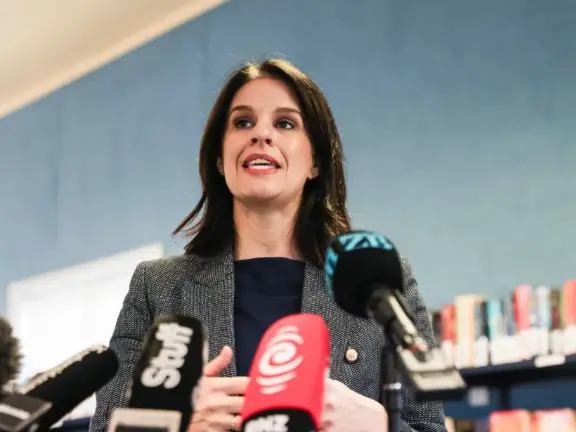
The government has confirmed the NCEA replacement will bring a new grading scale, compulsory subjects, and assessment requirements.
Prime Minister Christopher Luxon and Education Minister Erica Stanford made the announcement in Orewa, North Auckland today.
In March, the government confirmed that NCEA would be replaced by a new subject-based qualification over two years
The new qualification will be the New Zealand Certificate of Education (NZCE) at Year 12 and the New Zealand Advanced Certificate of Education (NZACE) at Year 13.
Luxon said in his speech that the current NCEA qualification was "hard to navigate".
"It doesn't give our kids and our prospective employers a clear indication of how that student has gone at school mastering the material."
He said the Certificate of Education and the Advanced Certificate of Education would replace that system bringing several changes.
"Gone is the ability to make up your overall qualification by choosing between thousands of different standards. Gone are fully internally assessed subjects. Gone is the ability to avoid exams."
Stanford said the current curriculum was more about "credit crunching than actually making sure that you're progressing through a curriculum that sets you up for life."
She said the new qualifications had been put together with the help of a professional advisory group, a technical advisory group and a curriculum advisory group.
In addition to Level 1 being removed in 2028, in 2029 year 12 students will begin the new New Zealand Certificate of Education (NZCE) and in 2030 year 13 students will take the New Zealand Advanced Certificate (NZACE).
"Students in year 12 and 13 will study at least five subjects each year with a pass of a minimum of three subjects required to achieve the qualification... The number of subjects passed will be clearly outlined."
She said obtaining the new literacy and numeracy Foundational Award, benchmarked at Year 11, will be a requirement to gain the new qualification.
"The new qualifications will introduce a six-point grading scale from A+ to E for every subject, making achievement easier to understand for parents, employers, tertiary providers and students themselves."
From 2028 the compulsory subjects in Year 11 will include science (pūtaiao), English (te reo rangatira) and mathematics (pāngarau).
Stanford also confirmed some of the new subjects that will be introduced into the curriculum including Civics, Politics and Philosophy, Advanced Mathematics and Journalism, Media and Communications.
"Also included are industry-led subjects being developed by Industry Skills Boards that will be included in the qualification with parity of esteem alongside the Ministry subjects. These include subjects like building and construction, outdoor education and primary Industries."
"This qualification rewards hard work and is designed to encourage young people to strive to do their very best, and ultimately to feel proud of what they achieved," Stanford said.
She confirmed every subject will include internal assessments and an examination, with the weighting of the examination varying depending on the curriculum area and the nature of the subject.
She added that certificates will show how many subjects a student has passed, along with the grade achieved in each subject.
Students who achieve excellent results across all five subjects will also be eligible for endorsement awards.
Stanford said current Year 9 students will be the first cohort to progress through these changes.
Luxon also touched base on other issues at the beginning of his speech saying the world is "changing and we are at an inflexion point".
"Countries are moving from working together under international law to much more transactional relationships without shared rules."
"... in a more volatile world, we must focus on controlling what we can control. And I'm telling you, that starts here at home. It starts by strengthening our collective national security."
He said the government had responded in some ways including ending the offshore oil and gas ban, clearing red tape and signing the India FTA.
Luxon also responded to what he said were recent suggestions by journalists and commentators about the possibility of a National and Labour "grand coalition".
"I gotta say to those journalists and commentators, you need to get real because our team, our team has spent the last two and a half years trying to fix the very mess left behind by the Labour Party."
