

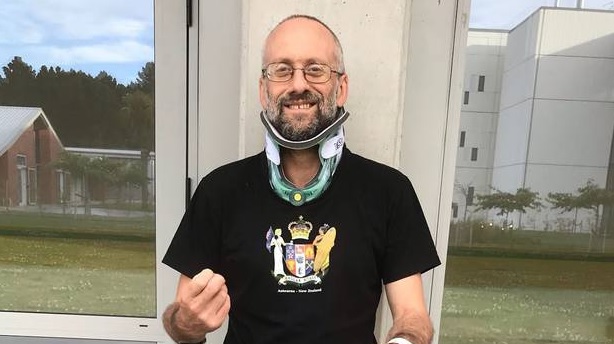
Motueka-based Ian Hunt (55) said he had long-time tramping mate Anthony Oakly (60), who hiked 20km in the dark to raise the alarm, and the Nelson Marlborough Rescue Helicopter team to thank for essentially saving his life.
Hunt and his brother-in-law Oakly, also from Motueka, had spent the afternoon of January 27 "hut bagging" in the rugged area near Molesworth Station.
The pursuit involved visiting as many huts as possible, and on this occasion they tackled several huts in the Molesworth area over 20km before stopping for the night at Severn Hut.
About 2.30am, Hunt popped outside on to the veranda "to take a leak", when he suddenly fainted.
"I have a medical condition called micturition syncope, which means I can faint sometimes when I urinate," Hunt said.
"It hadn't happened for a long time, and it definitely wasn't the best time to happen while taking a leak off the veranda."
While it was only about one metre high where he was, Hunt fell on his head, knocking himself unconscious briefly and damaging his spinal cord, paralysing him.
"I could breathe, but I couldn't talk. It was several minutes before I could even groan."
Oakly was inside, asleep at the time, but awoke soon after to "someone moaning outside".
He found Hunt lying on his back in the tussock below the hut veranda, paralysed and barely conscious.
"I think he thought I was just being a bit silly," Hunt said.
"Then he realised I couldn't move."
Oakly, who volunteers with the Motueka Land Search and Rescue team and has extensive first aid training, assessed his mate as having a severe spinal injury and potential concussion.
But it was then he realised he had left his personal locator beacon at home.
"I always take it, but the battery was flat and I thought it was such an easy trip we wouldn't need it," Oakly said.
With no cellphone coverage, Oakly helped his mate become as comfortable as possible before setting off about 3am down the Severn Valley, crossing five rivers and navigating "angry cows" before reaching Molesworth Station Rd some 15km away.
With no vehicles nor houses to be seen, he set off for the station some 20km up the road.
After about 5km a vehicle passed by and took him to the nearest Department of Conservation hut, where they were able to raise the alarm through a ranger at about 8am.
The Nelson Marlborough Rescue Helicopter reached Hunt at about 9.30am.
Hunt said it was an "awesome" feeling to see the helicopter coming.
"I didn't think I was going to die, but I was just in so much pain due to my spinal cord injury," Hunt said.
"All night, every small sound I thought it was the helicopter, so it was awesome to actually see it."
By that stage the summer's day had heated up, and the blankets he was wrapped in during the cool night were now overheating him. Due to his paralysis Hunt couldn't even use the water bottle Oakly had left for him.
"That was almost the worst part. I was severely overheating and dehydrated."
The rescue team took him straight to Christchurch Hospital, where he spent three days before being transferred to the spinal unit at Burwood Hospital.
He had a "hypertension injury" in his spinal cord, and it took him nearly two weeks of intensive physio and occupational therapy before he could walk again unsupported and be discharged.
While more than two months later his walking had improved greatly, he still lacked much feeling in his lower body.
He was scheduled for some neck surgery soon, which would improve his ability to walk on rough surfaces.
"After that I am hoping I can get back in the outdoors," Hunt said.
He was incredibly thankful to his mate, the rescue team and staff at the hospitals who got him back on his feet.
"They were amazing, I probably wouldn't have survived without them."
The tramping mates both said their experience was a reminder that "anything could happen" in the outdoors, and to always take their PLB.
Oakly said it was a different experience to be involved in the rescue of a good mate rather than his regular LandSAR work.
"Usually it is people you don't know. But I just did what I had to do."


