
PHOTO
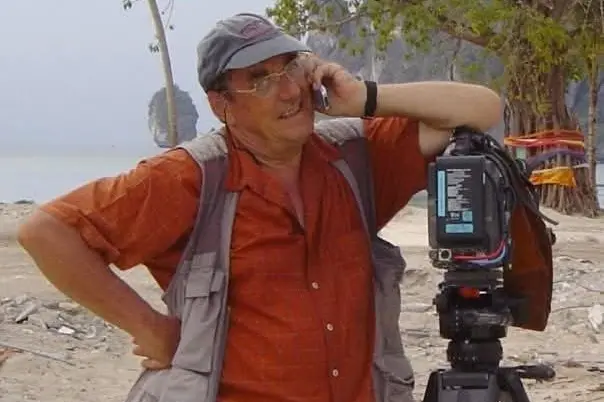
Queenstown-born and Otago-raised Derek Williams belied his small town origins to be present on some of the biggest stages in history.
The journalist was a sound operator and then a camera operator, cutting his teeth by covering the Vietnam war before bringing images of the Boxing Day tsunami, the Tiananmen Square crackdown, the Afghan war and turmoil in the Middle East to millions of homes worldwide.
Williams was an Emmy and Peabody-winning CBS News camera operator and a founding partner of the Bangkok production house AsiaWorks, and he spent close to five decades documenting the defining conflicts and upheavals in Asia during the late 20th century.
Although Williams was incredibly well travelled, he never forgot where he came from. He was a regular visitor to the South, and after his death in Christchurch on July 22 aged 79, he asked that half his ashes be interred in Bangkok and the remainder in Queenstown.
Williams was born shortly after World War 2, the son of Rev Philip Williams, Anglican vicar of Queenstown, and his wife Jean (nee Bell), a registered nurse and dietitian.
A year later the family move to Lawrence and then later on to Roxburgh, to tend a flock of dam workers at the Tuapeka parish.
The family then moved to Waikouaiti, which counted Karitane as one of the churches Rev Williams was responsible for; he taught himself Māori to preach to the people in their own language
In 1960 Williams was enrolled at King’s High School living with his father’s cousin, and fellow clergyman, Harold Harding. Williams did not settle well, chafing at the school’s discipline and hating the then compulsory Latin classes.
When Rev Williams was reassigned to Holy Trinity Church, Gore, his son happily transferred to the local High School, where he played first XV rugby. He also joined the local pipe band and learnt about drinking, something which prepared him for the pressure cooker atmosphere of war zone journalism.
Having decided not to attend university, Williams became a trainee radio technician at the New Zealand Broadcasting Corporation (NZBC) initially working at Radio 4ZA in Invercargill.
Newly fired with ambition Williams applied for a job transfer, but no radio jobs were available. He was asked if he would be interested in a position at a newly formed department named ‘‘Film Sound’’ in Wellington, aimed at training staff for the then new television business.
‘‘I said ‘yes’, and the rest is history,’’ Williams said.
Williams did the sound for two TV dramas, the award-winning Green Gin Sunset (1969) and The Killing of Kane (1970).
The following year fellow New Zealand sound man Dave Thomas rang to say that his US network, CBS, had promoted him, and that a replacement film sound man was needed in its Hong Kong bureau. CBS News took him for a thee-month try-out; he worked for them until 1991.
‘‘I was doing sound with Udo, a very professional German camera man, who told me I’d get used to it and I’d get a rhino skin to do this job,’’ Williams said.
‘‘As time went on, I did learn to block everything else out as I focused on getting the footage.’’
Williams went on to cover some of the most significant events of the late 20th century, including the refugee exodus from Bangladesh into India, the 1968 student riots in Tokyo, the final years of the Vietnam War, the Narita Airport protests in 1971, the Thammasat University massacre in Bangkok in October 1976, the Soviet invasion of Afghanistan in 1979, the wars in Beirut and between Iran and Iraq in the early 1980s, the People Power revolution in the Philippines in 1986, not to mention the Tiananmen Square crackdown in 1989, and the Gulf War in 1991.
In 1975, as Saigon fell, Williams married his Vietnamese partner Tran Thi Thu Ha.
‘‘I was convinced by various intelligence officers that Saigon was going to fall. I asked my boss if I could head over to Saigon, as I wanted to ensure that Thu Ha and her family were able to leave Vietnam,’ Williamson said.
``Once there, I had to convince a doubting future wife that Vietnam was truly going to fall. She didn't want to leave — she'd either leave with me or with her family, but not alone. She was not going to let me put her on a plane by herself. So there was only one thing for it, we got married.
‘‘I'd won a bunch of money in a poker game in the radio room of CBS News so I bribed the registry office to stay open on a Sunday (April 20). The registrar was blind, and deaf in one ear and really quite a character. The only one in the audience was the cleaning lady who thought my sister-in-law was the bride because she was wearing a beautiful ao dai and my wife and I were wearing blue jeans.’’
The next day Williamson went to the New Zealand Embassy and to get a passport for his wife: ‘‘Frank Wilson, the charge d'affaires at the Embassy, broke open a crate, pulled out a passport, glued Ha’s photo into it, stamped and signed it.’’
The couple escaped to Hong Kong, and soon after moved to a new CBS bureau in Bangkok bureau. Three years later the couple adopted Ki (Tran Quang Vu) and Ti (Trab Quang Dzung), children who had just left Vietnam.
While Williams had plenty of adventures, his was a job which also had plenty of danger.
When Soviet forces invaded Kabul in late 1979, Williams found himself under house arrest at the Holiday Inn alongside photographer Hugh van Es, who was on assignment for Time magazine.
In 1981 Williams had the rare experience of being able to work in New Zealand, after CBS sent a team including him to cover the early weeks of the tumultuous Springbok tour.
And in 1989, during the Tienanmen uprising in Beijing, Williams was arrested at gunpoint together with CBS correspondent Richard Roth, marched to the Great Hall of the People and interrogated inside the Forbidden City.
The duo were released later that day after signing confessions absolving Chinese authorities of any responsibility.
Arguably a greater ordeal awaited though: TVNZ had set up an interview with Williams after his release and host Paul Holmes surprised the cameraman by having his mother Jean join the broadcast.
‘‘My first thought was ‘You bastard, I know you will just try to make her cry’. And he did try, but stoic Jean just muscled on and replied in complete, concise, sentences. I was silently cheering her on,’’ Williams recalled.
‘‘I was so proud of my mother when Holmes asked her, ‘Don’t you wish Derek would stop going to wars and things and come home to quiet old New Zealand?’ and her response was, ‘He loves his job and would be quite miserable here. But I feel sorry for all the Chinese mothers who don’t know where their children are tonight’.’’
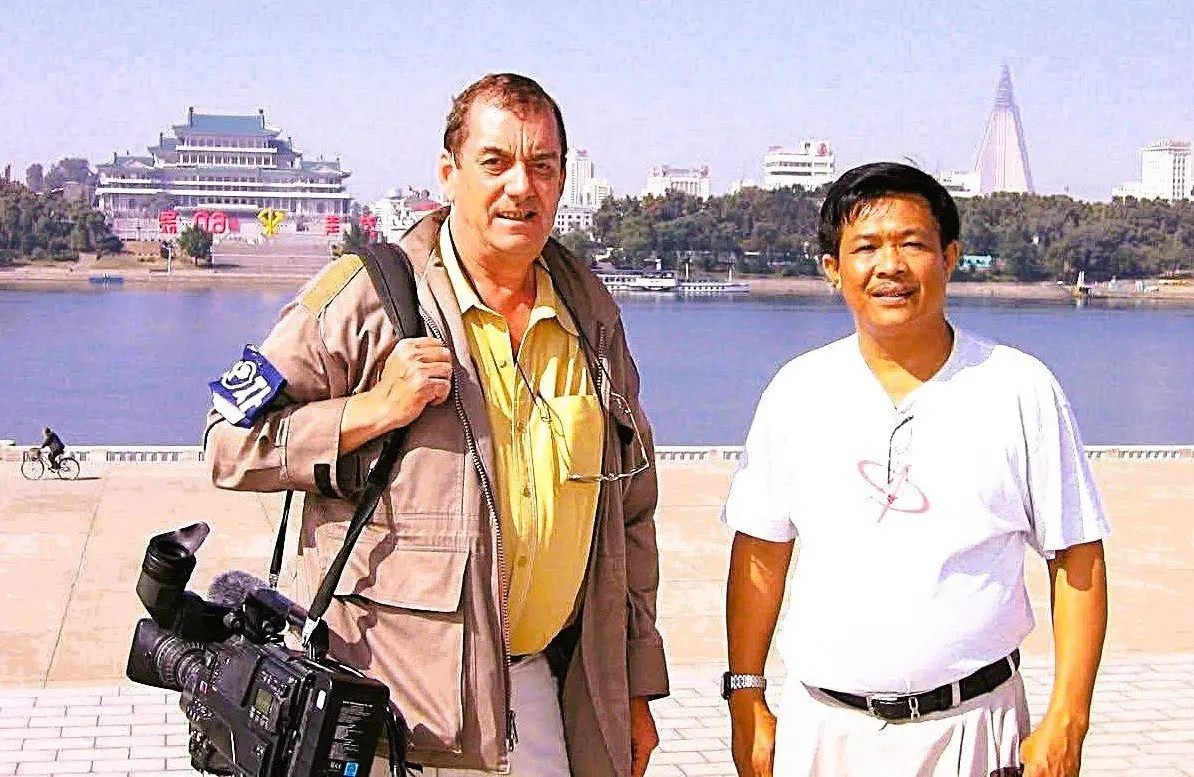
After being laid off by CBS in 1991, Williams co-founded AsiaWorks in 1996 with Marc Laban, Heather Kelly and David McKaige, building what became a major regional broadcasting hub from Bangkok's Maneeya building, also home to the Foreign Correspondents' Club of Thailand.
He went on to become something of a fixture at the club, always willing to impart a little wisdom to younger journalists turning up for a beer.
Williams was known as much for the journalists he shaped as for the history he filmed, and there are numerous tales of his tutoring and guiding young journalists in what can be a brutal region to cover.
For AsiaWorks Williams continued to travel to the world’s hotspots; assignments included Operation Desert Shield and Operation Desert Storm, various economic and political summits, and the 2004 Boxing Day tsunami, which Williamson called one of the defining stories he covered during career.
Williams retired in 2017, and the family resettled in Irvine, California, close to some of Ha’s family. They were also regular visitors to San Francisco, where Ki was living,
In 2020 Williams was diagnosed with Parkinson’s disease, and five years later he came home to New Zealand to move in to a care facility in Christchurch. In March this year he was diagnosed with oesophageal cancer.

Derek Williams is survived by his wife of 51 years, Thu Ha; his sons Ki and Ti, and grandson Nikhil.
On Facebook, former CBS News anchor Dan Rather said he was deeply saddened by the news.
‘‘He was one of the bravest and a great CBS News cameraman. The images he captured beautifully told the story of a dangerous world, from the Middle East to South Asia and beyond. He was also a great man.’’
- Asia Media Centre/Allied Media, with assistance from Chrissie Williams.