
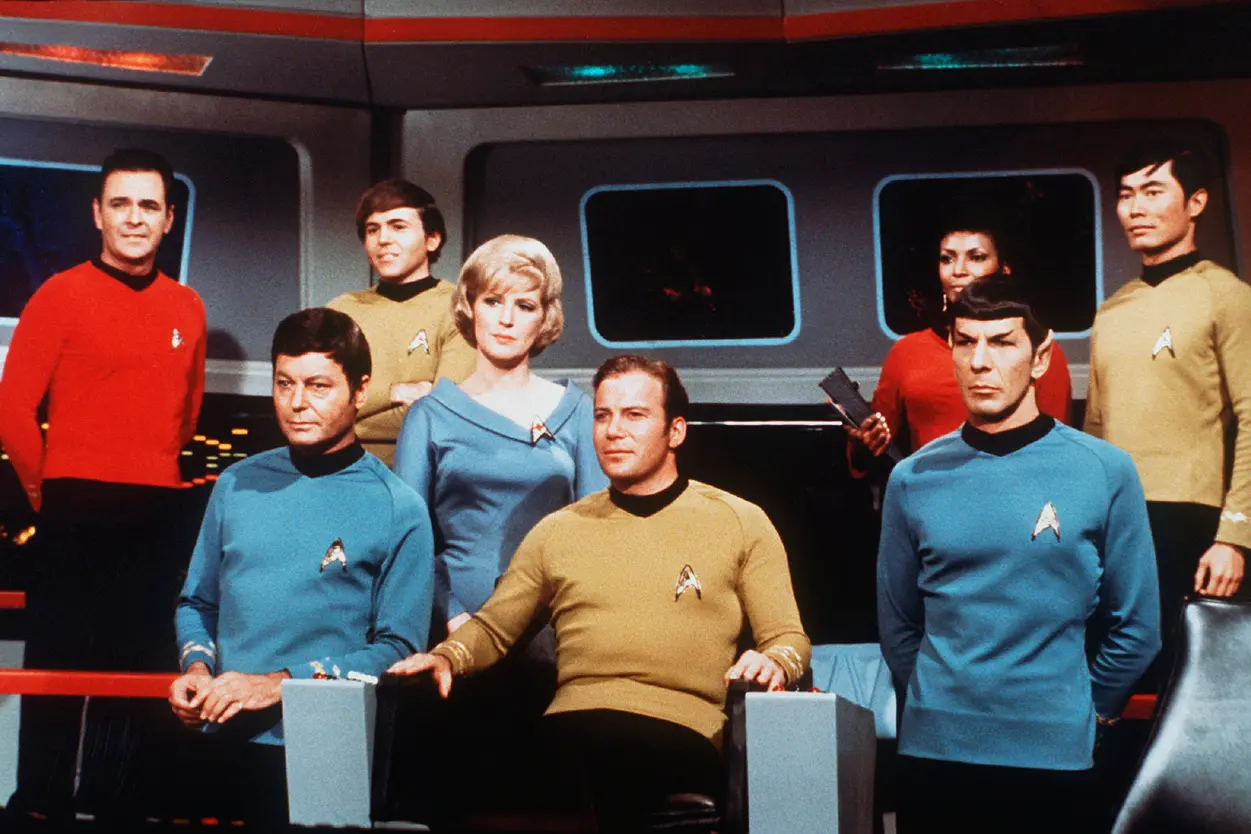
PHOTO
When Star Trek first appeared on television screens 60 years ago, audiences expected science fiction to offer aliens, monsters and futuristic technology. What they encountered was something far more ambitious.
From its very first broadcast episode on September 8 1966, Star Trek established that its true subject was the exploration of humanity itself. For all its reputation as an action-packed space adventure, the franchise has endured because it repeatedly returned to a universal question: what does it mean to be human?
In that first episode, entitled The Man Trap, the alien antagonist survives by appearing to each observer as the person they most wish to see. Dr Leonard “Bones” McCoy meets a lost love from his past; others see figures shaped by memory, expectation, desire and longing.
The creature, soon dubbed the “salt vampire” by fans of the series, is not simply a shape-shifter. Its power lies in exploiting human perception.
Rather than asking viewers to fear an alien with superior strength or advanced weaponry, the episode asks a more profound question: can we trust our experience of reality?
Sixty years on, this question looks remarkably prescient. Modern neuroscience increasingly suggests that perception is not a passive recording of the external world. According to theories of predictive processing, the brain continually generates expectations and compares them with incoming sensory information.
Long before such ideas were articulated, The Man Trap imagined a world in which people confront the same reality, but perceive it in profoundly different ways – based not only on what they see, but what they want to see.
This insight links the episode to a much older intellectual tradition. The ancient Greek philosopher Plato’s allegory of the cave imagined people mistaking shadows for reality, confusing appearance with truth.
The USS Enterprise crew’s first alien encounter offers a 20th-century variation on the same theme. They actively participate in their own deception because the creature reflects their hopes, memories and desires.
Star Trek’s memorable debut was not an isolated exploration of a philosophical problem. It was the beginning of a broader inquiry into the nature of humanity.
The Devil in the Dark (first aired March 1967) explores empathy and the challenge of understanding the unfamiliar. The apparently monstrous Horta is revealed to be an intelligent life-form protecting its offspring, forcing viewers to reconsider assumptions about difference and otherness.
The Enemy Within (October 1966) shifts the inquiry inward, splitting Captain James T Kirk into opposing aspects of his personality and challenging the assumption that human beings can divide their virtues from their vices.
The City on the Edge of Forever (April 1967), regarded by many as the series’ masterpiece, shifts the focus to ethics. Kirk discovers that saving the woman he loves would alter history catastrophically, forcing him to choose between personal happiness and moral responsibility.
Together, these and many more of the 79 original Star Trek episodes form a remarkable investigation into human nature. The progression reveals a series less interested in strange new worlds than the human beings who encounter them.
While many science-fiction programmes have aged with their technologies, Star Trek has endured because its deepest questions remain unresolved. We still debate perception, identity, empathy, consciousness and moral responsibility, because they are permanent features of human existence.
At its best, Star Trek engaged science fiction as a form of philosophical inquiry.
Alien civilisations became thought experiments about prejudice and empathy. Time travel became a vehicle for exploring ethics. Artificial intelligence became a means of questioning consciousness and identity. The future it imagined served as a laboratory for understanding ourselves.
The original Star Trek’s lasting legacy is not technological prophecy, but a sustained exploration of what it means to be human. Its enduring achievement lies not in predicting mobile phones, iPads or video calls, but in recognising that the most fascinating and vexing mystery remains humanity itself.
The final frontier, it suggests, lies not among the stars but within ourselves. — theconversation.com
- Stephen McVeigh is a Professor of History, Swansea University