

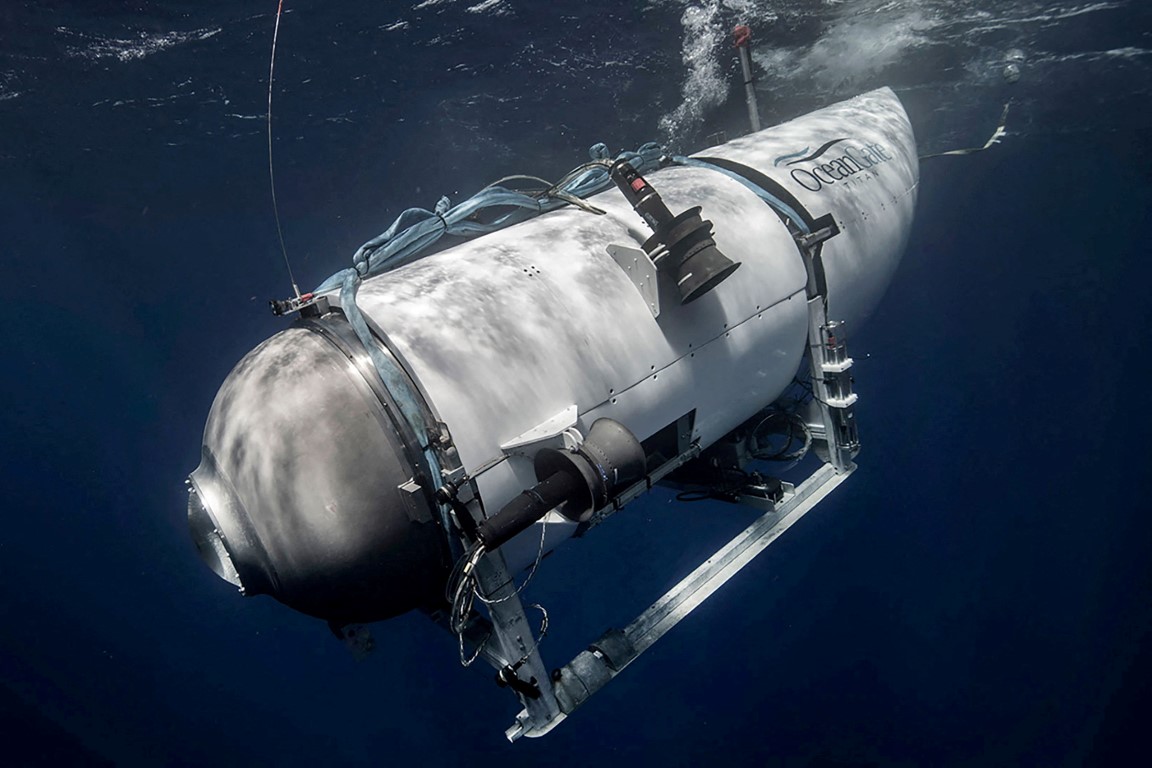
A deep-sea submersible carrying five people on a voyage to the century-old wreck of the Titanic has been found in pieces from a "catastrophic implosion" that killed everyone aboard, the US Coast Guard said, ending a multinational five-day search for the vessel.
A robotic diving vehicle deployed from a Canadian ship discovered a debris field from the submersible Titan on Thursday morning (local time) on the seabed some 488metres from the bow of the Titanic, 4km beneath the surface, in a remote corner of the North Atlantic, US Coast Guard Rear Admiral John Mauger told reporters.
The Titan, operated by the US-based company OceanGate Expeditions, had been missing since it lost contact with its surface support ship on Sunday morning about an hour and 45 minutes into what should have been a two-hour dive to the world's most famous shipwreck.
Five major fragments of the 6.7m Titan were located in the debris field left from its disintegration, including the vessel's tail cone and two sections of the pressure hull, Coast Guard officials said. No mention was made of whether human remains were sighted.
"The debris field here is consistent with a catastrophic implosion of the vehicle," Mauger said.
Even before the Coast Guard's press conference, OceanGate issued a statement saying there were no survivors among the five men aboard the Titan, including the company's founder and chief executive officer, Stockton Rush, who was piloting the Titan.
The four others were British billionaire and explorer Hamish Harding, 58; Pakistani-born businessman Shahzada Dawood, 48, and his 19-year-old son, Suleman, both British citizens; and French oceanographer and renowned Titanic expert Paul-Henri Nargeolet, 77, who had visited the wreck dozens of times.
"These men were true explorers who shared a distinct spirit of adventure, and a deep passion for exploring and protecting the world's oceans," the company said.
"Our hearts are with these five souls and every member of their families during this tragic time."
Rescue teams from several countries had spent days searching thousands of square miles of open seas with planes and ships for any sign of the 6.7m Titan.
Intense worldwide media coverage of the search largely overshadowed the aftermath of a far greater maritime disaster stemming from the wreck of a migrant vessel off the coast of Greece last week, killing hundreds of people.
SOUNDS FROM THE DEEP
Mauger said it was too early to tell when Titan met its fate. The search operation had sonar buoys in the water for more than three days in the area without detecting any loud, violent noise that would have been generated when the submersible imploded, Mauger said.
But the position of the debris field relatively close the shipwreck and the time frame of the last communication with the Titan seemed to suggest the failure occurred near the end of its descent on Sunday.
The buoys had picked up some sounds on Tuesday and Wednesday that temporarily offered hope the people on board the Titan were alive and trying to communicate by banging on the hull.
But officials said analysis of the sound was inconclusive and that the noises might not have emanated from the Titan at all.
"There doesn't appear to be any relation between the noises and the location of the debris field on the sea floor," Mauger said.
Robotic craft on the ocean floor would continue to gather evidence, Mauger said, but it was not clear whether recovering the bodies would be possible given the nature of the accident and the extreme conditions at those depths.
Five major pieces of the Titan had been found, including most of the pressure hull, officials said.
SAFETY CONCERNS
The search had grown increasingly desperate on Thursday, when the estimated 96-hour air supply was expected to run out if the Titan were still intact.
The Titanic, which sank in 1912 on its maiden voyage after hitting an iceberg, killing more than 1500 people, lies about 1450km east of Cape Cod, Massachusetts, and 640km south of St. John's, Newfoundland.
The expedition to the wreck, which OceanGate has been operating since 2021, cost $US250,000 ($NZ404,000) per person, according to OceanGate's website.
Questions about Titan's safety were raised in 2018 during a symposium of submersible industry experts and in a lawsuit by OceanGate's former head of marine operations, which was settled later that year.
The sweeping search covered more than 10,000 square miles of ocean - about the size of the US state of Massachusetts. On Thursday, the deployment of two specialized deep-sea unmanned vehicles expanded the search to the ocean's depths, where immense pressure and pitch-black darkness complicated the mission.
The missing submersible and subsequent hunt captured worldwide attention, in part due to the mythology surrounding the Titanic. The "unsinkable" British passenger liner has inspired both nonfiction and fiction accounts for a century, including the James Cameron blockbuster 1997 movie, which rekindled popular interest in the story.


