
PHOTO
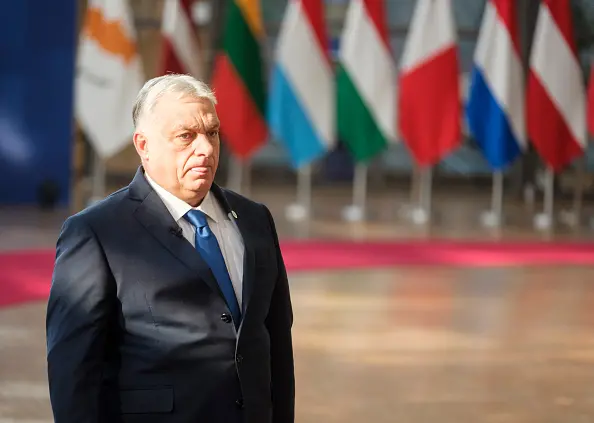
European Union leaders voiced their anger yesterday at Hungarian Prime Minister Viktor Orban over his blockade of a new €90 billion ($NZ177b) loan for Ukraine, despite an earlier commitment.
"It is an act of gross disloyalty," German Chancellor Friedrich Merz said after an EU summit in Brussels yesterday.
"There has never been anything like it."
Much to the dismay of many fellow EU leaders, Orban had approved the loan at a previous summit in December before his government changed course in a spat with Kyiv over halted oil deliveries from Russia.
"This will leave deep scars," Merz said, warning of the consequences of Orban’s U-turn.
French President Emmanuel Macron echoed Merz’s comments. The unanimous agreement on the loan "must be respected and implemented without delay, in accordance with the principle of loyal co-operation", he said.
Orban, however, ruled out lifting his government’s veto on the loan, as well as on the EU’s 20th sanction package on Moscow, until Russian oil deliveries through Ukraine resumed through the contested Druzhba pipeline.
"I will never support any kind of decision here which is in favour of Ukraine," Orban said.
"The Hungarian position is very simple. We are ready to support Ukraine when we get our oil, which is blocked by them."
The Druzhba pipeline delivered Russian oil through Ukraine to Hungary and Slovakia until, according to Kyiv, it was damaged by a Russian strike in January. The halt of fuel deliveries further heightened tensions between Budapest and Kyiv.
Hungary has demanded Kyiv repair the pipeline quickly and resume transit. According to Ukraine, a quick repair has not been possible.
Challenging Kyiv’s claims, Budapest has vetoed a new package of sanctions on Russia and blocked the disbursement of the loan to Ukraine.
According to EU officials, Ukraine has recently accepted technical and financial assistance from the EU to repair the pipeline. Kyiv, however, said the necessary repairs would take another month and a-half.
European Council president Antonio Costa said Hungary was not acting in good faith by attaching conditions to the loan that neither the EU nor its member states could ensure.
Russia had repeatedly struck the pipeline since it invaded Ukraine, Costa said. Continuously repairing the damage caused by Russia was neither the responsibility of Ukraine nor of the EU, he said.— dpa