

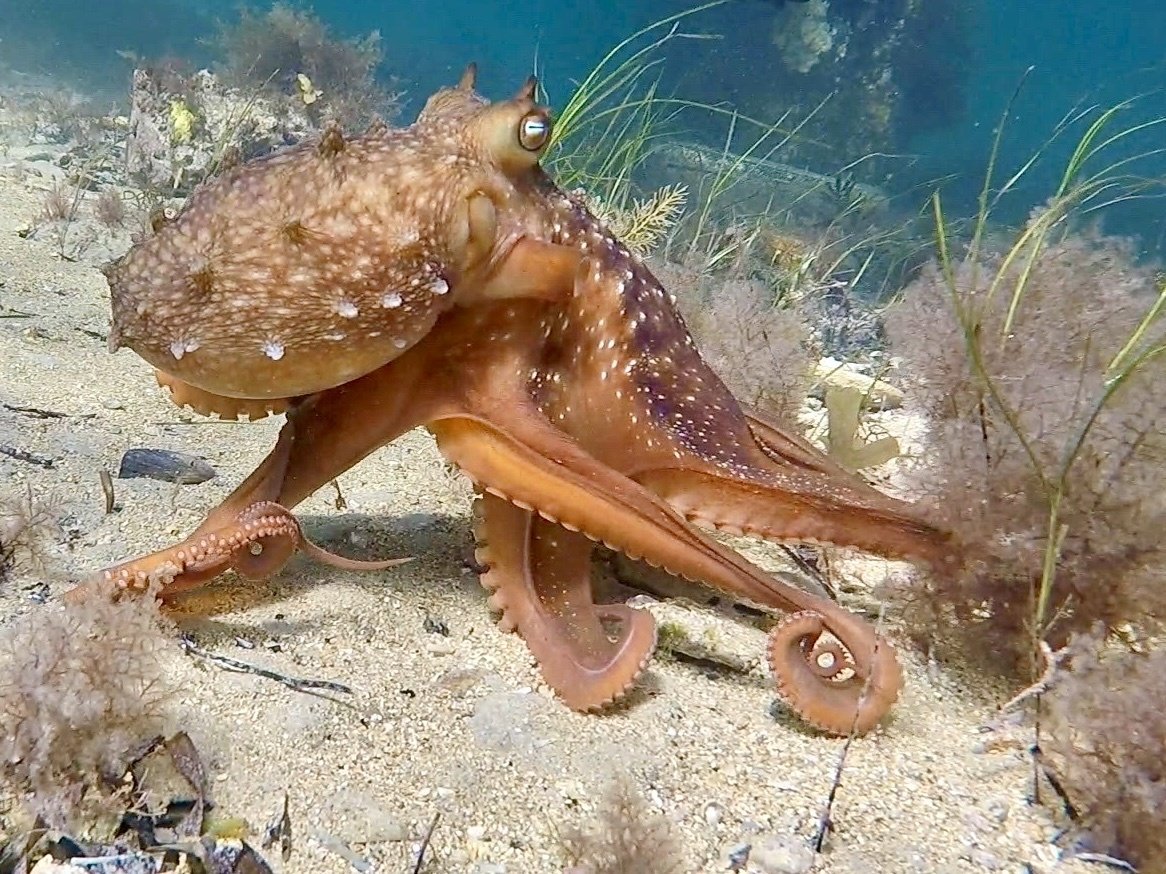
Foster learned how she hunted, hid from predators and concealed her eggs. His documentary enables one to see the octopus in a new light.

Somewhat bad publicity for the common New Zealand octopus appears on page 32 of the first edition of A.W.B. Powell’s Native Animals of New Zealand.
‘‘Some years ago, while collecting shellfish at Island Bay, Wellington, I noticed a large [Octopus maorum] idly drifting in amongst surging kelp,’’ Powell writes.
‘‘Presently it became animated and gave a splendid exhibition of swimming, which was accomplished by forcing a jet of water from the siphon and then catapulting the whole body through the outstretched circle of arms.
‘‘Soon it disappeared from view beneath the kelp and a few seconds later appeared right at my feet, and with incredible swiftness slid its whole body out of the water and fastened two of its arms firmly around my leg.
‘‘I had an open pocketknife in my hand, so lost no time in slashing at the creature’s arms; but it was not until three of them were severed that the octopus retired, no doubt convinced that he had underestimated his intended victim.’’
The unusual passage was removed from more recent editions of the book. Most zoologists I know do not consider our common octopus to be a threat.


