

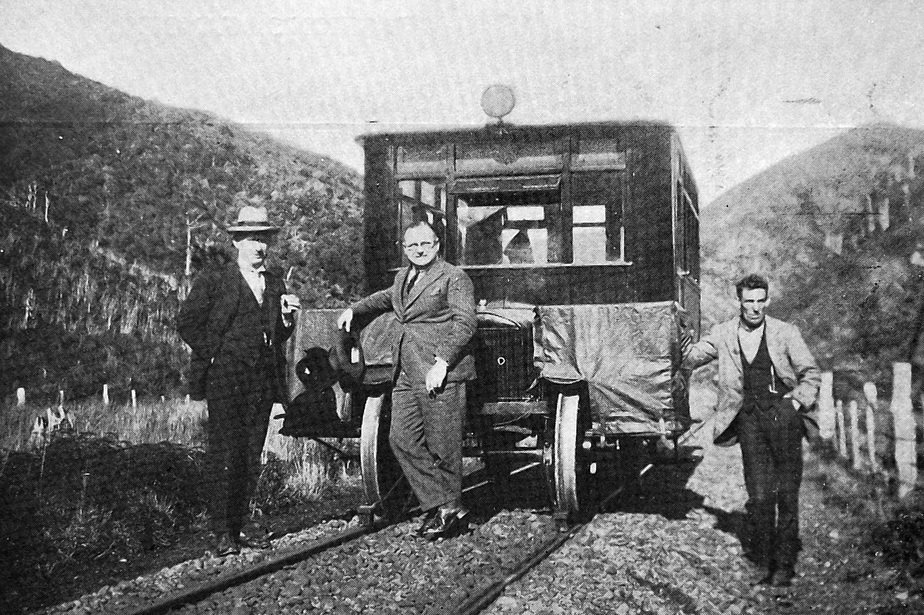
Built on reinforced Ford ton truck chassis at Petone, power is derived from the usual Ford unit.
Underneath the centre of the carriage is mounted a jack on which the body revolves, so that in effect each car carries its own turntable, by which the operation of turning can be carried out in a little less than four minutes.

The two carriages will leave for the south today and service the Switzers and Glenham branch lines.
It’s really quite simple
Say four cars, A, B, C and D, meet at the intersection of George and St Andrew streets. A is proceeding south along George street, B is coming up St Andrew street, C is going down George street towards Knox Church, and D is coming down St Andrew street from Filleul street. It is improbable that four motors would thus meet at any intersection, but should it happen, the procedure would be as follows: B would stop and let A through, B would then pass ahead of C (C having stopped because the crossing car B is on its right), C would then cross ahead of D, and D would follow. The driver of B would look for traffic at the north end of George street and pull up, C would look for cross traffic at the intersection of St Andrew street nearest the harbour,
D would be watching out for anything coming down George street, and A would be looking out for any vehicle coming down by Penrose’s corner. One car is always certain to arrive ahead of the other three, and it therefore follows that the first arrival would automatically control the other three.
Power to street lights
The formal ceremony of switching on the electric light at Lovell’s Flat took place on Friday night. The current had been used in the dwellings for a week, but no street lights are so far intended. The Power Board had had the Coronation Hall beautifully decorated and arranged with coloured lights. A switch had been placed on the stage, and when Mrs Clark (wife of Mr Jasper Clark, the former chairman of the board) pressed the button the change from dull kerosene lamps to the glowing electric bulbs was most striking. Mr John Miller represented the board at the function. — ODT, 27.5.1926


